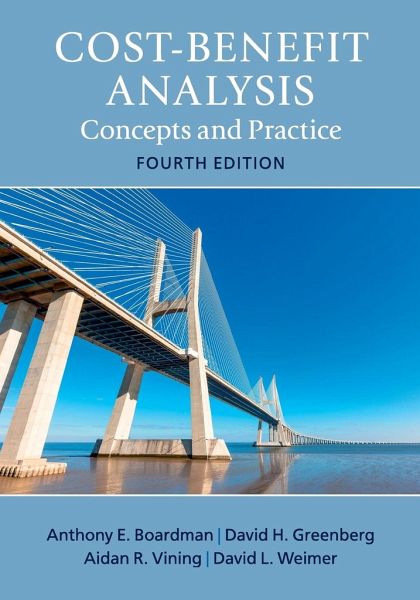
The fourth edition of Cost-Benefit Analysis is an authoritative, market-leading textbook that provides a practical introduction to cost-benefit analysis through problem solving. The text uses a consistent application of a nine-step framework for interpreting a cost-benefit analysis. This edition has been fully revised, updated and re-organized to provide the material more effectively. It presents application over abstract theory and clear discussion over mathematics to appeal to a larger, more diverse audience.
The fourth edition of Cost-Benefit Analysis is an authoritative, market-leading textbook that provides a practical introduction to cost-benefit analysis through problem solving. The text uses a consistent application of a nine-step framework for interpreting a cost-benefit analysis. This edition has been fully revised, updated and re-organized to provide the material more effectively. It presents application over abstract theory and clear discussion over mathematics to appeal to a larger, more diverse audience.
Anthony E. Boardman is the Van Dusen Professor of Business Administration at the University of British Columbia.
Inhaltsangabe
Preface. Part I. Overview: 1. Introduction to cost-benefit analysis 2. Conceptual foundations of cost-benefit analysis Part II. Fundamentals of CBA: 3. Microeconomic foundations of cost-benefit analysis 4. Valuing benefits and costs in primary markets 5. Valuing benefits and costs in secondary markets 6. Discounting benefits and costs in future time periods 7. Dealing with uncertainty: expected values, sensitivity analysis, and the value of information 8. Option price and option value 9. Existence value 10. The social discount rate 1 11. Predicting and monetizing impacts Part III. Valuation of Impacts: 12. Valuing impacts from observed behavior: experiments and quasi-experiments 13. Valuing impacts from observed behavior: direct estimation of demand curves 14. Valuing impacts from observed behavior: indirect market methods 15. Contingent valuation: using surveys to elicit information about costs and benefits 16. Shadow prices from secondary sources 17. Shadow prices: applications to developing countries 1 Part IV. Related Methods: 18. Cost-effective analysis 19. Distributionally weighted cost-benefit analysis 20. How accurate is CBA? Name index Subject index.
1. Introduction to cost-benefit analysis; 2. Conceptual foundations of cost-benefit analysis; 3. Microeconomic foundations of cost-benefit analysis; 4. Valuing impacts from observed behavior: direct estimation of demand schedules; Case: use of demand schedules in regulatory impact analyses; 5. Valuing impacts in output markets; 6. Valuing impacts in input markets; 7. Valuing impacts in secondary markets; 8. Predicting and monetizing impacts; Case: WSIPP CBA of the nurse-family partnership program; 9. Discounting future impacts and handling inflation; Case: a CBA of the North-East mine development project; 10. The social discount rate; 11. Dealing with uncertainty: expected values, sensitivity analysis, and the value of information; Case: using Monte Carlo simulation: assessing the net benefits of early detection of Alzheimer's Disease; 12. Risk, option price and option value; 13. Existence value; 14. Valuing impacts from observed behavior: experiments and quasi experiments; Case: findings from CBAs of welfare-to-work programs; 15. Valuing impacts from observed behavior: indirect market methods; 16. Contingent valuation: using surveys to elicit information about costs and benefits; Case: using contingent valuation to estimate benefits from higher education; 17. Shadow prices from secondary sources; Case: shadow pricing a high school diploma; 18. Cost-effectiveness analysis and cost-utility analysis; 19. Distributionally weighted CBA; Case: the Tulsa IDA account program; 20. How accurate is CBA?
Preface. Part I. Overview: 1. Introduction to cost-benefit analysis 2. Conceptual foundations of cost-benefit analysis Part II. Fundamentals of CBA: 3. Microeconomic foundations of cost-benefit analysis 4. Valuing benefits and costs in primary markets 5. Valuing benefits and costs in secondary markets 6. Discounting benefits and costs in future time periods 7. Dealing with uncertainty: expected values, sensitivity analysis, and the value of information 8. Option price and option value 9. Existence value 10. The social discount rate 1 11. Predicting and monetizing impacts Part III. Valuation of Impacts: 12. Valuing impacts from observed behavior: experiments and quasi-experiments 13. Valuing impacts from observed behavior: direct estimation of demand curves 14. Valuing impacts from observed behavior: indirect market methods 15. Contingent valuation: using surveys to elicit information about costs and benefits 16. Shadow prices from secondary sources 17. Shadow prices: applications to developing countries 1 Part IV. Related Methods: 18. Cost-effective analysis 19. Distributionally weighted cost-benefit analysis 20. How accurate is CBA? Name index Subject index.
1. Introduction to cost-benefit analysis; 2. Conceptual foundations of cost-benefit analysis; 3. Microeconomic foundations of cost-benefit analysis; 4. Valuing impacts from observed behavior: direct estimation of demand schedules; Case: use of demand schedules in regulatory impact analyses; 5. Valuing impacts in output markets; 6. Valuing impacts in input markets; 7. Valuing impacts in secondary markets; 8. Predicting and monetizing impacts; Case: WSIPP CBA of the nurse-family partnership program; 9. Discounting future impacts and handling inflation; Case: a CBA of the North-East mine development project; 10. The social discount rate; 11. Dealing with uncertainty: expected values, sensitivity analysis, and the value of information; Case: using Monte Carlo simulation: assessing the net benefits of early detection of Alzheimer's Disease; 12. Risk, option price and option value; 13. Existence value; 14. Valuing impacts from observed behavior: experiments and quasi experiments; Case: findings from CBAs of welfare-to-work programs; 15. Valuing impacts from observed behavior: indirect market methods; 16. Contingent valuation: using surveys to elicit information about costs and benefits; Case: using contingent valuation to estimate benefits from higher education; 17. Shadow prices from secondary sources; Case: shadow pricing a high school diploma; 18. Cost-effectiveness analysis and cost-utility analysis; 19. Distributionally weighted CBA; Case: the Tulsa IDA account program; 20. How accurate is CBA?
Rezensionen
'For measuring the social returns to public investments, this is the preeminent source of wisdom and guidance by the recognized experts. The fifth edition of Cost-Benefit Analysis must surely be designated as the classic treatment on the topic, encyclopedic in its coverage and authoritative in its wisdom.' Henry M. Levin, William Kilpatrick Professor of Economics and Education, Columbia University and David Jacks Professor of Education and Economics, Emeritus, Stanford University
Es gelten unsere Allgemeinen Geschäftsbedingungen: www.buecher.de/agb
Impressum
www.buecher.de ist ein Internetauftritt der buecher.de internetstores GmbH
Geschäftsführung: Monica Sawhney | Roland Kölbl | Günter Hilger
Sitz der Gesellschaft: Batheyer Straße 115 - 117, 58099 Hagen
Postanschrift: Bürgermeister-Wegele-Str. 12, 86167 Augsburg
Amtsgericht Hagen HRB 13257
Steuernummer: 321/5800/1497
USt-IdNr: DE450055826