
Andere Kunden interessierten sich auch für
 Nazism in Syria and Lebanon58,99 €
 The Syrian Social Nationalist Party23,99 €
 Syria and Lebanon48,99 €
 Syria and Lebanon Under the French Mandate135,99 €
 The Ayyubid Era41,99 €
 From the Holy Mountain22,99 €
 State and Society in Syria and Lebanon83,99 €







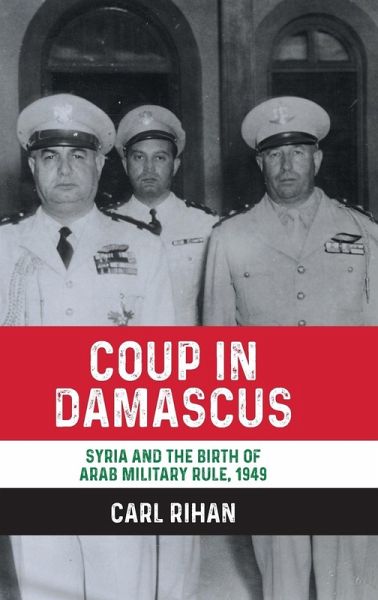
Coup in Damascus delves into one of the most pivotal yet under-explored moments in Middle Eastern history: the 1949 military coup in Syria, an event which set the stage for revolving door governments and autocracies across the region. At the interdisciplinary crossroad between economics, politics, and history, Carl Rihan challenges prevailing narratives that have either focused on Great Power Politics, cloak-and-dagger regional rivalries, or postcolonial dynamics by affirming the central role of cost-calculating, utility-driven political action in a constrained economic context. Bringing neoclassical and Austrian economic thought in contact with Middle East history, the book uncovers how unsound monetary practices, the disruption of historical trade routes, flawed interventionism, and the waning of market dynamics paved the way for military takeovers, political radicalization, and zero-sum games. By reaffirming the centrality of human action in its objective and praxeological sense, Coup in Damascus offers a fresh perspective on one of the region's most pivotal moments, one which still bares its bitter fruits today. It provides a timely analysis in light of the recent civil war and violence in the region and seeks to "write history differently" by re-imagining the past.