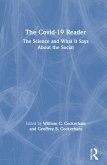
This book focuses on syndemics in the Global South and uses COVID 19 as a window to understand clusters of disparities and disease comorbidities. The pandemic has exposed and multiplied structural inequalities and certain subpopulations were more exposed to COVID 19 as well as experienced greater morbidity and mortality. The effects of the pandemic differ between countries but have had an especially major impact, although in varying ways, in the Global South. The contributions in this volume explore the differential impacts of COVID 19 at individual, community, national, or regional levels,…mehr
This book focuses on syndemics in the Global South and uses COVID 19 as a window to understand clusters of disparities and disease comorbidities. The pandemic has exposed and multiplied structural inequalities and certain subpopulations were more exposed to COVID 19 as well as experienced greater morbidity and mortality. The effects of the pandemic differ between countries but have had an especially major impact, although in varying ways, in the Global South. The contributions in this volume explore the differential impacts of COVID 19 at individual, community, national, or regional levels, considering how structural violence is institutionalized in a way that creates vulnerable situations and disproportionate suffering. The book will be of interest to anthropologists and sociologists as well as to those working in global and public health.
Produktdetails
Produktdetails
Routledge Studies in Health and Medical Anthropology
Inayat Ali leads the Department of Public Health and Allied Sciences at Fatima Jinnah Women University, and is Assistant Professor in the Department of Anthropology at FJWU, Pakistan. He is also Research Fellow in the Department of Social and Cultural Anthropology at the University of Vienna, Austria. Merrill Singer is Emeritus Professor of Anthropology at the University of Connecticut, USA. Nicola Bulled is Assistant Research Professor at the Institute for Collaboration on Health, Intervention, and Policy (InCHIP), University of Connecticut, USA.
Inhaltsangabe
Introduction Nicola Bulled, Merrill Singer, and Inayat Ali 1 Sick in the City: COVID-19 and the Syndemics of Urban Life Merrill Singer and Nicola Bulled 2 Effects Multiplied: Syndemic Interactions among Structured Disparities, Comorbidities, and COVID-19 in Pakistan Inayat Ali 3 Deadly Companions: The Diabetes/COVID-19 (DiaCOVID-19) Syndemic in Mexico and the U.S. Mexican Diaspora Merrill Singer and Jennifer A. Cook 4 TB-COVID-19 Syndemic in the Philippines: A Double Challenge amidst Public Health Emergency and Social, Political, and Economic Inequalities Trisha Denise D. Cedeño, Kimberly G. Ramos, Mary Grace A. Pelayo, Princess Rayevy I. Esmillo, and Ian Christopher N. Rocha 5 "Active in the Community" and "Underlying Health Conditions": Exploring Constructions of Blame, Responsibility, and Othering associated with Australia's COVID-19 Syndemic Kate Senior and Richard Chenhall 6 Understanding the COVID-19 Syndemic in South Africa: Concrete Responses and a Call to Action Peter van Heusden, Kezia Lewins, Louis Reynolds, and Laurel Baldwin-Ragaven 7 COVID-19 Syndemics in Three Distinct South African Communities and the Impact on Shared Loss and Grieving Lorena Nunez Carrasco, Gracsious Maviza, Vuyokazi Moyo, and Storm Theunissen 8 The Iatrogenic Syndemic of COVID-19/Diabetes Mellitus/Black Fungus in India: Evidence of the Shortcomings of Neoliberal Healthcare Policies Nicola Bulled 9 COVID-19 lockdown and "Shadow Pandemic" of Gender-Based Violence in Nigeria Chiemezie S. Atama and Obinna J. Eze 10 Ecosyndemics, COVID-19, and Child Health in the Anthropocene Merrill Singer Conclusion: COVID Syndemics in the Global South Merrill Singer, Nicola Bulled, and Inayat Ali
Introduction Nicola Bulled, Merrill Singer, and Inayat Ali 1 Sick in the City: COVID-19 and the Syndemics of Urban Life Merrill Singer and Nicola Bulled 2 Effects Multiplied: Syndemic Interactions among Structured Disparities, Comorbidities, and COVID-19 in Pakistan Inayat Ali 3 Deadly Companions: The Diabetes/COVID-19 (DiaCOVID-19) Syndemic in Mexico and the U.S. Mexican Diaspora Merrill Singer and Jennifer A. Cook 4 TB-COVID-19 Syndemic in the Philippines: A Double Challenge amidst Public Health Emergency and Social, Political, and Economic Inequalities Trisha Denise D. Cedeño, Kimberly G. Ramos, Mary Grace A. Pelayo, Princess Rayevy I. Esmillo, and Ian Christopher N. Rocha 5 "Active in the Community" and "Underlying Health Conditions": Exploring Constructions of Blame, Responsibility, and Othering associated with Australia's COVID-19 Syndemic Kate Senior and Richard Chenhall 6 Understanding the COVID-19 Syndemic in South Africa: Concrete Responses and a Call to Action Peter van Heusden, Kezia Lewins, Louis Reynolds, and Laurel Baldwin-Ragaven 7 COVID-19 Syndemics in Three Distinct South African Communities and the Impact on Shared Loss and Grieving Lorena Nunez Carrasco, Gracsious Maviza, Vuyokazi Moyo, and Storm Theunissen 8 The Iatrogenic Syndemic of COVID-19/Diabetes Mellitus/Black Fungus in India: Evidence of the Shortcomings of Neoliberal Healthcare Policies Nicola Bulled 9 COVID-19 lockdown and "Shadow Pandemic" of Gender-Based Violence in Nigeria Chiemezie S. Atama and Obinna J. Eze 10 Ecosyndemics, COVID-19, and Child Health in the Anthropocene Merrill Singer Conclusion: COVID Syndemics in the Global South Merrill Singer, Nicola Bulled, and Inayat Ali
Es gelten unsere Allgemeinen Geschäftsbedingungen: www.buecher.de/agb
Impressum
www.buecher.de ist ein Internetauftritt der buecher.de internetstores GmbH
Geschäftsführung: Monica Sawhney | Roland Kölbl | Günter Hilger
Sitz der Gesellschaft: Batheyer Straße 115 - 117, 58099 Hagen
Postanschrift: Bürgermeister-Wegele-Str. 12, 86167 Augsburg
Amtsgericht Hagen HRB 13257
Steuernummer: 321/5800/1497
USt-IdNr: DE450055826