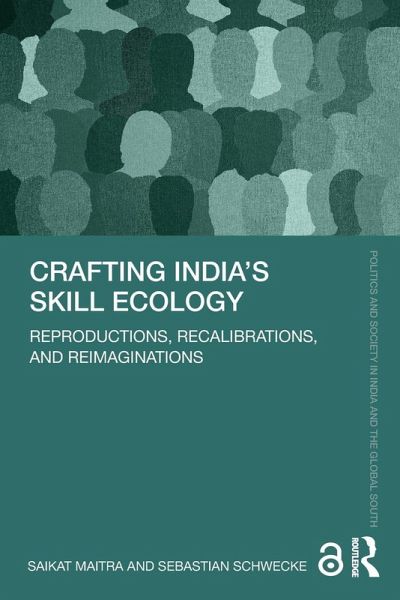
This volume traces how the discourse of skill evolved in colonial and postcolonial India, from the mid-nineteenth century to the present neoliberal era.
This volume traces how the discourse of skill evolved in colonial and postcolonial India, from the mid-nineteenth century to the present neoliberal era.
Produktdetails
Produktdetails
Politics and Society in India and the Global South
Saikat Maitra is a faculty member in the Public Policy and Management Group in the Indian Institute of Management, Calcutta, India. Sebastian Schwecke is the founding director of the Max Weber Forum for South Asian Studies (MWF) in Delhi, India.
Inhaltsangabe
1. Introduction Section I: Historical approaches to the study of the skill ecology 2. Skilling and mis-skilling managers: The Indian Institute of Management, business education, and Indian capitalism, 1964 - 1980 3. Having time passed: Education, skill development, control, and labour in prisons of colonial India 4. Practicing skills, processing skins: Urdu manuals on developing tanning as a rural trade (1940-1946) Section II: Skill as making, producing, doing 5. Skills, caste, and class in an eastern Indian steel town, 1950s-2000s 6. Haptic knowledge: Artisanal skills, labour, and embodied knowledge practices 7. Skilling as a mode of doing: Techniques and trajectories of street vending in Delhi's weekly bazaars Section III: Skilling at the margins of the skill ecology 8.The skills of 'city-makers': Waste-work in small-town India 9. Beyond the algorithm: The significance of skill in platform work 10. "Learning computers": Skilling, working, and waiting in Seelampur Section IV: Sociology of vocational training 11. Towards a gender transformative vision of TVET in India: Student experiences and labour market trajectories in India's contemporary TVET 12. Perceptions of teachers in Indian polytechnics: An exploratory study of the attractiveness in India in the higher vocational sector 13. Employment challenges of the Indian youth: An overview of the Indian VET sector
1. Introduction Section I: Historical approaches to the study of the skill ecology 2. Skilling and mis-skilling managers: The Indian Institute of Management, business education, and Indian capitalism, 1964 - 1980 3. Having time passed: Education, skill development, control, and labour in prisons of colonial India 4. Practicing skills, processing skins: Urdu manuals on developing tanning as a rural trade (1940-1946) Section II: Skill as making, producing, doing 5. Skills, caste, and class in an eastern Indian steel town, 1950s-2000s 6. Haptic knowledge: Artisanal skills, labour, and embodied knowledge practices 7. Skilling as a mode of doing: Techniques and trajectories of street vending in Delhi's weekly bazaars Section III: Skilling at the margins of the skill ecology 8.The skills of 'city-makers': Waste-work in small-town India 9. Beyond the algorithm: The significance of skill in platform work 10. "Learning computers": Skilling, working, and waiting in Seelampur Section IV: Sociology of vocational training 11. Towards a gender transformative vision of TVET in India: Student experiences and labour market trajectories in India's contemporary TVET 12. Perceptions of teachers in Indian polytechnics: An exploratory study of the attractiveness in India in the higher vocational sector 13. Employment challenges of the Indian youth: An overview of the Indian VET sector
Es gelten unsere Allgemeinen Geschäftsbedingungen: www.buecher.de/agb
Impressum
www.buecher.de ist ein Internetauftritt der buecher.de internetstores GmbH
Geschäftsführung: Monica Sawhney | Roland Kölbl | Günter Hilger
Sitz der Gesellschaft: Batheyer Straße 115 - 117, 58099 Hagen
Postanschrift: Bürgermeister-Wegele-Str. 12, 86167 Augsburg
Amtsgericht Hagen HRB 13257
Steuernummer: 321/5800/1497
USt-IdNr: DE450055826