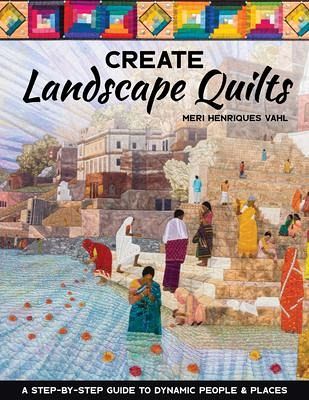
Quilt realistic people and places with artistic flair Create unique art quilts of your favorite places—and the places you want to go! Meri Vahl shares her simple yet unique method for quilting realistic nature scenes and villages from fabric. Using photographs from her travels, the author explains how to achieve stunning scenery with lifelike details. With techniques like fabric collage and tulle overlay, even beginners will learn to quilt majestic mountainscapes, charming buildings, and realistic people. A stunning gallery of quilts—some named best in the world—will inspire you to bring your…mehr
Quilt realistic people and places with artistic flair Create unique art quilts of your favorite places—and the places you want to go! Meri Vahl shares her simple yet unique method for quilting realistic nature scenes and villages from fabric. Using photographs from her travels, the author explains how to achieve stunning scenery with lifelike details. With techniques like fabric collage and tulle overlay, even beginners will learn to quilt majestic mountainscapes, charming buildings, and realistic people. A stunning gallery of quilts—some named best in the world—will inspire you to bring your own travel photos and art quilt ideas to life. * From photo to art quilt! Recreate landscapes, people, and buildings with ease * World-renowned art quilter Meri Vahl teaches you her award-winning process * Immortalize your journeys as you paint scenes with fabric, one step at a time
Meri Henriques Vahl teaches others how to use her favorite techniques in their own art quilts and lectures at quilt guilds in the U.S. and around the world. She lives near Santa Cruz, California with her family and two rowdy felines. www.meriartquilts.com
Inhaltsangabe
Table of Contents: 1. Why fabric collage art quilts?: The Collage/Tulle Overlay technique frees the quilter to develop her own art style and creativity. Using this technique, she can construct any image she desires without having to deal with such technical issues as ¼” seams, piecing or struggling to figure out how to put her design together. Collage quilting with a tulle overlay can be applied to any type of project: abstract, realistic or even geometric, and is especially effective for landscapes. Also, this technique allows the quilter to take advantage of adding anything to her picture that she can stitch over: yarn, paper, cheesecloth, dryer lint(!), etc.. 2. The Basic Technique: The basic technique is extremely simple and is appropriate for all skill levels, however some experience with free-motion quilting – or at least the willingness to experiment with free-motion quilting – is recommended (but since this technique is so flexible, it would also be possible to make a Collage/Tulle quilt using standard straight stitching only!). To begin: the ironed quilt back is placed face down on a worktable, a piece of batting of equivalent size is laid down over it, and then the quilter simply uses her scissors to cut out shapes and places them directly on the batting, starting with whatever is the farthest away in the background: for example, the sky. 3. Some design considerations: This chapter will discuss translating a photographic image into a quilt: fabric choices to enhance perspective and add interest to the picture; the use of color for design purposes and composition; using both sides of printed fabric to create light and dark contrasts; using torn fabric strips, thread, fabric confetti, etc.; the many possible uses of a variety of fine-weave colored tulles; and adding yarn, ribbon, roving, feathers, etc. to create special effects. 4. This chapter will guide the student through my process of adding people to their quilt. I will also elaborate on how to use this same technique for creating realistic architecture and other elements without using photo transfers; and I will discuss useful aids, such as freezer paper templates, glue and fusible webbing, colored pencils and permanent marker pens. 5. Although I encourage the quilter to create her own first project, for the beginning art quilter who is not ready to experiment on her own, I will sketch out the steps for a simple landscape design. This chapter will include a landscape photograph, a simple line drawing of the same image, a discussion of how to lay out the design, possible fabric choices, etc., and will also include a small sample of a person that could be added to the quilt, if the quilter so desires. 8. Quilt gallery: a short bio and examples of my own quilts, as well as photos of student quilts.
Table of Contents: 1. Why fabric collage art quilts?: The Collage/Tulle Overlay technique frees the quilter to develop her own art style and creativity. Using this technique, she can construct any image she desires without having to deal with such technical issues as ¼” seams, piecing or struggling to figure out how to put her design together. Collage quilting with a tulle overlay can be applied to any type of project: abstract, realistic or even geometric, and is especially effective for landscapes. Also, this technique allows the quilter to take advantage of adding anything to her picture that she can stitch over: yarn, paper, cheesecloth, dryer lint(!), etc.. 2. The Basic Technique: The basic technique is extremely simple and is appropriate for all skill levels, however some experience with free-motion quilting – or at least the willingness to experiment with free-motion quilting – is recommended (but since this technique is so flexible, it would also be possible to make a Collage/Tulle quilt using standard straight stitching only!). To begin: the ironed quilt back is placed face down on a worktable, a piece of batting of equivalent size is laid down over it, and then the quilter simply uses her scissors to cut out shapes and places them directly on the batting, starting with whatever is the farthest away in the background: for example, the sky. 3. Some design considerations: This chapter will discuss translating a photographic image into a quilt: fabric choices to enhance perspective and add interest to the picture; the use of color for design purposes and composition; using both sides of printed fabric to create light and dark contrasts; using torn fabric strips, thread, fabric confetti, etc.; the many possible uses of a variety of fine-weave colored tulles; and adding yarn, ribbon, roving, feathers, etc. to create special effects. 4. This chapter will guide the student through my process of adding people to their quilt. I will also elaborate on how to use this same technique for creating realistic architecture and other elements without using photo transfers; and I will discuss useful aids, such as freezer paper templates, glue and fusible webbing, colored pencils and permanent marker pens. 5. Although I encourage the quilter to create her own first project, for the beginning art quilter who is not ready to experiment on her own, I will sketch out the steps for a simple landscape design. This chapter will include a landscape photograph, a simple line drawing of the same image, a discussion of how to lay out the design, possible fabric choices, etc., and will also include a small sample of a person that could be added to the quilt, if the quilter so desires. 8. Quilt gallery: a short bio and examples of my own quilts, as well as photos of student quilts.
Es gelten unsere Allgemeinen Geschäftsbedingungen: www.buecher.de/agb
Impressum
www.buecher.de ist ein Internetauftritt der buecher.de internetstores GmbH
Geschäftsführung: Monica Sawhney | Roland Kölbl | Günter Hilger
Sitz der Gesellschaft: Batheyer Straße 115 - 117, 58099 Hagen
Postanschrift: Bürgermeister-Wegele-Str. 12, 86167 Augsburg
Amtsgericht Hagen HRB 13257
Steuernummer: 321/5800/1497
USt-IdNr: DE450055826