
141,99 €
inkl. MwSt.
Versandkostenfrei*
Versandfertig in über 4 Wochen
payback
71 °P sammeln
  • Gebundenes Buch

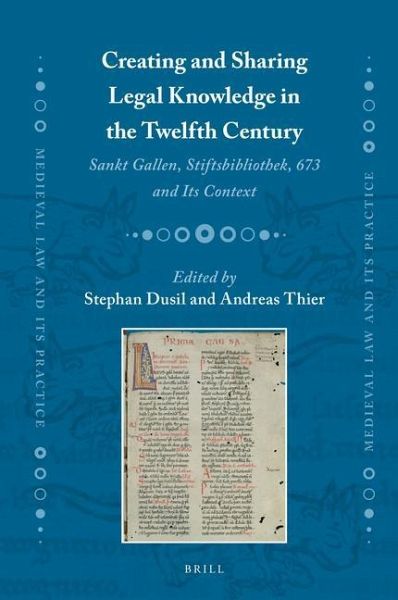
The Decretum Gratiani is the cornerstone of medieval canon law, and the manuscript St Gallen, Stiftsbibliothek, 673 an essential witness to its evolution. The studies in this volume focus on that manuscript, providing critical insights into its genesis, linguistic features, and use of Roman Law, while evaluating its attraction to medieval readers and modern scholars. Together, these studies offer a fascinating view on the evolution of the Decretum Gratiani, as well as granting new insights on the complex dynamics and processes by which legal knowledge was first created and then transferred in…mehr

Produktbeschreibung
The Decretum Gratiani is the cornerstone of medieval canon law, and the manuscript St Gallen, Stiftsbibliothek, 673 an essential witness to its evolution. The studies in this volume focus on that manuscript, providing critical insights into its genesis, linguistic features, and use of Roman Law, while evaluating its attraction to medieval readers and modern scholars. Together, these studies offer a fascinating view on the evolution of the Decretum Gratiani, as well as granting new insights on the complex dynamics and processes by which legal knowledge was first created and then transferred in medieval jurisprudence. Contributors are Enrique de León, Stephan Dusil, Melodie H. Eichbauer, Atria A. Larson, Titus Lenherr, Philipp Lenz, Kenneth Pennington, Andreas Thier, José Miguel Viejo-Ximénez, John C. Wei, and Anders Winroth.
Autorenporträt
Stephan Dusil, Dr. iur. (Frankfurt, 2005), is Professor at Eberhard Karls Universität, Tübingen. He has published on different aspects of medieval history, including a book on the history of canon law: Wissensordnungen des Rechts im Wandel. Päpstlicher Jurisdiktionsprimat und Zölibat zwischen 1000 und 1215 (Leuven, 2018). Andreas Thier, Dr. iur. (Munich, 1997), is Professor at the University of Zurich. He has published on the evolution of legal knowledge since late Antiquity, including "Semantiken des Alten, des Neuen und des Modernen im gelehrten kanonischen Recht" (ZRG KA, 2020).