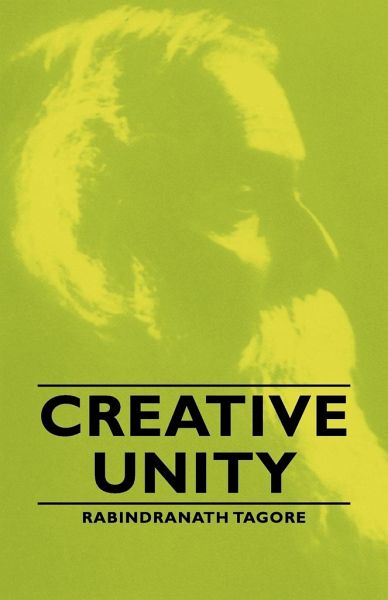
This antiquarian book contains Rabindranath Tagore's 1922 work, "Creative Unity". Tagore's extensive knowledge on every subject with regard to the spiritual and physical aspects of nature and man, which according to him exist for the sole purpose of creation rather than production, is the chief idea behind this wonderful book. A veritable literary extravaganza, "Creative Unity" would make for a worthy addition to any bookshelf, and is not to be missed by fans and collectors of Tagore's seminal work. The chapters of this book include: "The Poet's Religion", "The Creative Ideal", "The Religion…mehr
This antiquarian book contains Rabindranath Tagore's 1922 work, "Creative Unity". Tagore's extensive knowledge on every subject with regard to the spiritual and physical aspects of nature and man, which according to him exist for the sole purpose of creation rather than production, is the chief idea behind this wonderful book. A veritable literary extravaganza, "Creative Unity" would make for a worthy addition to any bookshelf, and is not to be missed by fans and collectors of Tagore's seminal work. The chapters of this book include: "The Poet's Religion", "The Creative Ideal", "The Religion of the Forest", "An Indian Folk Religion", "East and West", "The Modern Age", "The Spirit of Freedom", "Woman and Home", "An Eastern University", etcetera. Rabindranath Tagore (1861 - 1941) was a Bengali polymath who single-handedly reshaped Bengali literature and music. This antiquarian book is being republished now in an affordable, modern, high-quality edition - complete with a specially commissioned new biography of the author.
Indian polymath Rabindranath Tagore was a well-known poet, philosopher, musician, and artist who had a significant impact on changing the country's intellectual and cultural landscape in the late 19th and early 20th centuries. In Calcutta (now Kolkata), Tagore was born into a well-to-do Bengali family and started writing poems at a young age. He was the first non-European laureate to win the Nobel Prize in Literature in 1913 for his most well-known work, "Gitanjali" (Song Offerings). In addition to being a brilliant poet, Tagore was a well-known participant in the Indian Renaissance. In Santiniketan, he established Visva-Bharati University, putting a strong emphasis on a holistic education that combined the arts, culture, and environment. Poems, plays, essays, and short tales are among Tagore's literary works, which showcase his profound understanding of spirituality, human nature, and the nexus of tradition and modernity. He wrote both the music and the words to "Jana Gana Mana," which is India's national song. His influence affected India's political and cultural domains in addition to literature. As a fervent supporter of internationalism and humanism, Tagore's achievements have created a lasting legacy that has elevated him to a respected status both in India and around the world.
Es gelten unsere Allgemeinen Geschäftsbedingungen: www.buecher.de/agb
Impressum
www.buecher.de ist ein Internetauftritt der buecher.de internetstores GmbH
Geschäftsführung: Monica Sawhney | Roland Kölbl | Günter Hilger
Sitz der Gesellschaft: Batheyer Straße 115 - 117, 58099 Hagen
Postanschrift: Bürgermeister-Wegele-Str. 12, 86167 Augsburg
Amtsgericht Hagen HRB 13257
Steuernummer: 321/5800/1497
USt-IdNr: DE450055826