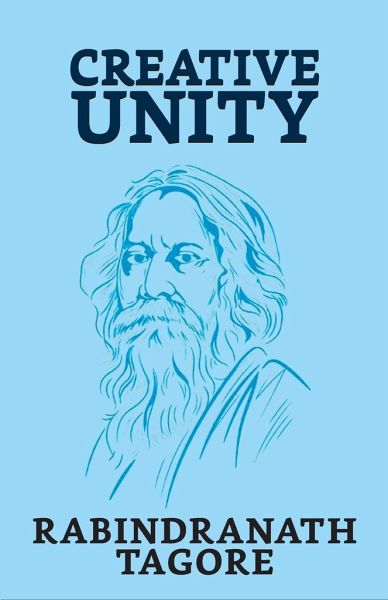
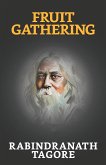
Any creative work is the power of a person to feel one with the divine as it makes him a creator himself. This holds especially true when it comes to Rabindranath Tagore's profound writings where he is constantly trying to explore himself and, in the process, ends up exploring the limitless universe created by HIM. Creative Unity is without doubt a profound read that allows man to feel oneness within himself, that adds to serenity and calmness of his being. Tagore, as usual speaks of philosophy in such an eloquent manner that one is carried over by its simplicity and hence it passes through…mehr
Any creative work is the power of a person to feel one with the divine as it makes him a creator himself. This holds especially true when it comes to Rabindranath Tagore's profound writings where he is constantly trying to explore himself and, in the process, ends up exploring the limitless universe created by HIM. Creative Unity is without doubt a profound read that allows man to feel oneness within himself, that adds to serenity and calmness of his being. Tagore, as usual speaks of philosophy in such an eloquent manner that one is carried over by its simplicity and hence it passes through him. Woven with a wonderful choice of words, laced with fond remembrances of this childhood, this book is for those who value leisure and simplicity in life.
Rabindranath Tagore (1861-1941) Popularly known as Gurudev, Rabindranath Tagore was born into a rich zamindar (landowners) family on the 7th of May, 1861, in Calcutta (now Kolkata), West Bengal. Tagore grew up to become a famous poet, writer, and composer. However, he also became a passionate advocate of humanism and internationalism- especially during the war years-and India's freedom struggle. Tagore's anxieties surrounding nationalism grew as it saw resurgence in the politics of the time, following the First World War. Tagore took a critical stance at the rise of nationalism in the East and West during the 20th century. This is evident in his university lectures as well as essays, such as The Nation and East and West, in which he visited the themes of nation, nationalism, and violence. Between 1878 and 1932, Tagore travelled to more than 30 countries, including the United States of America, Japan, United Kingdom, Java, and the Soviet Union. His commitment to revamping Indian education can be seen with the founding of Shantiniketan in 1863, and eventually Visva-Bharati University in 1921. He became the first non-European to win the Nobel Peace Prize in 1913. Although Tagore mostly wrote poetry, short stories, novels, and essays, he also wrote non-fiction, primarily centred on issues of history and spirituality.
Es gelten unsere Allgemeinen Geschäftsbedingungen: www.buecher.de/agb
Impressum
www.buecher.de ist ein Internetauftritt der buecher.de internetstores GmbH
Geschäftsführung: Monica Sawhney | Roland Kölbl | Günter Hilger
Sitz der Gesellschaft: Batheyer Straße 115 - 117, 58099 Hagen
Postanschrift: Bürgermeister-Wegele-Str. 12, 86167 Augsburg
Amtsgericht Hagen HRB 13257
Steuernummer: 321/5800/1497
USt-IdNr: DE450055826