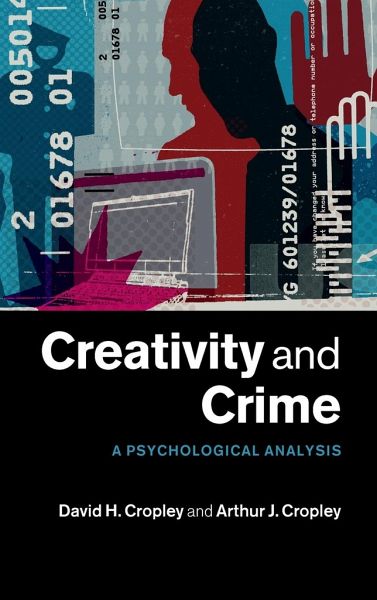
Creativity is typically perceived to be a positive, constructive attribute and yet, highly effective, novel crimes are committed which illustrate that creativity can also be utilised to serve a darker and more destructive end. But how can these 'creative criminals' be stopped? Adopting a psychological approach, renowned subject experts Cropley and Cropley draw upon concepts such as 'Person,' 'Process', 'Press' and 'Product' to explain how existing psychological theories of creativity can be applied to a more subtle subset of ingenuity; that is to say criminal behaviour and its consequences.…mehr
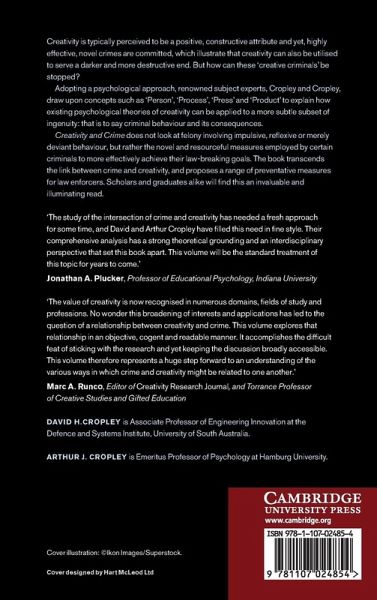
Creativity is typically perceived to be a positive, constructive attribute and yet, highly effective, novel crimes are committed which illustrate that creativity can also be utilised to serve a darker and more destructive end. But how can these 'creative criminals' be stopped? Adopting a psychological approach, renowned subject experts Cropley and Cropley draw upon concepts such as 'Person,' 'Process', 'Press' and 'Product' to explain how existing psychological theories of creativity can be applied to a more subtle subset of ingenuity; that is to say criminal behaviour and its consequences. Creativity and Crime does not look at felony involving impulsive, reflexive or merely deviant behaviour, but rather the novel and resourceful measures employed by criminals to more effectively achieve their lawbreaking goals. The book transcends the link between crime and creativity, and proposes a range of preventative measures for law enforcers. Scholars and graduates alike will find this an invaluable and illuminating read.
Arthur Cropley obtained his PhD from the University of Alberta (Canada) in 1965 and taught at the Universities of Regina (Canada) and Hamburg (Germany), with brief stints in Australia. He has also lectured in Belgium, Bulgaria, Egypt, France, Latvia, Switzerland, Turkey, the United Kingdom and the USA. After becoming Professor Emeritus on April 1, 1999, he was Adjunct Professor of Engineering at the University of South Australia for six years and also became visiting professor at the University of Latvia. He was founding editor of High Ability Studies and is on the board of the Creativity Research Journal. He has received awards and fellowships, and an honorary doctorate from the University of Latvia. In 2004, he received the Order of the Three Stars from the President of Latvia. He has published extensively on creativity and is the author of 25 books, with translations into a dozen languages including Hungarian, Latvian, Chinese and Korean. He has become increasingly interested in recent years in using creativity concepts to examine areas not usually associated with creativity (such as engineering) and has looked closely at the dark side of creativity, and particularly crime.
Inhaltsangabe
1. Creativity and crime: basic principles 2. The social science approach to crime 3. Basic creativity concepts 4. Creativity: a bundle of paradoxes 5. General enchantment with creativity 6. The dark side of creativity 7. Creativity and crime 8. Consumer and corporate fraud: scams, hustles and swindles 9. Terrorism: a case study 10. Practical implications and countermeasures.
1. Creativity and crime: basic principles 2. The social science approach to crime 3. Basic creativity concepts 4. Creativity: a bundle of paradoxes 5. General enchantment with creativity 6. The dark side of creativity 7. Creativity and crime 8. Consumer and corporate fraud: scams, hustles and swindles 9. Terrorism: a case study 10. Practical implications and countermeasures.
Es gelten unsere Allgemeinen Geschäftsbedingungen: www.buecher.de/agb
Impressum
www.buecher.de ist ein Internetauftritt der buecher.de internetstores GmbH
Geschäftsführung: Monica Sawhney | Roland Kölbl | Günter Hilger
Sitz der Gesellschaft: Batheyer Straße 115 - 117, 58099 Hagen
Postanschrift: Bürgermeister-Wegele-Str. 12, 86167 Augsburg
Amtsgericht Hagen HRB 13257
Steuernummer: 321/5800/1497
USt-IdNr: DE450055826