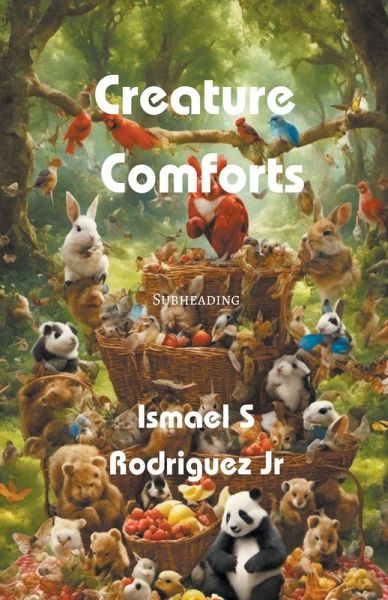
Creature Comforts: Poetic Animal Tales" is a book of fun and whimsical animal poems for children. The book is filled with playful and imaginative poems that introduce children to a variety of animals and their unique characteristics. The poems are written in a simple and easy-to-understand style, making them perfect for young readers. This book is a perfect way to introduce children to the world of poetry and nature while encouraging them to develop a love for reading.
Creature Comforts: Poetic Animal Tales" is a book of fun and whimsical animal poems for children. The book is filled with playful and imaginative poems that introduce children to a variety of animals and their unique characteristics. The poems are written in a simple and easy-to-understand style, making them perfect for young readers. This book is a perfect way to introduce children to the world of poetry and nature while encouraging them to develop a love for reading.
Ismael S. Rodriguez Jr. is a poet and writer whose work dwells in the space where stillness meets pressure. Shaped by lived experience, movement, and sustained attention to power and survival, his writing blends lyrical witness, surrealism, and contemplative resistance. A U.S. Navy veteran who served during Operation Desert Storm aboard a ship deployed in the Mediterranean, he carries an enduring fascination with authority, machinery, discipline, and moral ambiguity-often approached sideways, with humor and grace. His work has appeared in Halfway Down the Stairs, The Beatnik Cowboy, Chiron Review, Nebo, Home Planet, Lost Lake Folk Opera, Pensive: A Global Journal of Spirituality & the Arts, Muse Literary Journal, and elsewhere. He is the author of multiple poetry and fiction collections and is currently working toward traditional publication while continuing to explore what survives after spectacle fades. Rodriguez lives in Florida, where he writes quietly, listens closely, and believes that attention itself can be a radical act.
Es gelten unsere Allgemeinen Geschäftsbedingungen: www.buecher.de/agb
Impressum
www.buecher.de ist ein Internetauftritt der buecher.de internetstores GmbH
Geschäftsführung: Monica Sawhney | Roland Kölbl | Günter Hilger
Sitz der Gesellschaft: Batheyer Straße 115 - 117, 58099 Hagen
Postanschrift: Bürgermeister-Wegele-Str. 12, 86167 Augsburg
Amtsgericht Hagen HRB 13257
Steuernummer: 321/5800/1497
USt-IdNr: DE450055826