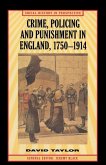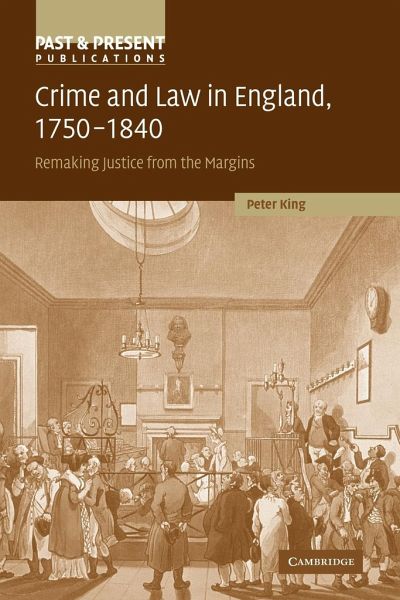
How was law made in England in the eighteenth and early nineteenth centuries? Through detailed studies of what the courts actually did, Peter King argues that parliament and the Westminster courts played a less important role in the process of law making than is usually assumed. Justice was often remade from the margins by magistrates, judges and others at the local level. His book also focuses on four specific themes - gender, youth, violent crime and the attack on customary rights. In doing so it highlights a variety of important changes - the relatively lenient treatment meted out to women…mehr
How was law made in England in the eighteenth and early nineteenth centuries? Through detailed studies of what the courts actually did, Peter King argues that parliament and the Westminster courts played a less important role in the process of law making than is usually assumed. Justice was often remade from the margins by magistrates, judges and others at the local level. His book also focuses on four specific themes - gender, youth, violent crime and the attack on customary rights. In doing so it highlights a variety of important changes - the relatively lenient treatment meted out to women by the late eighteenth century, the early development of the juvenile reformatory in England before 1825, i.e. before similar changes on the continent or in America, and the growing intolerance of the courts towards everyday violence. This study is invaluable reading to anyone interested in British political and legal history.
Born on October 25, 1940 in Glasgow Scotland he came to Canada in 1959 and served in the Canadian Navy, the Canadian Federal Public Service, as a Consultant with First Nations, and was appointed a University Professor at the University of Hearst (Ontario) and Beijing University of Technology (Beijing, China). Lives in Ottawa, Ontario
Inhaltsangabe
Introduction; 1. Shaping and remaking justice from the margins: the courts, the law and patterns of lawbreaking 1750-1840; Part I. Juveniles: 2. The rise of juvenile delinquency in England 1780-1840: changing patterns of perception and prosecution; 3. The punishment of juvenile offenders in the English Courts 1780-1830: changing attitudes and policies; 4. The making of the reformatory: the development of informal reformatory sentences for juvenile offenders 1780-1830; Part II. Gender: 5. Female offenders, work and lifecycle change in late eighteenth-century London; 6. Gender, crime and justice in late eighteenth and early nineteenth-century England; 7. Gender and recorded crime. The impact of female offenders in England and Wales 1750-1850; Part III. Non-Lethal Violence: 8. Punishing assault: the transformation of attitudes in the English courts; 9. Changing attitudes to violence in the Cornish courts 1730-1830; Part IV. The Attack on Customary Rights: 10. Customary right and women's earnings: the importance of gleaning to the rural labouring poor 1750-1850; 11. Legal change, customary right and social conflict in late eighteenth-century England: the origins of the great gleaning case of 1788; 12. Gleaners, farmers and the failure of legal sanctions in England 1750-1850.
Es gelten unsere Allgemeinen Geschäftsbedingungen: www.buecher.de/agb
Impressum
www.buecher.de ist ein Internetauftritt der buecher.de internetstores GmbH
Geschäftsführung: Monica Sawhney | Roland Kölbl | Günter Hilger
Sitz der Gesellschaft: Batheyer Straße 115 - 117, 58099 Hagen
Postanschrift: Bürgermeister-Wegele-Str. 12, 86167 Augsburg
Amtsgericht Hagen HRB 13257
Steuernummer: 321/5800/1497
USt-IdNr: DE450055826