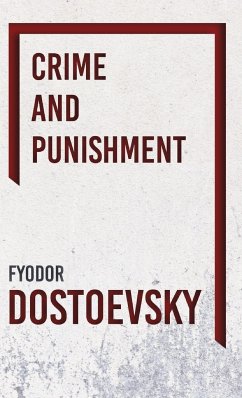
¿Crime and Punishment¿ is an 1866 novel by Russian author Fyodor Dostoevsky. The narrative concerns the inner anguish of Rodion Raskolnikov, a poor ex-student in Saint Petersburg who conceives a murderous plan to steal from a notorious pawnbroker. However, after the deed is done he deteriorates into a feverish state and begins to fret obsessively. In his delirium, Rodion wanders the streets of the city unknowingly drawing attention to himself and his connection to the crime. A masterpiece that places you into the confused mind of a misguided murderer, Dostoevsky's ¿Crime and Punishment¿ is a…mehr
¿Crime and Punishment¿ is an 1866 novel by Russian author Fyodor Dostoevsky. The narrative concerns the inner anguish of Rodion Raskolnikov, a poor ex-student in Saint Petersburg who conceives a murderous plan to steal from a notorious pawnbroker. However, after the deed is done he deteriorates into a feverish state and begins to fret obsessively. In his delirium, Rodion wanders the streets of the city unknowingly drawing attention to himself and his connection to the crime. A masterpiece that places you into the confused mind of a misguided murderer, Dostoevsky's ¿Crime and Punishment¿ is a classic of Russian literature not to be missed by any lover of fiction. Fyodor Mikhailovich Dostoevsky (1821 ¿ 1881) was a Russian novelist, essayist, short story writer, journalist, and philosopher. His literature examines human psychology during the turbulent social, spiritual and political atmosphere of 19th-century Russia, and he is considered one of the greatest psychologists in world literature. A prolific writer, Dostoevsky produced 11 novels, three novellas, 17 short stories and numerous other works. Many vintage books such as this are increasingly scarce and expensive. We are republishing this volume now in an affordable, modern, high-quality edition complete with a specially-commissioned new biography of the author.
The narrator-referred to in this SparkNote as the Underground Man-introduces himself. He describes himself as sick, wicked, and unattractive, and notes that he has a problem with his liver. He refuses to treat this ailment out of spite, although he understands that keeping his problems from doctors does the doctors themselves no harm. The Underground Man explains that, during his many years in civil service, he was wicked, but that he considers this wickedness a kind of compensation for the fact that he never accepted bribes. He almost immediately revises this claim, however, admitting that he never achieved genuine wickedness toward his customers, but only managed to be rude and intimidating as a kind of game. We learn that the Underground Man has retired early from his civil service job after inheriting a modest sum of money. He only held onto his low-ranking job so that he would be able to afford food, not because he got any satisfaction from it. He notes that he is filled with conflicting impulses: wickedness, sentimentality, self-loathing, contempt for others. His intense consciousness of these opposing elements has paralyzed him. He has settled into his miserable corner of the world, incapable of wickedness and incapable of action, loathing himself even as he congratulates himself on his own intelligence and sensitivity. He adds that the weather in St. Petersburg is probably bad for his health, but that he will stay there anyway, out of spite.
Es gelten unsere Allgemeinen Geschäftsbedingungen: www.buecher.de/agb
Impressum
www.buecher.de ist ein Internetauftritt der buecher.de internetstores GmbH
Geschäftsführung: Monica Sawhney | Roland Kölbl | Günter Hilger
Sitz der Gesellschaft: Batheyer Straße 115 - 117, 58099 Hagen
Postanschrift: Bürgermeister-Wegele-Str. 12, 86167 Augsburg
Amtsgericht Hagen HRB 13257
Steuernummer: 321/5800/1497
USt-IdNr: DE450055826