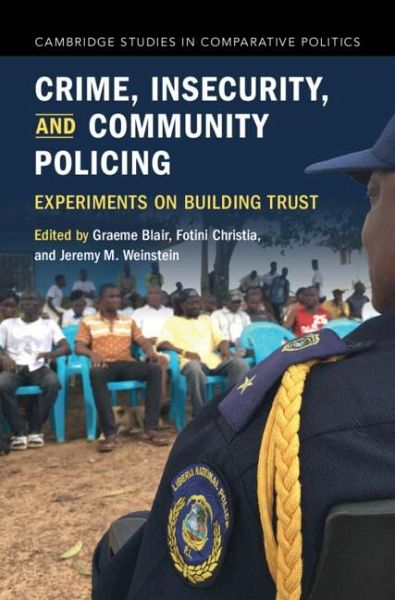
How can societies effectively reduce crime without exacerbating adversarial relationships between the police and citizens? In recent decades, perhaps the most celebrated innovation in police reform has been the introduction of community policing, where citizens are involved in building channels of dialogue and improving police-citizen collaboration. Despite the widespread adoption of community policing in the United States and increasingly in the developing world, there is still limited credible evidence about whether it realistically increases trust in the police or reduces crime. Through…mehr
How can societies effectively reduce crime without exacerbating adversarial relationships between the police and citizens? In recent decades, perhaps the most celebrated innovation in police reform has been the introduction of community policing, where citizens are involved in building channels of dialogue and improving police-citizen collaboration. Despite the widespread adoption of community policing in the United States and increasingly in the developing world, there is still limited credible evidence about whether it realistically increases trust in the police or reduces crime. Through simultaneously coordinated field experiments in a diversity of political contexts, this book presents the outcome of a major research initiative into the efficacy of community policing. Scholars from around the world uncover whether, and under what conditions, this highly influential strategy for tackling crime and insecurity is effective. With its highly innovative approach to cumulative learning, this project represents a new frontier in the study of police reform.
Part I. Crime Insecurity and Policing: 1. Introduction Graeme Blair Fotini Christia and Jeremy M. Weinstein; 2. Crime violence and insecurity Graeme Blair Fotini Christia and Jeremy M. Weinstein; 3. The policing challenge Graeme Blair Ellen Chapin Fotini Christia and Jeremy M. Weinstein; 4. Understanding community policing Graeme Blair Fotini Christia Andrew Miller and Jeremy M. Weinstein; 5. Studying community policing Graeme Blair Fotini Christia and Jeremy M. Weinstein; Part II. The Effects of Community Policing: 6. Meta-analysis of the effects of community policing Graeme Blair Fotini Christia Fatiq Nadeem and Jeremy M. Weinstein; 7. Can trust be built through citizen monitoring of police activity? Evidence from Santa Catarina Brazil Daniel Barbosa Thiemo Fetzer Caterina Soto and Pedro C. L. Souza; 8. Do police-community meetings work? Experimental evidence from Medellín Colombia Rebecca Hanson Dorothy Kronick Tara Slough and Eric Arias; 9. Community policing vigilantism and the rule of law: Evidence from Liberia Benjamin S. Morse; 10. Community policing and citizen trust in Pakistan Ali Cheema Ahsan Zia Farooqui Ali Hasanain Jacob N. Shapiro and Zulfiqar Hameed; 11. Community policing in the Philippines: Communication trust and service provision Dotan Haim Matthew Nanes and Nico Ravanilla; 12. Restoring police-community relations in Uganda Robert A. Blair Guy Grossman and Anna M. Wilke; Part III. Reflecting on Community Policing: 13. Understanding partnerships with the police Graeme Blair Ellen Chapin Fotini Christia and Jeremy M. Weinstein; 14. Conclusion Graeme Blair Fotini Christia and Jeremy M. Weinstein; References.
Es gelten unsere Allgemeinen Geschäftsbedingungen: www.buecher.de/agb
Impressum
www.buecher.de ist ein Internetauftritt der buecher.de internetstores GmbH
Geschäftsführung: Monica Sawhney | Roland Kölbl | Günter Hilger
Sitz der Gesellschaft: Batheyer Straße 115 - 117, 58099 Hagen
Postanschrift: Bürgermeister-Wegele-Str. 12, 86167 Augsburg
Amtsgericht Hagen HRB 13257
Steuernummer: 321/5800/1497
USt-IdNr: DE450055826