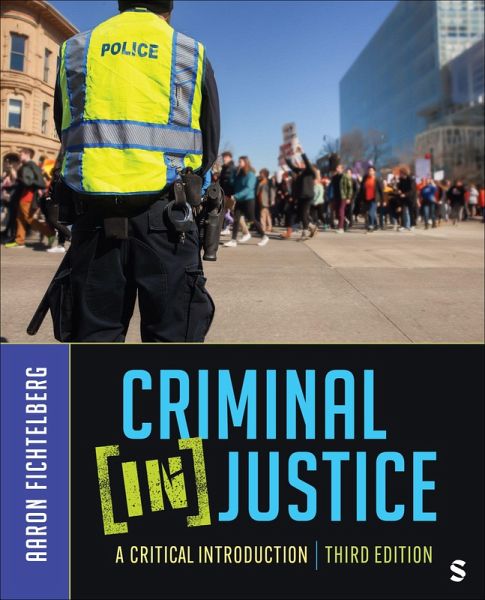
Criminal (In)Justice: A Critical Introduction examines the American criminal justice system and the social forces that shape it. Using a conversational voice, the book engages readers and challenges them to consider the structural inequalities within the criminal justice system and the broader society it is designed to protect, prompting the question, " What can I do to make this better?" Author Aaron Fichtelberg employs a unique, critical perspective to encourage learners to closely examine the intersection of multiple factors in the criminal justice system. Covering the foundational areas of…mehr
Criminal (In)Justice: A Critical Introduction examines the American criminal justice system and the social forces that shape it. Using a conversational voice, the book engages readers and challenges them to consider the structural inequalities within the criminal justice system and the broader society it is designed to protect, prompting the question, " What can I do to make this better?" Author Aaron Fichtelberg employs a unique, critical perspective to encourage learners to closely examine the intersection of multiple factors in the criminal justice system. Covering the foundational areas of policing, courts, and corrections, the new Third Edition continues to push readers to challenge the status quo, confront the marginalization of social groups, and explore the role of discretion within the criminal justice system, encouraging them to develop their own informed perspectives on the system and its impact on society. Also available in Sage Vantage, an intuitive learning platform that integrates quality Sage textbook content with assignable multimedia activities and auto-graded assessments to drive student engagement and ensure accountability. Learn more about 979-8-3488-0873-0, Criminal (In)Justice - Vantage Digital Option, Third Edition.
Aaron Fichtelberg received his BA from UC San Diego, a Master's Degree from DePaul University, an LLM from Utrecht University in the Netherlands, and a PhD from Emory University. He is currently an Associate Professor at the Department of Sociology and Criminal Justice at the University of Delaware, where he has taught criminal law and criminal justice for 15 years. Criminal (In)Justice: A Critical Introduction is his fourth book. His earlier works are: Crime Without Borders: An Introduction to International Criminal Justice, Law at the Vanishing Point, and Hybrid Tribunals: A Comparative Examination. He has also published in journals such as The Journal of International Criminal Justice, Criminal Justice Ethics, the Journal of Science and Engineering Ethics, and the Journal of Theoretical and Philosophical Criminology. His work generally combines the study of criminal justice with a critical perspective provided by the humanities.
Inhaltsangabe
About the Author Acknowledgments To Professors Using This Book General Introduction Part I: Crime Chapter 1: Defining, Classifying, and Measuring Crime The Media and Crime The Rhetoric of "Crime" Defining Crime Classifying Crime Measuring Crime The Politics of Crime Data Chapter Summary Review/Discussion Questions Key Terms Notes Chapter 2: Criminal Law The Rule of Law The "Ingredients" (Elements) of Crime Defenses Jaywalking: The Invention of a Crime Chapter Summary Review/Discussion Questions Key Terms Notes Chapter 3: Criminology Perspectives on the Crime Problem Religious Approaches to Crime Classical Criminology Biological Criminology Psychological Criminology Sociological Criminology Chapter Summary Review/Discussion Questions Key Terms Notes Chapter 4: Crime and Inequality Economic Inequality and Crime Racial Inequality and Crime Gender Inequality and Crime Intersectionality Green Criminology, Queer Criminology, and Postmodernism Chapter Summary Review/Discussion Questions Key Terms Part II: Policing Chapter 5: The Nature and History of Policing Distinctions in American Policing Policing From a Critical Perspective Policing From a Critical Perspective Policing in America: The Early Years Federal Policing The 1960s and Their Aftermath The Homeland Security Era and Beyond Chapter Summary Review/Discussion Questions Key Terms Chapter 6: Modern Policing The Organization of Policing The Use of Force The Constitution and the Police: The Fourth Amendment Police Discretion Civil Forfeiture Chapter Summary Review/Discussion Questions Key Terms Chapter 7: Police Deviance Police Deviance in Context Overenthusiastic Policing Corruption The Causes of Police Deviance Addressing Police Deviance Defunding the Police? Chapter Summary Review/Discussion Questions Key Terms Part III: Courts And Trials Chapter 8: Courts The Function(s) of the Trial Adversarial Justice Plea Bargains The Courtroom Workgroup Chapter Summary Review/Discussion Questions Key Terms Notes Chapter 9: Criminal Trials The Process is the Punishment" Pretrial The Trial Jury Instructions, Deliberation, and Verdict Appeals and Appellate Courts The Supreme Court Politics and Constitutional Interpretation Chapter Summary Review/Discussion Questions Key Terms Part IV: Corrections and Special Topics Chapter 10: The Theory and History of Punishment Why We Punish The History of Punishment The Rise of the Prison Prison Labor and Indeterminate Sentencing Rehabilitation Mass Incarceration The Prison-Industrial Complex After Incarceration? Chapter Summary Review/Discussion Questions Key Terms Chapter 11: Prison Life Going to Prison The Prison Population Types of Prisons Life in Prison, the Inmate Code Women in Prison Trans People in Prison The Rights of the Incarcerated Chapter Summary Review/Discussion Questions Key Terms Notes Chapter 12: Alternatives to Prison The Collateral Effects of Incarceration Community Corrections Sex Offenses and Criminal Punishment Alternative Incarcerations Restorative Justice Chapter Summary Review/Discussion Questions Key Terms Chapter 13: The Death Penalty The History of the Death Penalty The Death Penalty and the Constitution Other Developments in the Death Penalty Chapter Summary Review/Discussion Questions Key Terms Notes Chapter 14: Juvenile Justice The Language of Juvenile Justice The History of Childhood Crime Juvenile Justice Juvenile Corrections Special Cases Chapter Summary Review/Discussion Questions Key Terms Notes Glossary References Index
About the Author Acknowledgments To Professors Using This Book General Introduction Part I: Crime Chapter 1: Defining, Classifying, and Measuring Crime The Media and Crime The Rhetoric of "Crime" Defining Crime Classifying Crime Measuring Crime The Politics of Crime Data Chapter Summary Review/Discussion Questions Key Terms Notes Chapter 2: Criminal Law The Rule of Law The "Ingredients" (Elements) of Crime Defenses Jaywalking: The Invention of a Crime Chapter Summary Review/Discussion Questions Key Terms Notes Chapter 3: Criminology Perspectives on the Crime Problem Religious Approaches to Crime Classical Criminology Biological Criminology Psychological Criminology Sociological Criminology Chapter Summary Review/Discussion Questions Key Terms Notes Chapter 4: Crime and Inequality Economic Inequality and Crime Racial Inequality and Crime Gender Inequality and Crime Intersectionality Green Criminology, Queer Criminology, and Postmodernism Chapter Summary Review/Discussion Questions Key Terms Part II: Policing Chapter 5: The Nature and History of Policing Distinctions in American Policing Policing From a Critical Perspective Policing From a Critical Perspective Policing in America: The Early Years Federal Policing The 1960s and Their Aftermath The Homeland Security Era and Beyond Chapter Summary Review/Discussion Questions Key Terms Chapter 6: Modern Policing The Organization of Policing The Use of Force The Constitution and the Police: The Fourth Amendment Police Discretion Civil Forfeiture Chapter Summary Review/Discussion Questions Key Terms Chapter 7: Police Deviance Police Deviance in Context Overenthusiastic Policing Corruption The Causes of Police Deviance Addressing Police Deviance Defunding the Police? Chapter Summary Review/Discussion Questions Key Terms Part III: Courts And Trials Chapter 8: Courts The Function(s) of the Trial Adversarial Justice Plea Bargains The Courtroom Workgroup Chapter Summary Review/Discussion Questions Key Terms Notes Chapter 9: Criminal Trials The Process is the Punishment" Pretrial The Trial Jury Instructions, Deliberation, and Verdict Appeals and Appellate Courts The Supreme Court Politics and Constitutional Interpretation Chapter Summary Review/Discussion Questions Key Terms Part IV: Corrections and Special Topics Chapter 10: The Theory and History of Punishment Why We Punish The History of Punishment The Rise of the Prison Prison Labor and Indeterminate Sentencing Rehabilitation Mass Incarceration The Prison-Industrial Complex After Incarceration? Chapter Summary Review/Discussion Questions Key Terms Chapter 11: Prison Life Going to Prison The Prison Population Types of Prisons Life in Prison, the Inmate Code Women in Prison Trans People in Prison The Rights of the Incarcerated Chapter Summary Review/Discussion Questions Key Terms Notes Chapter 12: Alternatives to Prison The Collateral Effects of Incarceration Community Corrections Sex Offenses and Criminal Punishment Alternative Incarcerations Restorative Justice Chapter Summary Review/Discussion Questions Key Terms Chapter 13: The Death Penalty The History of the Death Penalty The Death Penalty and the Constitution Other Developments in the Death Penalty Chapter Summary Review/Discussion Questions Key Terms Notes Chapter 14: Juvenile Justice The Language of Juvenile Justice The History of Childhood Crime Juvenile Justice Juvenile Corrections Special Cases Chapter Summary Review/Discussion Questions Key Terms Notes Glossary References Index
Es gelten unsere Allgemeinen Geschäftsbedingungen: www.buecher.de/agb
Impressum
www.buecher.de ist ein Internetauftritt der buecher.de internetstores GmbH
Geschäftsführung: Monica Sawhney | Roland Kölbl | Günter Hilger
Sitz der Gesellschaft: Batheyer Straße 115 - 117, 58099 Hagen
Postanschrift: Bürgermeister-Wegele-Str. 12, 86167 Augsburg
Amtsgericht Hagen HRB 13257
Steuernummer: 321/5800/1497
USt-IdNr: DE450055826