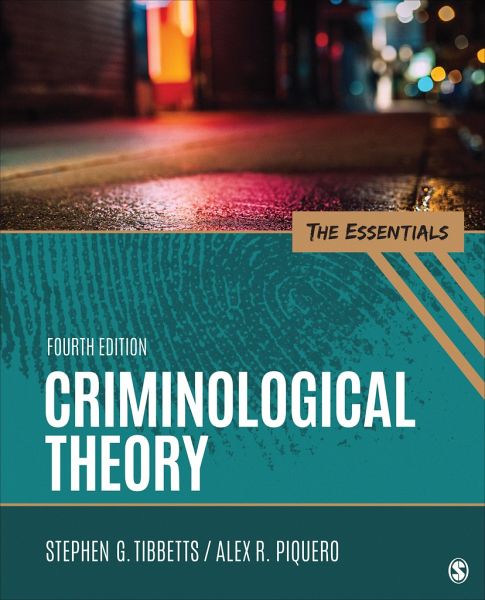
Criminological Theory: The Essentials, Fourth Edition is a brief yet comprehensive overview of the major concepts and perspectives of the key theories in the evolution of criminology. The new edition has been thoroughly updated with the latest theoretical extensions and empirical research, with links made to specific theories and recent events.
Criminological Theory: The Essentials, Fourth Edition is a brief yet comprehensive overview of the major concepts and perspectives of the key theories in the evolution of criminology. The new edition has been thoroughly updated with the latest theoretical extensions and empirical research, with links made to specific theories and recent events.
Stephen G. Tibbetts, currently a Professor at California State University, San Bernardino, has been pursuing an understanding of criminal offending for over the past two decades. He has attempted to discover the extent to which individuals' inherent dispositions and attitudinal traits contribute to their offending decisions, especially in relation to other factors, such as demographic, developmental, and situational factors. Dr. Tibbetts' research has included work on the differences between men and women in their decisions to commit deviant behavior, as well as their perceptions of risk and consequences of getting caught. His additional research interests include the effects of perinatal disorders as an influence in future criminality, the etiology of white-collar crime, and gang intervention. Dr. Tibbetts has published nine books and more than 50 scholarly papers examining various issues in criminology. He received the 2011 Outstanding Professor Award at CSU, San Bernardino. He previously worked extensively as an Officer of the Court in providing recommendations for dispositions of numerous juvenile court cases from 1997 to 2008.
Inhaltsangabe
Chapter 1. Introduction to the Book: An Overview of Issues in Criminological Theory Chapter 2. Preclassical and Classical Theories of Crime Chapter 3. Modern Applications of the Classical Perspective: Deterrence, Rational Choice, and Routine Activities or Lifestyle Theories of Crime Chapter 4. Early Positive School Perspectives of Criminality Chapter 5. Modern Biosocial Perspectives of Criminal Behavior Chapter 6. Early Social Structure and Strain Theories of Crime Chapter 7. The Chicago School and Cultural and Subcultural Theories of Crime Chapter 8. Social Process and Learning Theories of Crime Chapter 9. Social Reaction and Critical Models of Crime Chapter 10. Feminist Models of Crime Chapter 11. Life-Course Perspectives of Criminality Chapter 12. Integrated Theoretical Models and New Perspectives of Crime
Chapter 1. Introduction to the Book: An Overview of Issues in Criminological Theory Chapter 2. Preclassical and Classical Theories of Crime Chapter 3. Modern Applications of the Classical Perspective: Deterrence, Rational Choice, and Routine Activities or Lifestyle Theories of Crime Chapter 4. Early Positive School Perspectives of Criminality Chapter 5. Modern Biosocial Perspectives of Criminal Behavior Chapter 6. Early Social Structure and Strain Theories of Crime Chapter 7. The Chicago School and Cultural and Subcultural Theories of Crime Chapter 8. Social Process and Learning Theories of Crime Chapter 9. Social Reaction and Critical Models of Crime Chapter 10. Feminist Models of Crime Chapter 11. Life-Course Perspectives of Criminality Chapter 12. Integrated Theoretical Models and New Perspectives of Crime
Es gelten unsere Allgemeinen Geschäftsbedingungen: www.buecher.de/agb
Impressum
www.buecher.de ist ein Internetauftritt der buecher.de internetstores GmbH
Geschäftsführung: Monica Sawhney | Roland Kölbl | Günter Hilger
Sitz der Gesellschaft: Batheyer Straße 115 - 117, 58099 Hagen
Postanschrift: Bürgermeister-Wegele-Str. 12, 86167 Augsburg
Amtsgericht Hagen HRB 13257
Steuernummer: 321/5800/1497
USt-IdNr: DE450055826