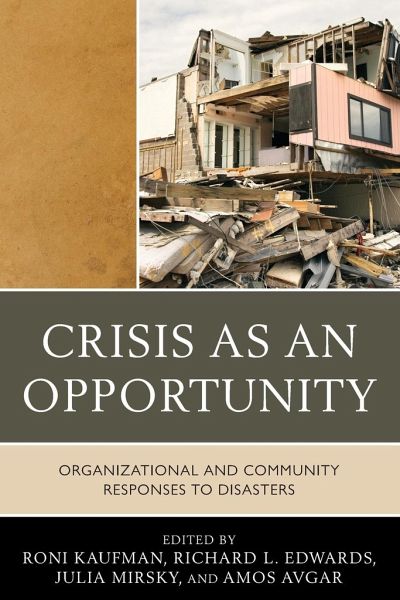
This book addresses the development of long-term interventions following disasters, emphasizing disadvantaged communities. Attention is given to the role of change agents, such as local and international non-governmental organizations (NGOs) and psychosocial professionals, to ensure that the window of opportunity is realized, generating immediate help and sustained community development.
This book addresses the development of long-term interventions following disasters, emphasizing disadvantaged communities. Attention is given to the role of change agents, such as local and international non-governmental organizations (NGOs) and psychosocial professionals, to ensure that the window of opportunity is realized, generating immediate help and sustained community development.
Roni Kaufman, Ph.D., is a senior lecturer at the Department of Social Work, Ben Gurion University, Israel. He co-edited Social Disaster as an Opportunity: The Hesed Model with Mirsky and Avgar. Richard L. Edwards, Ph.D., is dean and professor at the School of Social Work at Rutgers, The State University of New Jersey, and currently serves as interim vice president for academic affairs. He was president of the National Association of Social Workers and a member of the executive committee of the International Federation of Social Workers. Julia Mirsky, Ph.D., is associate professor at the Department of Social Work, Ben Gurion University and was a visiting scholar at universities in the United States and France. She is a clinical psychologist specializing in the psychological aftermaths of migration. Amos Avgar, Ph.D., is chief operations officer for TAG International Development and was executive director of the International Development Program at the American Jewish Joint Distribution Committee (JDC), where he was responsible for strategic planning and implementation of JDC nonsectarian programs worldwide.
Inhaltsangabe
Preface Acknowledgments Introduction Part One: Analytic Frameworks and Perspectives Chapter One: Community and Organizational Responses to Disasters Chapter Two: Intervention in Disasters: An International Perspective Part Two: Community Development and Organizational Interventions Chapter Three: Challenges for Community Development in Disaster Situations Chapter Four: Program Logic Modeling as a Tool for Developing a Disaster Response and Mitigation Plan: The Somaliland Experience Chapter Five: Planning for the Unimaginable: Having Your Personal, Family, Organizational, and Community Plan Chapter Six: Taking the Disabled into Account in Preparing for And Responding to Disasters Chapter Seven: Neighbors Helping Neighbors: The Disability Community and Emergency Preparedness Part Three: Notes from the Field Chapter Eight: Mud and Mold: Making Meaning of Adversity in New Orleans Chapter Nine: Words of Wisdom Following the Tsunami: Lessons from Sri Lanka Chapter Ten: Making the Voices of Victims Heard Chapter Eleven: The Human Hand Behind Natural Disasters: The Ugandan Experience Part Four: Psychosocial Interventions Chapter Twelve: Cultural Sensitivity in Psychosocial Interventions Following a Disaster: A Tri-national Collaboration in Sri Lanka Chapter Thirteen: Psychological Outcomes of the 2001 World Trade Center Attack Chapter Fourteen: Social Work Students During Wartime: False Effect of Professional Self-efficacy? Chapter Fifteen: Shared Traumatic Reality: Social Work Students and Clients in an Area Under Attack Part Five: Conclusion Chapter Sixteen: From Helping to Changing Editors Contributors
Preface Acknowledgments Introduction Part One: Analytic Frameworks and Perspectives Chapter One: Community and Organizational Responses to Disasters Chapter Two: Intervention in Disasters: An International Perspective Part Two: Community Development and Organizational Interventions Chapter Three: Challenges for Community Development in Disaster Situations Chapter Four: Program Logic Modeling as a Tool for Developing a Disaster Response and Mitigation Plan: The Somaliland Experience Chapter Five: Planning for the Unimaginable: Having Your Personal, Family, Organizational, and Community Plan Chapter Six: Taking the Disabled into Account in Preparing for And Responding to Disasters Chapter Seven: Neighbors Helping Neighbors: The Disability Community and Emergency Preparedness Part Three: Notes from the Field Chapter Eight: Mud and Mold: Making Meaning of Adversity in New Orleans Chapter Nine: Words of Wisdom Following the Tsunami: Lessons from Sri Lanka Chapter Ten: Making the Voices of Victims Heard Chapter Eleven: The Human Hand Behind Natural Disasters: The Ugandan Experience Part Four: Psychosocial Interventions Chapter Twelve: Cultural Sensitivity in Psychosocial Interventions Following a Disaster: A Tri-national Collaboration in Sri Lanka Chapter Thirteen: Psychological Outcomes of the 2001 World Trade Center Attack Chapter Fourteen: Social Work Students During Wartime: False Effect of Professional Self-efficacy? Chapter Fifteen: Shared Traumatic Reality: Social Work Students and Clients in an Area Under Attack Part Five: Conclusion Chapter Sixteen: From Helping to Changing Editors Contributors
Es gelten unsere Allgemeinen Geschäftsbedingungen: www.buecher.de/agb
Impressum
www.buecher.de ist ein Internetauftritt der buecher.de internetstores GmbH
Geschäftsführung: Monica Sawhney | Roland Kölbl | Günter Hilger
Sitz der Gesellschaft: Batheyer Straße 115 - 117, 58099 Hagen
Postanschrift: Bürgermeister-Wegele-Str. 12, 86167 Augsburg
Amtsgericht Hagen HRB 13257
Steuernummer: 321/5800/1497
USt-IdNr: DE450055826