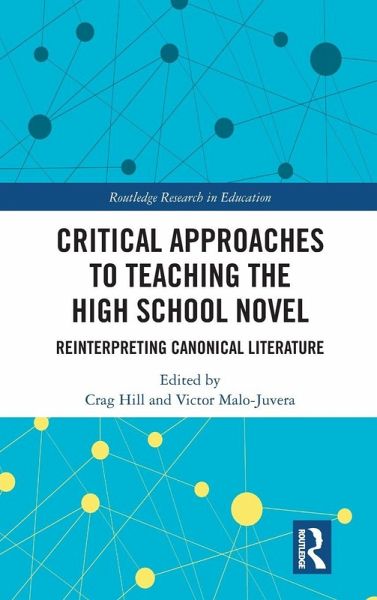
Critical Approaches to Teaching the High School Novel
Reinterpreting Canonical Literature
Herausgeber: Hill, Crag; Malo-Juvera, Victor
Critical Approaches to Teaching the High School Novel
Reinterpreting Canonical Literature
Herausgeber: Hill, Crag; Malo-Juvera, Victor
- Gebundenes Buch
- Merkliste
- Auf die Merkliste
- Bewerten Bewerten
- Teilen
- Produkt teilen
- Produkterinnerung
- Produkterinnerung
This edited collection will turn a critical spotlight on the set of texts that has constituted the high school canon of literature by introducing and applying these interpretive frames to the field of secondary English education.
Andere Kunden interessierten sich auch für
Carol AldousUnlocking Creativity in Solving Novel Mathematics Problems186,99 €
Suzanne CarringtonResearch Approaches to Supporting Students on the Autism Spectrum in Inclusive Schools167,99 €
LornamarieHow to Write a Good and Compelling Novel From Your Imagination to A Thriller35,99 €
Emma ClarkeContemporary Approaches to Behaviour and Mental Health in the Classroom168,99 €
Fiona CarnieAlternative Approaches to Education151,99 €
Handbook of Critical Approaches to Politics and Policy of Education257,99 €
Donna HardinaInnovative Approaches for Teaching Community Organization Skills in the Classroom53,99 €-
-
-
This edited collection will turn a critical spotlight on the set of texts that has constituted the high school canon of literature by introducing and applying these interpretive frames to the field of secondary English education.
Produktdetails
- Produktdetails
- Verlag: Routledge
- Seitenzahl: 244
- Erscheinungstermin: 17. Oktober 2018
- Englisch
- Abmessung: 235mm x 157mm x 18mm
- Gewicht: 510g
- ISBN-13: 9780815379881
- ISBN-10: 0815379889
- Artikelnr.: 54710511
- Herstellerkennzeichnung
- Libri GmbH
- Europaallee 1
- 36244 Bad Hersfeld
- gpsr@libri.de
- Verlag: Routledge
- Seitenzahl: 244
- Erscheinungstermin: 17. Oktober 2018
- Englisch
- Abmessung: 235mm x 157mm x 18mm
- Gewicht: 510g
- ISBN-13: 9780815379881
- ISBN-10: 0815379889
- Artikelnr.: 54710511
- Herstellerkennzeichnung
- Libri GmbH
- Europaallee 1
- 36244 Bad Hersfeld
- gpsr@libri.de
Crag Hill is an associate professor of English Education at the University of Oklahoma, USA. Victor Malo-Juvera is an associate professor of English Education at the University of North Carolina Wilmington, USA.
1. Introduction: The Center of the Canon: The High School Classroom
Crag Hill and Victor Malo-Juvera
2. Why Did the "Star-Crossed Lovers" Never Have a Chance? (Mis)Guided Adult
Interference in Romeo and Juliet
Mark A. Lewis
3. Dances, Dresses, and Speaking Her Mind: The Cultural Work of Pride and
Prejudice
Katharine Montwieler, University of North Carolina Wilmington
4. Teaching Huckleberry Finn in an Era of Tenuous Race Relations
Judith A. Hayn and Autumn M. Dodge
5. It's Really All About Tom: Performances of the Masculine Self in The
Great Gatsby
Michael Macaluso and Kati Macaluso
6. Readers' Hearts Seek Connection: Transactional Theory Applied to The
Heart Is a Lonely Hunter
Sharon Kane
7. Disturbing the Universe: Reading The Stranger Through a Lens of
Philosophical Criticism
Sean P. Connors
8. What Does The Glass Menagerie and Its Discussion Questions Teach about
Disability?
And How to Undo It
Patricia A. Dunn and Angela Broderick
9. Reinterpreting Revolutions: An "Encoding/Decoding" Analysis of Animal
Farm
Lara Searcy, Jonathan B. Allred, Seth D. French, and Christian Z. Goering
10. When New Criticism and Reader Response Aren't Enough: Reading "Against"
To Kill a Mockingbird Through a Critical Whiteness Lens
Susan L. Groenke
11. Literary Authorship and Community Seers in Bless Me, Última and The
House on Mango Street: 'Let me begin at the beginning'
R. Joseph Rodríguez
12. "We got to be smart to git away": Revisiting African American Language
and Emancipatory Literacy in Alice Walker's The Color Purple and Sapphire's
PUSH
Raquel Kennon
Crag Hill and Victor Malo-Juvera
2. Why Did the "Star-Crossed Lovers" Never Have a Chance? (Mis)Guided Adult
Interference in Romeo and Juliet
Mark A. Lewis
3. Dances, Dresses, and Speaking Her Mind: The Cultural Work of Pride and
Prejudice
Katharine Montwieler, University of North Carolina Wilmington
4. Teaching Huckleberry Finn in an Era of Tenuous Race Relations
Judith A. Hayn and Autumn M. Dodge
5. It's Really All About Tom: Performances of the Masculine Self in The
Great Gatsby
Michael Macaluso and Kati Macaluso
6. Readers' Hearts Seek Connection: Transactional Theory Applied to The
Heart Is a Lonely Hunter
Sharon Kane
7. Disturbing the Universe: Reading The Stranger Through a Lens of
Philosophical Criticism
Sean P. Connors
8. What Does The Glass Menagerie and Its Discussion Questions Teach about
Disability?
And How to Undo It
Patricia A. Dunn and Angela Broderick
9. Reinterpreting Revolutions: An "Encoding/Decoding" Analysis of Animal
Farm
Lara Searcy, Jonathan B. Allred, Seth D. French, and Christian Z. Goering
10. When New Criticism and Reader Response Aren't Enough: Reading "Against"
To Kill a Mockingbird Through a Critical Whiteness Lens
Susan L. Groenke
11. Literary Authorship and Community Seers in Bless Me, Última and The
House on Mango Street: 'Let me begin at the beginning'
R. Joseph Rodríguez
12. "We got to be smart to git away": Revisiting African American Language
and Emancipatory Literacy in Alice Walker's The Color Purple and Sapphire's
PUSH
Raquel Kennon
1. Introduction: The Center of the Canon: The High School Classroom
Crag Hill and Victor Malo-Juvera
2. Why Did the "Star-Crossed Lovers" Never Have a Chance? (Mis)Guided Adult
Interference in Romeo and Juliet
Mark A. Lewis
3. Dances, Dresses, and Speaking Her Mind: The Cultural Work of Pride and
Prejudice
Katharine Montwieler, University of North Carolina Wilmington
4. Teaching Huckleberry Finn in an Era of Tenuous Race Relations
Judith A. Hayn and Autumn M. Dodge
5. It's Really All About Tom: Performances of the Masculine Self in The
Great Gatsby
Michael Macaluso and Kati Macaluso
6. Readers' Hearts Seek Connection: Transactional Theory Applied to The
Heart Is a Lonely Hunter
Sharon Kane
7. Disturbing the Universe: Reading The Stranger Through a Lens of
Philosophical Criticism
Sean P. Connors
8. What Does The Glass Menagerie and Its Discussion Questions Teach about
Disability?
And How to Undo It
Patricia A. Dunn and Angela Broderick
9. Reinterpreting Revolutions: An "Encoding/Decoding" Analysis of Animal
Farm
Lara Searcy, Jonathan B. Allred, Seth D. French, and Christian Z. Goering
10. When New Criticism and Reader Response Aren't Enough: Reading "Against"
To Kill a Mockingbird Through a Critical Whiteness Lens
Susan L. Groenke
11. Literary Authorship and Community Seers in Bless Me, Última and The
House on Mango Street: 'Let me begin at the beginning'
R. Joseph Rodríguez
12. "We got to be smart to git away": Revisiting African American Language
and Emancipatory Literacy in Alice Walker's The Color Purple and Sapphire's
PUSH
Raquel Kennon
Crag Hill and Victor Malo-Juvera
2. Why Did the "Star-Crossed Lovers" Never Have a Chance? (Mis)Guided Adult
Interference in Romeo and Juliet
Mark A. Lewis
3. Dances, Dresses, and Speaking Her Mind: The Cultural Work of Pride and
Prejudice
Katharine Montwieler, University of North Carolina Wilmington
4. Teaching Huckleberry Finn in an Era of Tenuous Race Relations
Judith A. Hayn and Autumn M. Dodge
5. It's Really All About Tom: Performances of the Masculine Self in The
Great Gatsby
Michael Macaluso and Kati Macaluso
6. Readers' Hearts Seek Connection: Transactional Theory Applied to The
Heart Is a Lonely Hunter
Sharon Kane
7. Disturbing the Universe: Reading The Stranger Through a Lens of
Philosophical Criticism
Sean P. Connors
8. What Does The Glass Menagerie and Its Discussion Questions Teach about
Disability?
And How to Undo It
Patricia A. Dunn and Angela Broderick
9. Reinterpreting Revolutions: An "Encoding/Decoding" Analysis of Animal
Farm
Lara Searcy, Jonathan B. Allred, Seth D. French, and Christian Z. Goering
10. When New Criticism and Reader Response Aren't Enough: Reading "Against"
To Kill a Mockingbird Through a Critical Whiteness Lens
Susan L. Groenke
11. Literary Authorship and Community Seers in Bless Me, Última and The
House on Mango Street: 'Let me begin at the beginning'
R. Joseph Rodríguez
12. "We got to be smart to git away": Revisiting African American Language
and Emancipatory Literacy in Alice Walker's The Color Purple and Sapphire's
PUSH
Raquel Kennon