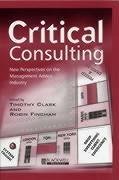
This timely volume provides innovative perspectives on the management advice industry from leading contributors in critical theory, organizational behaviour, sociology, psychology, actor-network theory and narrative analysis. It addresses such fundamental questions as: * What is management knowledge? * How is it created and sold? * What is the role of consultants, gurus, academics in this process? * Does the management advice industry add value? * What is the nature of the client-consultant relationship? The development of interest in the management advice industry, both within the business…mehr
This timely volume provides innovative perspectives on the management advice industry from leading contributors in critical theory, organizational behaviour, sociology, psychology, actor-network theory and narrative analysis. It addresses such fundamental questions as: * What is management knowledge? * How is it created and sold? * What is the role of consultants, gurus, academics in this process? * Does the management advice industry add value? * What is the nature of the client-consultant relationship? The development of interest in the management advice industry, both within the business press and the social sciences, reflects the need to answer these questions. The critical analysis presented here evaluates what management consultants offer as well as investigating the emergence of their industry as a contemporary social phenomenon. This volume provides the first critical evaluation of the different actors and activities that comprise the management advice sector, and will be invaluable both to those teaching courses in consultancy and to analysts who are trying to make sense of the explosion in the management knowledge industry.
Timothy Clark is Professor of Organisational Behaviour at the University of Durham Business School. He has written or edited seven previous books including Managing Consultants (1995) and has written numerous articles in a range of leading journals. He is also an Assistant Editor of Human Relations. Robin Fincham is Senior Lecturer at Stirling University. He has written or edited three previous books, including Principles of Organizational Behaviour (1999), now in its third edition.
Inhaltsangabe
List of Figures and Tables. Notes on Contributors. Introduction: The Emergence of Critical Perspectives on Consulting: Robin Fincham (Stirling University) and Timothy Clark (King's College). Part I: Setting the Scene: The Nature of Management Consultancy and Management Advice:. 1. Consulting: What Should it Mean?: Edgar H Schein (MIT Sloan School of Management). 2. Trapped in their Wave: The Evolution of Management Consultancies: Matthias Kipping (University of Reading). 3. The Rise of Consultancy and the Prospect for Regions: Peter Wood (University College London). 4. On Knowledge, Business Consultants and the Selling of TQM: Karen Legge (University of Warwick). Part II: The Contexts of Management Consultancy and Management Advice:. 5. Virtual Stories of Virtual Working: Critical Reflections on CTI Consultancy Discourse: Peter Case (Oxford Brookes University). 6. The Vision Thing: Constructing Technology and the Future in Management Advice: Brian P Bloomfield (Lancaster University Management School) and Theo Vurdubakis (Manchester School of Management). 7. Front-Line Diffusion: The Production and Negotiation of Knowledge Through Training Interactions: Andrew Sturdy (University of Melbourne). 8. Knowledge Legitimation and Audience Affiliation Through Storytelling: The Example of Management Gurus: Timothy Clark (King's College) and David Greatbatch (Independent Social Scientist). 9. A Fantasy Theme Analysis of Three Guru-Led Management Fashions: Brad Jackson (Victoria University of Wellington). Part III: Critical Reflections on Management Consultancy and Management Advice:. 10. Charisma versus Technique: Differentiating the Expertise of Management Gurus and Management Consultants: Robin Fincham (Stirling University). 11. On Communication Barriers between Management Science, Consultancies and Business Companies: Alfred Kieser (University of Mannheim). 12. Professionalism and Politics in Management Consultancy Work: Mats Alvesson (Lund University) and Anders W Johansson (Jonkoping International Business School, Sweden). 13. Understanding Advice: Towards a Sociology of Management Consultancy: Graeme Salaman (Open University). 14. What Next? More Critique of Consultants, Gurus and Managers: Frank Heller (Centre for Decision Making Studies). Index.
List of Figures and Tables. Notes on Contributors. Introduction: The Emergence of Critical Perspectives on Consulting: Robin Fincham (Stirling University) and Timothy Clark (King's College). Part I: Setting the Scene: The Nature of Management Consultancy and Management Advice:. 1. Consulting: What Should it Mean?: Edgar H Schein (MIT Sloan School of Management). 2. Trapped in their Wave: The Evolution of Management Consultancies: Matthias Kipping (University of Reading). 3. The Rise of Consultancy and the Prospect for Regions: Peter Wood (University College London). 4. On Knowledge, Business Consultants and the Selling of TQM: Karen Legge (University of Warwick). Part II: The Contexts of Management Consultancy and Management Advice:. 5. Virtual Stories of Virtual Working: Critical Reflections on CTI Consultancy Discourse: Peter Case (Oxford Brookes University). 6. The Vision Thing: Constructing Technology and the Future in Management Advice: Brian P Bloomfield (Lancaster University Management School) and Theo Vurdubakis (Manchester School of Management). 7. Front-Line Diffusion: The Production and Negotiation of Knowledge Through Training Interactions: Andrew Sturdy (University of Melbourne). 8. Knowledge Legitimation and Audience Affiliation Through Storytelling: The Example of Management Gurus: Timothy Clark (King's College) and David Greatbatch (Independent Social Scientist). 9. A Fantasy Theme Analysis of Three Guru-Led Management Fashions: Brad Jackson (Victoria University of Wellington). Part III: Critical Reflections on Management Consultancy and Management Advice:. 10. Charisma versus Technique: Differentiating the Expertise of Management Gurus and Management Consultants: Robin Fincham (Stirling University). 11. On Communication Barriers between Management Science, Consultancies and Business Companies: Alfred Kieser (University of Mannheim). 12. Professionalism and Politics in Management Consultancy Work: Mats Alvesson (Lund University) and Anders W Johansson (Jonkoping International Business School, Sweden). 13. Understanding Advice: Towards a Sociology of Management Consultancy: Graeme Salaman (Open University). 14. What Next? More Critique of Consultants, Gurus and Managers: Frank Heller (Centre for Decision Making Studies). Index.
Rezensionen
"...an important and theoretically innovative book highlighting thepower games and discursive strategies that consutlants used tolegitimise their knowledge claimes". Denis Saint-Martin,Universite de Montreal
"This book represents an admirable resource for learning aboutcurrent consulting practices, about their historical roots, andtheir underlying assumptions. The case studies are rich withconcrete illustrations and informed by sound scholarly research."Chris Argyris, Harvard Business School
"Management Consultants are unloved - perhaps even by their ownmothers - and they are misunderstood. This splendid volume tacklesthe latter problem with considerable success; now we understand whymanagement consultants are unloved." Stuart Macdonald,University of Sheffield
"With contributions from the leading researchers in the area,this book provides fresh insights into the growth of the managementadvice industry and a valuable addition to the critical literaturein this area". Dr Christopher Wright, University of New SouthWales
"This book is a landmark that will set the parameters for futurethinking about the role of consultants." Professor Stephen Hill,London School of Economics
Es gelten unsere Allgemeinen Geschäftsbedingungen: www.buecher.de/agb
Impressum
www.buecher.de ist ein Internetauftritt der buecher.de internetstores GmbH
Geschäftsführung: Monica Sawhney | Roland Kölbl | Günter Hilger
Sitz der Gesellschaft: Batheyer Straße 115 - 117, 58099 Hagen
Postanschrift: Bürgermeister-Wegele-Str. 12, 86167 Augsburg
Amtsgericht Hagen HRB 13257
Steuernummer: 321/5800/1497
USt-IdNr: DE450055826