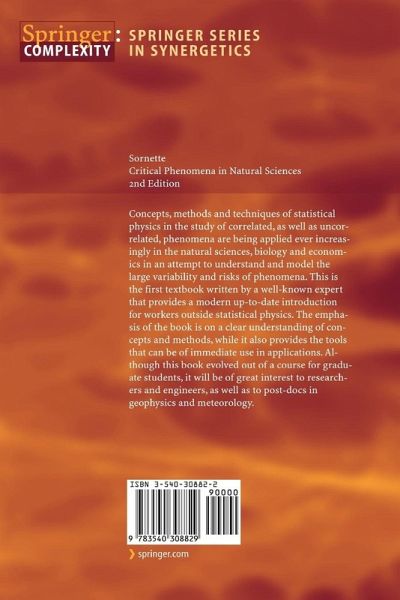
Concepts, methods and techniques of statistical physics in the study of correlated, as well as uncorrelated, phenomena are being applied ever increasingly in the natural sciences, biology and economics in an attempt to understand and model the large variability and risks of phenomena. This is the first textbook written by a well-known expert that provides a modern up-to-date introduction for workers outside statistical physics. The emphasis of the book is on a clear understanding of concepts and methods, while it also provides the tools that can be of immediate use in applications. Although…mehr
Concepts, methods and techniques of statistical physics in the study of correlated, as well as uncorrelated, phenomena are being applied ever increasingly in the natural sciences, biology and economics in an attempt to understand and model the large variability and risks of phenomena. This is the first textbook written by a well-known expert that provides a modern up-to-date introduction for workers outside statistical physics. The emphasis of the book is on a clear understanding of concepts and methods, while it also provides the tools that can be of immediate use in applications. Although this book evolved out of a course for graduate students, it will be of great interest to researchers and engineers, as well as to post-docs in geophysics and meteorology.
Artikelnr. des Verlages: 11595526, 978-3-540-30882-9
2. Aufl.
Seitenzahl: 552
Erscheinungstermin: 13. März 2006
Englisch
Abmessung: 235mm x 155mm x 30mm
Gewicht: 889g
ISBN-13: 9783540308829
ISBN-10: 3540308822
Artikelnr.: 20752071
Herstellerkennzeichnung
Springer-Verlag GmbH
Tiergartenstr. 17
69121 Heidelberg
ProductSafety@springernature.com
Autorenporträt
Dr. Dmitry Chernov is a senior researcher at the Chair of Reliability and Risk Engineering at the Swiss Federal Institute of Technology in Zurich (ETH Zurich). He has more than 15 years of experience as a crisis communication and disaster management consultant for large corporate clients working in oil and gas, electric power, metals and mining, chemical, telecommunication, transport, utilities, retail manufacturing, etc. He first recognized the importance of intra-organizational risk concealment in 2007 during one of his seminars for a critical infrastructure company. Since then, he has focused on researching solutions to improve intra-organizational risk communication, in order to enable timely decision-making before and during industrial disasters. Additional information: www.riskcommunication.info/en Dr. Didier Sornette is Chair Professor and co-Dean of the Institute of Risk Analysis, Prediction and Management (Risks-X) at the Southern University of Science and Technology (SUSTech) Shenzhen, China. He is professor emeritus of ETH Zurich since 31st July 2022, where he was a founding member of the Risk Center at ETH Zurich. Since 1s August 2022, he has taken an active role in the private sector, applying his energy to develop socially important business products associated to earthquake forecasts and financial crises, as well as in medical applications. He is a Fellow of the American Association for the Advancement of Science, a member of the Swiss Academy of Engineering Sciences and of the Academia Europaea. He uses rigorous data-driven mathematical statistical analyses combined with nonlinear multi-variable dynamical models with positive and negative feedbacks to study the predictability and control of crises and extreme events in complex systems, with applications to all domains of science and practice. Dr. Giovanni Sansavini is an associate professor of Reliability and Risk Engineering at the Institute of Energy and Process Engineering, ETH Zurich. Currently, he is the chairperson of the ETH Risk Center and of the Technical Committee on Critical Infrastructures of the European Safety and Reliability Association (ESRA). His research focuses on the development of hybrid analytical and computational tools suitable for analyzing and simulating failure behaviors of engineered complex systems, with focus on physically networked critical infrastructures and sustainable energy systems. He aims to quantitatively define reliability, vulnerability, resilience and risk within these systems using a computational approach based on physical system modeling, advanced Monte Carlo simulation, soft computing techniques and optimization. Dr. Ali Ayoub is a postdoctoral researcher at the Department of Nuclear Science and Engineering at the Massachusetts Institute of Technology. He received his Ph.D. and M.Sc. in nuclear engineering from the ETH Zurich after finishing his undergraduate training at the American University of Beirut. Dr. Ayoub is a member of the European Commission ESReDA "Risk, knowledge, and management" project group. Besides his interests in tackling the problems of risk communication and risk information transmission in critical industries, his research interests include: risk analysis and nuclear safety, uncertainty quantification and model-data integration, atmospheric dispersion, resilience engineering and timely decision-making.
Inhaltsangabe
Useful Notions of Probability Theory.- Sums of Random Variables, Random Walks and the Central Limit Theorem.- Large Deviations.- Power Law Distributions.- Fractals and Multifractals.- Rank-Ordering Statistics and Heavy Tails.- Statistical Mechanics: Probabilistic Point of View and the Concept of Temperature .- Long-Range Correlations.- Phase Transitions: Critical Phenomena and First-Order Transitions.- Transitions, Bifurcations and Precursors.- The Renormalization Group.- The Percolation Model.- Rupture Models.- Mechanisms for Power Laws.- Self-Organized Criticality.- to the Physics of Random Systems.- Randomness and Long-Range Laplacian Interactions.
Useful Notions of Probability Theory.- Sums of Random Variables, Random Walks and the Central Limit Theorem.- Large Deviations.- Power Law Distributions.- Fractals and Multifractals.- Rank-Ordering Statistics and Heavy Tails.- Statistical Mechanics: Probabilistic Point of View and the Concept of Temperature .- Long-Range Correlations.- Phase Transitions: Critical Phenomena and First-Order Transitions.- Transitions, Bifurcations and Precursors.- The Renormalization Group.- The Percolation Model.- Rupture Models.- Mechanisms for Power Laws.- Self-Organized Criticality.- to the Physics of Random Systems.- Randomness and Long-Range Laplacian Interactions.
Es gelten unsere Allgemeinen Geschäftsbedingungen: www.buecher.de/agb
Impressum
www.buecher.de ist ein Internetauftritt der buecher.de internetstores GmbH
Geschäftsführung: Monica Sawhney | Roland Kölbl | Günter Hilger
Sitz der Gesellschaft: Batheyer Straße 115 - 117, 58099 Hagen
Postanschrift: Bürgermeister-Wegele-Str. 12, 86167 Augsburg
Amtsgericht Hagen HRB 13257
Steuernummer: 321/5800/1497
USt-IdNr: DE450055826