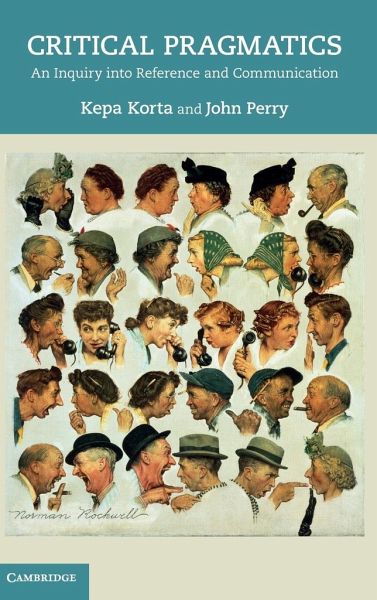
Critical Pragmatics develops three ideas: language is a way of doing things with words; meanings of phrases and contents of utterances derive ultimately from human intentions; and language combines with other factors to allow humans to achieve communicative goals. In this book, Kepa Korta and John Perry explain why critical pragmatics provides a coherent picture of how parts of language study fit together within the broader picture of human thought and action. They focus on issues about singular reference, that is, talk about particular things, places or people, which have played a central…mehr
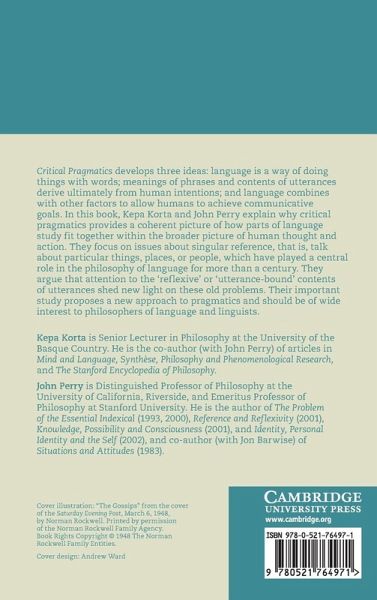
Critical Pragmatics develops three ideas: language is a way of doing things with words; meanings of phrases and contents of utterances derive ultimately from human intentions; and language combines with other factors to allow humans to achieve communicative goals. In this book, Kepa Korta and John Perry explain why critical pragmatics provides a coherent picture of how parts of language study fit together within the broader picture of human thought and action. They focus on issues about singular reference, that is, talk about particular things, places or people, which have played a central role in the philosophy of language for more than a century. They argue that attention to the 'reflexive' or 'utterance-bound' contents of utterances sheds new light on these old problems. Their important study proposes a new approach to pragmatics and should be of wide interest to philosophers of language and linguists.
Kepa Korta is Senior Lecturer in Philosophy at the University of the Basque Country. His work has been focused on the study of dialogue, the implicit/explicit distinction, and the semantics/pragmatics interface. His research fields include the philosophy of language, semantics and pragmatics, and the philosophy of action. He has authored a number of books and papers, and recently co-authored with John Perry several works on pragmatics in Mind and Language, Synthese, Philosophy and Phenomenological Research and The Stanford Encyclopedia of Philosophy. He is currently director of the Institute for Logic, Cognition, Language and Information (ILCLI) of the University of the Basque Country, Donostia-San Sebastian.
Inhaltsangabe
1. Introduction 2. A short history of reference 3. Acts, roles and singular reference 4. Elements of reference 5. Demonstratives 6. Context sensitivity and indexicals 7. Names 8. Definite descriptions 9. Implicit reference and unarticulated constituents 10. Locutionary content and speech acts 11. Reference and implicature 12. Semantics, pragmatics and critical pragmatics 13. Harnessing information 14. Examples.
1. Introduction; 2. A short history of reference; 3. Acts, roles and singular reference; 4. Elements of reference; 5. Demonstratives; 6. Context sensitivity and indexicals; 7. Names; 8. Definite descriptions; 9. Implicit reference and unarticulated constituents; 10. Locutionary content and speech acts; 11. Reference and implicature; 12. Semantics, pragmatics and critical pragmatics; 13. Harnessing information; 14. Examples.
1. Introduction 2. A short history of reference 3. Acts, roles and singular reference 4. Elements of reference 5. Demonstratives 6. Context sensitivity and indexicals 7. Names 8. Definite descriptions 9. Implicit reference and unarticulated constituents 10. Locutionary content and speech acts 11. Reference and implicature 12. Semantics, pragmatics and critical pragmatics 13. Harnessing information 14. Examples.
1. Introduction; 2. A short history of reference; 3. Acts, roles and singular reference; 4. Elements of reference; 5. Demonstratives; 6. Context sensitivity and indexicals; 7. Names; 8. Definite descriptions; 9. Implicit reference and unarticulated constituents; 10. Locutionary content and speech acts; 11. Reference and implicature; 12. Semantics, pragmatics and critical pragmatics; 13. Harnessing information; 14. Examples.
Rezensionen
'Critical Pragmatics is an original and highly impressive contribution to the field of pragmatics. It is a must-read for anyone who is interested in pragmatics in general and meaning in particular.' Professor Dr Eckard Rolf, Language and Dialogue
Es gelten unsere Allgemeinen Geschäftsbedingungen: www.buecher.de/agb
Impressum
www.buecher.de ist ein Internetauftritt der buecher.de internetstores GmbH
Geschäftsführung: Monica Sawhney | Roland Kölbl | Günter Hilger
Sitz der Gesellschaft: Batheyer Straße 115 - 117, 58099 Hagen
Postanschrift: Bürgermeister-Wegele-Str. 12, 86167 Augsburg
Amtsgericht Hagen HRB 13257
Steuernummer: 321/5800/1497
USt-IdNr: DE450055826