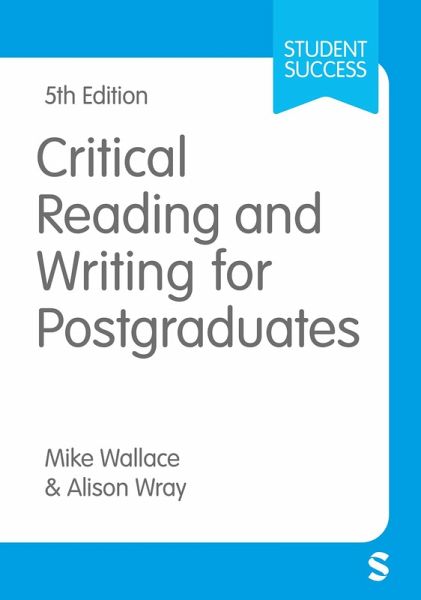
Step into academic success with Critical Reading and Writing for Postgraduates, your trusted companion for reviewing and writing convincingly about the research literature. This detailed guide takes you through the essentials: deciding what to read, developing techniques for evaluating the claims in texts, building strong arguments through structured literature reviews and dissertations, and writing convincingly for your readers and assessors. With practical tools, advice on using AI, and worked examples, this book provides everything you need for approaching academic work with a critical eye…mehr
Step into academic success with Critical Reading and Writing for Postgraduates, your trusted companion for reviewing and writing convincingly about the research literature. This detailed guide takes you through the essentials: deciding what to read, developing techniques for evaluating the claims in texts, building strong arguments through structured literature reviews and dissertations, and writing convincingly for your readers and assessors. With practical tools, advice on using AI, and worked examples, this book provides everything you need for approaching academic work with a critical eye and a clear voice. You will learn: ¿ Strategies for critically reading and analysing academic texts. ¿ Step-by-step methods for developing convincing written arguments. ¿ Strategies for planning, structuring, and writing your literature reviews and dissertation. ¿ Ways of responding effectively to your supervisor's feedback. Supplemented by online self-study materials, this book is ideal for postgraduates in the social sciences and beyond, keen to develop their skills and academic confidence. Student Success is a series of essential guides for students of all levels. From how to think critically and write great essays to boosting your employability and managing your wellbeing, the Student Success series helps you study smarter and get the best from your time at university.
Mike Wallace is a Professor of Public Management at Cardiff Business School, Cardiff University. From 2009 to 2012 he was the Economic and Social Research Council's Strategic Adviser for Researcher Development. His research on managing change in the public services is reported in many books and academic journals. He is co-author, with Eric Hoyle, of the book Educational Leadership: Ambiguity, Professionals, and Managerialism (Sage, 2005), lead editor, with Michael Fertig and Eugene Schneller, of the book Managing Change in the Public Services (Blackwell, 2007), and lead co-author, with Michael Reed, Dermot O¿Reilly, Jonathan Morris, Michael Tomlinson and Rosemary Deem, of the book Developing Public Service Leaders: Elite Orchestration, Change Agency, Leaderism, and Neoliberalization (Oxford University Press, 2023). His contribution to teaching at Cardiff centres on the design of postgraduate research programmes incorporating research methods training.
Inhaltsangabe
Part 1: Becoming a Critical Reader and Self-Critical Writer Chapter 1: What it Means to be Critical Chapter 2: Making a Critical Choice Chapter 3: A First Look: Interrogating Abstracts Chapter 4: Getting Started on Critical Reading Chapter 5: Getting Started on Self-Critical Writing Chapter 6: Creating a Comparative Critical Summary Chapter 7: Developing Your Writing Skills to Communicate Effectively Part 2: Developing an In-Depth Analysis Chapter 8: A Mental Map for Critical Reading and Self-critical Writing in Depth Chapter 9: Tools for Thinking - Concepts and their Combinations Chapter 10: Ways of Thinking - Philosophical Positions Chapter 11: Reasons for Conducting the Research - Intellectual Projects Chapter 12: Knowledge Claims - Creating Different Types of Literature Chapter 13: Key Claim Characteristics - Certainty and Generalization Chapter 14: Developing a Critical Analysis of a Text Chapter 15: A Worked Example of a Critical Analysis Chapter 16: Developing Your Argument in a Critical Review of a Text Chapter 17: Writing a Comparative Critical Review of Several Texts Part 3: Putting Your Critical Reviews to Work Chapter 18: Focusing and Building Up Your Critical Literature Review Chapter 19: Integrating Critical Literature Reviews into Your Dissertation Chapter 20: Critical Literature Reviews in Alternative Dissertation Structures Chapter 21: Tools for Structuring a Dissertation Chapter 22: Using the Literature in Research Papers, Oral Presentations and Posters Chapter 23: Understanding your Supervisor's Feedback
Part 1: Becoming a Critical Reader and Self-Critical Writer Chapter 1: What it Means to be Critical Chapter 2: Making a Critical Choice Chapter 3: A First Look: Interrogating Abstracts Chapter 4: Getting Started on Critical Reading Chapter 5: Getting Started on Self-Critical Writing Chapter 6: Creating a Comparative Critical Summary Chapter 7: Developing Your Writing Skills to Communicate Effectively Part 2: Developing an In-Depth Analysis Chapter 8: A Mental Map for Critical Reading and Self-critical Writing in Depth Chapter 9: Tools for Thinking - Concepts and their Combinations Chapter 10: Ways of Thinking - Philosophical Positions Chapter 11: Reasons for Conducting the Research - Intellectual Projects Chapter 12: Knowledge Claims - Creating Different Types of Literature Chapter 13: Key Claim Characteristics - Certainty and Generalization Chapter 14: Developing a Critical Analysis of a Text Chapter 15: A Worked Example of a Critical Analysis Chapter 16: Developing Your Argument in a Critical Review of a Text Chapter 17: Writing a Comparative Critical Review of Several Texts Part 3: Putting Your Critical Reviews to Work Chapter 18: Focusing and Building Up Your Critical Literature Review Chapter 19: Integrating Critical Literature Reviews into Your Dissertation Chapter 20: Critical Literature Reviews in Alternative Dissertation Structures Chapter 21: Tools for Structuring a Dissertation Chapter 22: Using the Literature in Research Papers, Oral Presentations and Posters Chapter 23: Understanding your Supervisor's Feedback
Es gelten unsere Allgemeinen Geschäftsbedingungen: www.buecher.de/agb
Impressum
www.buecher.de ist ein Internetauftritt der buecher.de internetstores GmbH
Geschäftsführung: Monica Sawhney | Roland Kölbl | Günter Hilger
Sitz der Gesellschaft: Batheyer Straße 115 - 117, 58099 Hagen
Postanschrift: Bürgermeister-Wegele-Str. 12, 86167 Augsburg
Amtsgericht Hagen HRB 13257
Steuernummer: 321/5800/1497
USt-IdNr: DE450055826