
Andere Kunden interessierten sich auch für
 Dialectic and Difference63,99 €
 Enlightened Common Sense38,99 €
 Has Science Got Any Basic Principle?33,99 €
 The Well-Being of Children64,99 €
 Science, Realism and Conceptual Schemes22,99 €
 Hegelian Logic and Knowledge Development64,99 €
 The epistemological orientation of educational research76,99 €
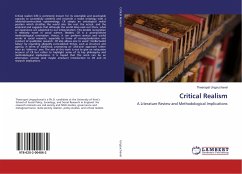
Critical realism (CR) is commonly known for its ostensible and practicable capacity to successfully combine and reconcile a realist ontology with a relativist/constructivist epistemology. CR adapts an ontological realist position which stratifies the world into the real, the actual, and the empirical and suggests that although the world does exist out there, what we experience are subjected to our interpretation. This double recognition is relatively novel in social science. Besides, CR is a post-positivist methodological orientation. Hence, it can perform serious and useful works in social research, especially in terms of conceptualization and conduct of qualitative research. CR also allows one to avoid 'intellectualist fallacy' by regarding allegedly contradicted things, such as structure and agency, in terms of dialectical, promoting an 'and-and' approach rather than an 'either-or' one. The aim of this work is not to give an exhaustive account of CR but rather to highlight some of its key philosophy and methodological implications. It is hoped that this work can be an alternative, concise (and maybe amatuer) introduction to CR and its research implications.