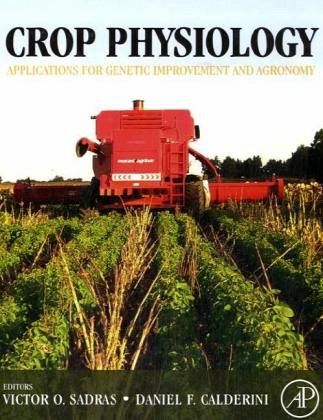
Never before has a holistic approach to sustainable agriculture and plant physiology been presented in one source. This book compiles a multi-authored and international perspective on the ways in which crop physiology could be integrated with other disciplines. With a focus on genetic improvement and agronomy, this book addresses the challenges of environmentally sound production of bulk and quality food, fodder, fiber and energy, which are of ongoing international concern.
Never before has a holistic approach to sustainable agriculture and plant physiology been presented in one source. This book compiles a multi-authored and international perspective on the ways in which crop physiology could be integrated with other disciplines. With a focus on genetic improvement and agronomy, this book addresses the challenges of environmentally sound production of bulk and quality food, fodder, fiber and energy, which are of ongoing international concern.
Artikelnr. des Verlages: B978-0-12-374431-9.X0001-1
Erscheinungstermin: Mai 2009
Englisch
Abmessung: 234mm x 190mm x 240mm
Gewicht: 1400g
ISBN-13: 9780123744319
ISBN-10: 0123744318
Artikelnr.: 25903550
Herstellerkennzeichnung
Die Herstellerinformationen sind derzeit nicht verfügbar.
Autorenporträt
Victor Sadras is a crop ecophysiologist with interest in the adaptation of crops to environmental stresses, including water deficit, extreme temperatures, nutrient deficit, soil physical and chemical constraints, pathogens and insects. He has measured and modelled aspects of the water, carbon and nitrogen economies of annual (wheat, field pea, chickpea, sunflower, maize, soybean, cotton) and perennial crops (grapevine, olive) in rain-fed and irrigated systems.
Inhaltsangabe
1. Sustainable Agriculture and Crop PhysiologyVictor Sadras, Daniel Calderini and David ConnorPart 1 -Farming Systems: Case Studies2. Farming Systems of Australia: Exploiting the Synergy between Genetic Improvement and Agronomy 3. Farming Systems of Argentina: Yield Constraints and Risk Management 4. Improving Farming Systems in Northern European Conditions5. Cereal-based Cropping Systems in Asia: Nutrition and Disease ManagementPart 2 - Capture and Efficiency in the Use of Resources: Quantitative Frameworks6. Improving Productivity to Face Water Scarcity in Irrigated Agriculture7. Crop Radiation Capture and Use Efficiency: A Framework for Crop Growth Analysis8. Quantifying Crop Responses to Nitrogen Deficiency and Avenues to Improve Nitrogen-use EfficiencyPart 3 - Crop physiology, Genetic Improvement, 9. Darwinian Agriculture: Real, Imaginary and Complex Trade-offs as Constraints and Opportunities10. Modelling Crop Improvement in a G x E x M Framework via Gene-trait-phenotype Relationships11. Integration of Biotechnology, Plant Breeding and Crop Physiology: Dealing with Complex Interactions from a Physiological Perspective12. Crop Development: Genetic Control, Environmental Modulation and Relevance for Genetic Improvement of Crop Yield13. Crop Roots Systems Form and Function: Improving the Capture of Water and Nutrients with Vigorous Root Systems14. Integrated Views in Plant Breeding: Modern Approaches for an Old Topic15. Genetic Improvement of Grain Crops: Yield Potential16. Management and Breeding Strategies for the Improvement of Grain and Oil Quality17. Dynamics of Crop-Pathogen Interactions: From Gene to Continental Scale18. Improving Crop Competitiveness with Weeds: Adaptations and Tradeoffs 19. Dynamic and Functional Monitoring Technologies for Applications in Crop Management 20. Crop Physiology, Modelling and Climate Change: Impact and Adaptation Strategies 21. Whither Crop Physiology?
1. Sustainable Agriculture and Crop PhysiologyVictor Sadras, Daniel Calderini and David ConnorPart 1 -Farming Systems: Case Studies2. Farming Systems of Australia: Exploiting the Synergy between Genetic Improvement and Agronomy 3. Farming Systems of Argentina: Yield Constraints and Risk Management 4. Improving Farming Systems in Northern European Conditions5. Cereal-based Cropping Systems in Asia: Nutrition and Disease ManagementPart 2 - Capture and Efficiency in the Use of Resources: Quantitative Frameworks6. Improving Productivity to Face Water Scarcity in Irrigated Agriculture7. Crop Radiation Capture and Use Efficiency: A Framework for Crop Growth Analysis8. Quantifying Crop Responses to Nitrogen Deficiency and Avenues to Improve Nitrogen-use EfficiencyPart 3 - Crop physiology, Genetic Improvement, 9. Darwinian Agriculture: Real, Imaginary and Complex Trade-offs as Constraints and Opportunities10. Modelling Crop Improvement in a G x E x M Framework via Gene-trait-phenotype Relationships11. Integration of Biotechnology, Plant Breeding and Crop Physiology: Dealing with Complex Interactions from a Physiological Perspective12. Crop Development: Genetic Control, Environmental Modulation and Relevance for Genetic Improvement of Crop Yield13. Crop Roots Systems Form and Function: Improving the Capture of Water and Nutrients with Vigorous Root Systems14. Integrated Views in Plant Breeding: Modern Approaches for an Old Topic15. Genetic Improvement of Grain Crops: Yield Potential16. Management and Breeding Strategies for the Improvement of Grain and Oil Quality17. Dynamics of Crop-Pathogen Interactions: From Gene to Continental Scale18. Improving Crop Competitiveness with Weeds: Adaptations and Tradeoffs 19. Dynamic and Functional Monitoring Technologies for Applications in Crop Management 20. Crop Physiology, Modelling and Climate Change: Impact and Adaptation Strategies 21. Whither Crop Physiology?
Rezensionen
"This volume is a compilation of 21 reviews, ably edited and presented in three parts as Farming System, Capture and Use of Resources and Crop Physiology.The scale The book contains a great deal of useful information." --Experimental Agriculture
"This book provides deep and detailed study of the latest research problems in crop physiology for breeders, geneticist, ecologists, ecophysiologists and physiologists; therefore, this book is recommendable to practitioners of, all those who want to implement the most recent advances in crop technology. Moreover, this textbook is a valuable reference for physiology and agronomy students." --Acta Physiologiae Plantarum
Es gelten unsere Allgemeinen Geschäftsbedingungen: www.buecher.de/agb
Impressum
www.buecher.de ist ein Internetauftritt der buecher.de internetstores GmbH
Geschäftsführung: Monica Sawhney | Roland Kölbl | Günter Hilger
Sitz der Gesellschaft: Batheyer Straße 115 - 117, 58099 Hagen
Postanschrift: Bürgermeister-Wegele-Str. 12, 86167 Augsburg
Amtsgericht Hagen HRB 13257
Steuernummer: 321/5800/1497
USt-IdNr: DE450055826