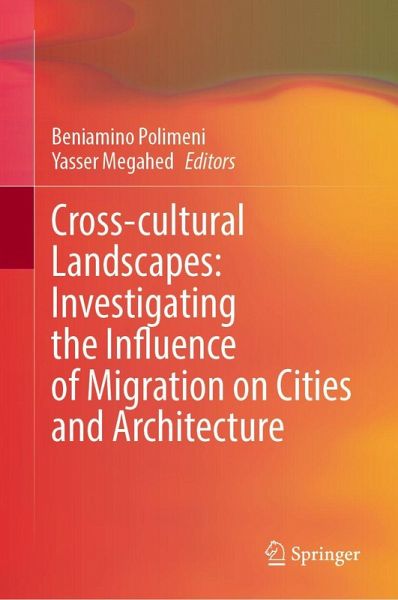
This book explores how migration has shaped cities over time and continues to influence their architecture and urban landscapes today. It examines how people s movement across borders connects with buildings, urban life, and cultural heritage. Bringing together perspectives from an interdisciplinary group of authors, it also highlights how design and planning can help build more welcoming and connected communities. Drawing on case studies from around the world, the contributors bring together diverse research approaches and perspectives that enrich current debates on migration and the built…mehr
This book explores how migration has shaped cities over time and continues to influence their architecture and urban landscapes today. It examines how people s movement across borders connects with buildings, urban life, and cultural heritage. Bringing together perspectives from an interdisciplinary group of authors, it also highlights how design and planning can help build more welcoming and connected communities. Drawing on case studies from around the world, the contributors bring together diverse research approaches and perspectives that enrich current debates on migration and the built environment.
Divided into four thematic sections, the book gathers papers exploring the central questions that arise where migration meets the built environment. It considers how architecture and urban design respond to global mobility, showing how effective strategies can promote integration, resilience, and the active participation of migrant communities. The influence of transnational movement on architectural languages is also studied, revealing how diverse cultural traditions shape the evolution of spatial forms.
The volume gives special attention to the transformation of urban scenarios through adaptive reuse and heritage preservation, illustrating how the movement of people reshapes shared spaces and collective memory. Ultimately, it stresses the importance of sustainable planning and calls for collaboration among architects, urban designers, and policymakers to build resilient and pluralistic cities.
Dr Beniamino Polimeni is an architect, conservation specialist and Senior Lecturer in Architecture at the University of Hertfordshire, where he directs the Professional Doctorate in Design. His research focuses on architectural representation, heritage conservation and Islamic architecture, with particular emphasis on the Mediterranean and North Africa. His recent work examines migrant communities and adaptive reuse in England, linking socially engaged design with the sustainable preservation of heritage. Widely published by Springer, Thames & Hudson and other leading presses, he also serves on the editorial boards of Disegnare Con, Tribelon, Quaderni di Architettura e Design and The Saharan Journal, as well as acting as an ARB accreditation visitor. Yasser Megahed is an educator, researcher and practitioner, and Senior Lecturer at the Welsh School of Architecture. He is also an Associate Architect at Design Office, Newcastle, shortlisted for the RIBA North-East Award (2019), and was named in the Architects’ Journal’s “40 under 40” (2020). His research interrogates contemporary architectural practice, bridging design research and professional practice, with special interests in design fiction, graphic novels, and contemporary mosque typologies. His work has appeared in journals including JAE, Interstices and arq, and culminated in his book Practiceopolis: Stories from the Architectural Profession (Routledge, 2020).
Inhaltsangabe
Living Together: designing interreligious spaces in the plural city. Suspended Identity: Internal Migrations in Sub Saharan Africa and the Rural/Urban Divide. A Project for the Senegal Sahel’s City Villages along the Tambacounda Kidira Axis. Hygienic Assemblage(s) of Hassan Fathy: A Decolonial History of Global Architecture. Matter Matters: Sacred Breads and Liturgical Place Making in St Andrew’s Orthodox Christian Community, Edinburgh. Architecture, Migration and Constructions of Home in Kolkata. The Migration of Italian Architectural Theories into Argentina during the Post WWII Era. Architectural Fusion: Ideas Migration, Cross Culturalism and Modern Forms of Eclecticism—The Case of Mosque Architecture. Ismailia:The Metamorphosis of a Colonial City to an Egyptian Urban Conglomerate. Architectural Diversity and Cultural Expression: Hindu Religious Structures in Leicester (2010–2020). Mediterranean Syncretism. The Migrations of Byzantine Monks to Southern Italy and Oriental Influences in Religious Architecture. Documenting Transnational Migrants: Residential Typologies of Diuenses. Carried Across Climates: Migrating Environmental Design Strategies. Aetiology and Morphology of the Architecture of a Migrant Town. Muslim Urban Experiences in a Diverse Berlin. Tracing change along Sonnenallee, Karl Marx Strasse, and Hermannstrasse. Ethics in Urban Form: How Spatial Configuration Shapes Migrant Integration in Algiers’ Boushaki District in Bab Ezzouar, Al Jaza’ir. Navigating Integration: Mapping the Socio Spatial Experiences of Asylum Seeking Women in Molins de Rei, Catalonia. Moving East South Asian Workers and Environments of Domesticity in Postsocialist Romania.
Living Together: designing interreligious spaces in the plural city. Suspended Identity: Internal Migrations in Sub Saharan Africa and the Rural/Urban Divide. A Project for the Senegal Sahel’s City Villages along the Tambacounda Kidira Axis. Hygienic Assemblage(s) of Hassan Fathy: A Decolonial History of Global Architecture. Matter Matters: Sacred Breads and Liturgical Place Making in St Andrew’s Orthodox Christian Community, Edinburgh. Architecture, Migration and Constructions of Home in Kolkata. The Migration of Italian Architectural Theories into Argentina during the Post WWII Era. Architectural Fusion: Ideas Migration, Cross Culturalism and Modern Forms of Eclecticism—The Case of Mosque Architecture. Ismailia:The Metamorphosis of a Colonial City to an Egyptian Urban Conglomerate. Architectural Diversity and Cultural Expression: Hindu Religious Structures in Leicester (2010–2020). Mediterranean Syncretism. The Migrations of Byzantine Monks to Southern Italy and Oriental Influences in Religious Architecture. Documenting Transnational Migrants: Residential Typologies of Diuenses. Carried Across Climates: Migrating Environmental Design Strategies. Aetiology and Morphology of the Architecture of a Migrant Town. Muslim Urban Experiences in a Diverse Berlin. Tracing change along Sonnenallee, Karl Marx Strasse, and Hermannstrasse. Ethics in Urban Form: How Spatial Configuration Shapes Migrant Integration in Algiers’ Boushaki District in Bab Ezzouar, Al Jaza’ir. Navigating Integration: Mapping the Socio Spatial Experiences of Asylum Seeking Women in Molins de Rei, Catalonia. Moving East South Asian Workers and Environments of Domesticity in Postsocialist Romania.
Es gelten unsere Allgemeinen Geschäftsbedingungen: www.buecher.de/agb
Impressum
www.buecher.de ist ein Internetauftritt der buecher.de internetstores GmbH
Geschäftsführung: Monica Sawhney | Roland Kölbl | Günter Hilger
Sitz der Gesellschaft: Batheyer Straße 115 - 117, 58099 Hagen
Postanschrift: Bürgermeister-Wegele-Str. 12, 86167 Augsburg
Amtsgericht Hagen HRB 13257
Steuernummer: 321/5800/1497
USt-IdNr: DE450055826