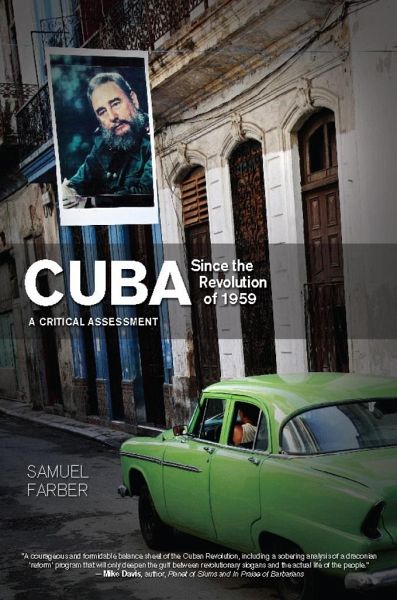
Samuel Farber was born and raised in Marianao, Cuba, and came to the United States in February 1958. He obtained a Ph.D. in Sociology from the University of California at Berkeley in 1969 and taught at a number of colleges and universities including UCLA and, most recently, Brooklyn College of the City University of New York, where he is a Professor Emeritus of Political Science. His scholarship on Cuba is extensive and includes many articles and two previous books: Revolution and Reaction in Cuba, 1933?1960 (Wesleyan University Press, 1976) and The Origins of the Cuban Revolution Reconsidered (University of North Carolina Press, 2006). He is also the author of Before Stalinism. The Rise and Fall of Soviet Democracy (Polity/Verso, 1990) and Social Decay and Transformation. A View From The Left (Lexington Books, 2000). Farber was active in the Cuban high school student movement against Fulgencio Batista in the 1950s, and has been involved in socialist politics for more than fifty years.
Inhaltsangabe
Acknowledgments Chronology Introduction Chapter One - Towards "Monolithic Unity" - Building Cuban State Power from Above. Chapter Two - Economic Development and Standard of Living Since the 1959 Revolution. Chapter Three - Cuba's Foreign Policy - Between Revolution and Reasons of State. Chapter Four - Cuban Workers After the 1959 Revolution - Ruling Class or Exploited Class? Chapter Five - Black Cubans - An Oppression that Dared Not Speak Its Name. Chapter Six - Gender Politics and the Cuban Revolution. Chapter Seven - Dissidents and Critics - From right to left. Conclusion Epilogue Selected Bibliography
Acknowledgments Chronology Introduction Chapter One - Towards "Monolithic Unity" - Building Cuban State Power from Above. Chapter Two - Economic Development and Standard of Living Since the 1959 Revolution. Chapter Three - Cuba's Foreign Policy - Between Revolution and Reasons of State. Chapter Four - Cuban Workers After the 1959 Revolution - Ruling Class or Exploited Class? Chapter Five - Black Cubans - An Oppression that Dared Not Speak Its Name. Chapter Six - Gender Politics and the Cuban Revolution. Chapter Seven - Dissidents and Critics - From right to left. Conclusion Epilogue Selected Bibliography
Es gelten unsere Allgemeinen Geschäftsbedingungen: www.buecher.de/agb
Impressum
www.buecher.de ist ein Internetauftritt der buecher.de internetstores GmbH
Geschäftsführung: Monica Sawhney | Roland Kölbl | Günter Hilger
Sitz der Gesellschaft: Batheyer Straße 115 - 117, 58099 Hagen
Postanschrift: Bürgermeister-Wegele-Str. 12, 86167 Augsburg
Amtsgericht Hagen HRB 13257
Steuernummer: 321/5800/1497
USt-IdNr: DE450055826