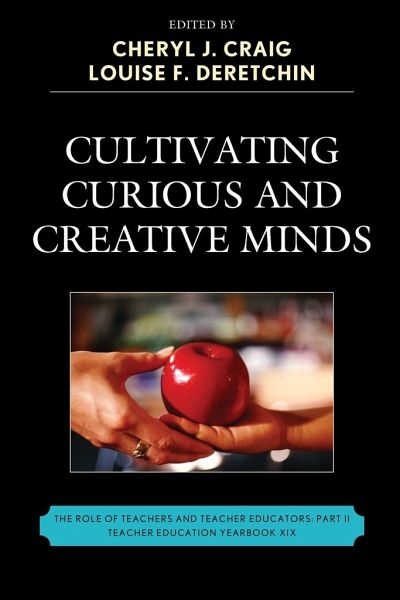
Presents a plethora of approaches to developing human potential in areas not conventionally addressed. Organized in two parts, this international collection of essays provides viable educational alternatives to those currently holding sway in an era of high-stakes accountability.
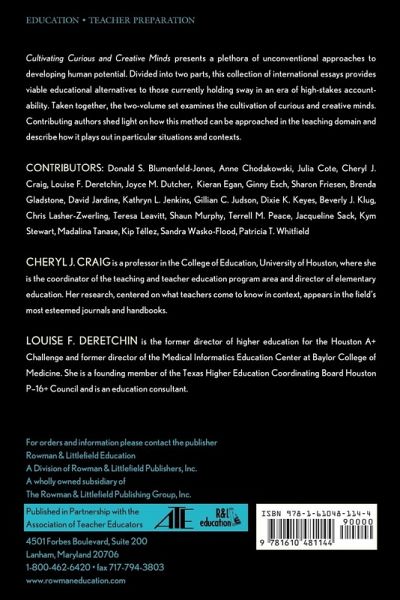
Presents a plethora of approaches to developing human potential in areas not conventionally addressed. Organized in two parts, this international collection of essays provides viable educational alternatives to those currently holding sway in an era of high-stakes accountability.
Cheryl J. Craig is a professor in the College of Education, University of Houston, where she is the coordinator of the eaching and teacher education program area and director of elementary education. Her research, centered on what teachers come to know in context, appears in the field's most esteemed journals and handbooks. Louise F. Deretchin is the former director of higher education for the Houston A+ Challenge and former director of the Medical Informatics Education Center at Baylor College of Medicine. She is a founding member of the Texas Higher Education Coordinating Board Houston P-16+ Council and is currently an education consultant.
Inhaltsangabe
Chapter 1 Foreword Chapter 2 Introduction Part 3 Division 1: Teacher Education Chapter 4 Overview and Framework Chapter 5 1. Some Neglected Components of Teacher Education Programs Chapter 6 2. Fostering Creativity and Aesthetic Consciousness in Teachers: Theory and Practice Chapter 7 3. Sunshine and Shadows: Opening Spaces for Creativity, Metaphor, and Paradox in Teaching and Teacher Education Chapter 8 4. No Less ìRealî in My Mind: Using Fiction as Creative Curriculum in an Undergraduate Teacher Education Course Chapter 9 5. The Power of Art in Observation Chapter 10 Summary and Implications Part 11 Division 2: Students/Programs/Schools Chapter 12 Overview and Framework Chapter 13 6. Young Children: Creativity in the Classroom Chapter 14 7. Arts-Based Education and Creativity Chapter 15 8. Labyrinths for Creativity and Peace in Schools Chapter 16 9. A Mind with a View: Education Through the Kaleidoscopic Lenses of the Arts Chapter 17 10. The First Thunder Clap of Spring: An Invitation Into Aboriginal Ways of Knowing and the Creative Possibilities of Digital Technologies Chapter 18 11. Fostering Creative Minds through Problem-Solving in a 3-D Visualization Design Research Program Chapter 19 12. A Report on the Introduction and Resulting Effects of Novel Teaching Strategies in Increasing Creativity and Independent Thought Chapter 20 13. Poetry from Report Cards: Childrenís Understanding of Themselves in Relationship with Their Teachers Chapter 21 Summary and Implications Chapter 22 Afterword
Chapter 1 Foreword Chapter 2 Introduction Part 3 Division 1: Teacher Education Chapter 4 Overview and Framework Chapter 5 1. Some Neglected Components of Teacher Education Programs Chapter 6 2. Fostering Creativity and Aesthetic Consciousness in Teachers: Theory and Practice Chapter 7 3. Sunshine and Shadows: Opening Spaces for Creativity, Metaphor, and Paradox in Teaching and Teacher Education Chapter 8 4. No Less ìRealî in My Mind: Using Fiction as Creative Curriculum in an Undergraduate Teacher Education Course Chapter 9 5. The Power of Art in Observation Chapter 10 Summary and Implications Part 11 Division 2: Students/Programs/Schools Chapter 12 Overview and Framework Chapter 13 6. Young Children: Creativity in the Classroom Chapter 14 7. Arts-Based Education and Creativity Chapter 15 8. Labyrinths for Creativity and Peace in Schools Chapter 16 9. A Mind with a View: Education Through the Kaleidoscopic Lenses of the Arts Chapter 17 10. The First Thunder Clap of Spring: An Invitation Into Aboriginal Ways of Knowing and the Creative Possibilities of Digital Technologies Chapter 18 11. Fostering Creative Minds through Problem-Solving in a 3-D Visualization Design Research Program Chapter 19 12. A Report on the Introduction and Resulting Effects of Novel Teaching Strategies in Increasing Creativity and Independent Thought Chapter 20 13. Poetry from Report Cards: Childrenís Understanding of Themselves in Relationship with Their Teachers Chapter 21 Summary and Implications Chapter 22 Afterword
Es gelten unsere Allgemeinen Geschäftsbedingungen: www.buecher.de/agb
Impressum
www.buecher.de ist ein Internetauftritt der buecher.de internetstores GmbH
Geschäftsführung: Monica Sawhney | Roland Kölbl | Günter Hilger
Sitz der Gesellschaft: Batheyer Straße 115 - 117, 58099 Hagen
Postanschrift: Bürgermeister-Wegele-Str. 12, 86167 Augsburg
Amtsgericht Hagen HRB 13257
Steuernummer: 321/5800/1497
USt-IdNr: DE450055826