
Sean Franzel, Michael Swellander, Volker Mergenthaler, Christiane Arndt, Nicholas SaulA Critical Anthology
Cultural Journalism in Germany, 1815-1848
A Critical Anthology
Herausgeber: Franzel, Sean; Swellander, Michael
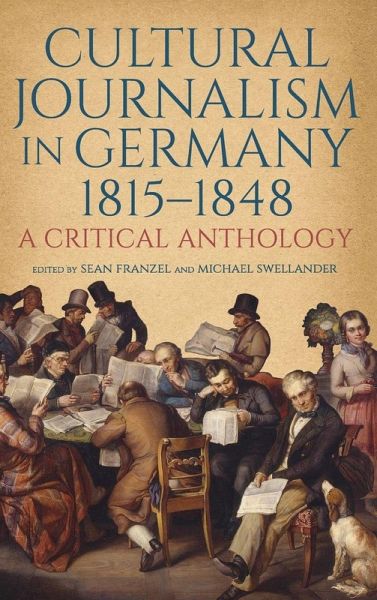
Sean Franzel, Michael Swellander, Volker Mergenthaler, Christiane Arndt, Nicholas SaulA Critical Anthology
Cultural Journalism in Germany, 1815-1848
A Critical Anthology
Herausgeber: Franzel, Sean; Swellander, Michael
- Gebundenes Buch
- Merkliste
- Auf die Merkliste
- Bewerten Bewerten
- Teilen
- Produkt teilen
- Produkterinnerung
- Produkterinnerung
The first critical anthology of major programmatic texts of cultural journalism from the crucial period known in Germany as the Vormà rz, the time before the March Revolutions of 1848.
Andere Kunden interessierten sich auch für
 Professor William Carr (University of Sheffie Professor of HistoryA History of Germany, 1800 to the Present124,99 €
 The Period of Transition 1815-1848") Edward ChanningA history of the United States (Volume V) The Period of Transition 1815-184830,99 €
Edward ChanningA history of the United States (Volume V) The Period of Transition 1815-184830,99 € Matthew Stibbe (UK Sheffield Hallam University)Germany, 1914-193353,99 €
 Professor William Carr (University of Sheffie Professor of HistoryA History of Germany, 1800 to the Present49,99 €
 Maxine BergThe Machinery Question and the Making of Political Economy 1815 184862,99 €
 Dr Meike G. Werner (Royalty Account)Germany's Other Modernism106,99 €
 Rainer Maria RilkeRainer Maria Rilke's the Book of Hours34,99 €
-
-
-





The first critical anthology of major programmatic texts of cultural journalism from the crucial period known in Germany as the Vormà rz, the time before the March Revolutions of 1848.
Produktdetails
- Produktdetails
- Studies in German Literature Linguistics and Culture
- Verlag: Boydell & Brewer Ltd
- Seitenzahl: 442
- Erscheinungstermin: 15. Juli 2025
- Englisch
- Abmessung: 235mm x 157mm x 28mm
- Gewicht: 752g
- ISBN-13: 9781640141735
- ISBN-10: 1640141731
- Artikelnr.: 73495509
- Herstellerkennzeichnung
- Libri GmbH
- Europaallee 1
- 36244 Bad Hersfeld
- gpsr@libri.de
- Studies in German Literature Linguistics and Culture
- Verlag: Boydell & Brewer Ltd
- Seitenzahl: 442
- Erscheinungstermin: 15. Juli 2025
- Englisch
- Abmessung: 235mm x 157mm x 28mm
- Gewicht: 752g
- ISBN-13: 9781640141735
- ISBN-10: 1640141731
- Artikelnr.: 73495509
- Herstellerkennzeichnung
- Libri GmbH
- Europaallee 1
- 36244 Bad Hersfeld
- gpsr@libri.de
Edited by Sean Franzel and Michael Swellander
List of Figures Acknowledgments Introduction - Sean Franzel and Michael
Swellander I. NEW BEGINNINGS: JOURNALISTIC PROGRAMS 1. J. F. Cotta recruits
Jean Paul to contribute to the inaugural issue of a new belletristic
journal and Jean Paul offers readers a vision of its end (1807) - Sean
Franzel Jean Paul, "Farewell Speech on the Occasion of the Future End of
the Morning Pages" 2. The Berlin Evening Pages takes to the stage of Berlin
publishing (1810) - Volker Mergenthaler Heinrich von Kleist, "Introduction"
3. Joseph von Görres exhorts the German press to cultivate an independent
spirit (1814) - Sean Franzel Joseph Görres, "The German Newspapers" 4.
Lorenz Oken evaluates the current situation of scientific review journals
in Isis or Encyclopedic Journal (1818) - Christiane Arndt and Nicholas Saul
Lorenz Oken, "On Criticism and Review Journals" 5. Ludwig Börne elaborates
his vision of a public sphere where nothing is off limits (1818) - Michael
Swellander Ludwig Börne, "Introduction" to The Scale 6. Johann Peter Hebel
returns to editing his yearly calendar The Rhenish Family Friend after a
four-year absence (1819) - Michael Swellander and Ilinca Iurascu Johann
Peter Hebel, "The Rhenish Family Friend's Preface" II. EDITING, CRITICISM,
AND THE BUSINESS OF JOURNAL LITERATURE 7. Helmine von Chézy reports from
Napoleonic France and highlights the achievements of women writers (1803,
1805, 1820) - Karin Baumgartner Helmine von Chézy, Introductions to French
Miscellanies Life and Art in Paris Iduna 8. F.A. Brockhaus surveys the
market for yearly anthologies in his Conversations-Lexicon and advertises
his own print products in the process (1820) - Nicola Kaminski Friedrich
Arnold Brockhaus, "Pocketbook and Almanac Literature in Germany" 9. The
Polytechnic Journal advertises new high-speed printing technology for the
uneven German print market (1826) - Petra S. McGillen Andreas Bauer and
Friedrich Koenig, "High Speed Presses of Mssrs. Bauer and König in Oberzell
near Würzburg" 10. Wilhelm Hauff picks apart contemporary belletristic
journals (1827) - Petra S. McGillen Wilhelm Hauff, "The Belletristic
Journals in Germany" 11. Willibald Alexis offers readers topics for
conversation about present-day Berlin (1831, 1838) - Lynne Tatlock
Willibald Alexis, "Walks through Berlin" "Berlin in its New Form" 12. In
his satirical entertainment journal Berliner Don Quixote, Adolf Glaßbrenner
digs graves for journals and anticipates the burial of his own (1832-33) -
Carlos Spoerhase and Pauline Solvi Adolph Glaßbrenner, "The Graveyard of
Journals" Final Article from Berliner Don Quixote 13. The publishers Carl
Joseph Meyer and Philipp Jakob Siebenpfeiffer attempt different journal
projects in the face of censorship (1830s) - Kirsten Belgum Carl Joseph
Meyer and Philipp Jakob Siebenpfeiffer, selections from The House Friend
and The People's Friend 14. Ernst Keil founds the revolutionary journal
The Lighthouse before turning to the less political format of the domestic
journal The Garden Arbor (1846, 1853) - Kirsten Belgum Ernst Keil,
selections from The Lighthouse and The Garden Arbor (with Ferdinand Stolle)
15. Karl Gutzkow skeptically evaluates contemporary illustrated journal
literature (1834) - Shane D. Peterson Karl Gutzkow, "Penny Literature" 16.
Heinrich von Kleist's Berlin Evening Pages anticipates the journalistic
applications of telegraphy almost forty years before the technology is
introduced for the first time in German newspaper publishing (1810) - Jake
Fraser Heinrich von Kleist, "Useful Inventions: Proposal for a Projectile
Post" Bernhard Wolff, announcement of introduction of telegraphic
dispatches (1849) III. JOURNALISM AS CROSS-CULTURAL COMMUNICATION 17.
Johann Wolfgang von Goethe insists on journals' role in the development of
world literature (1828) - Daniel Purdy Johann Wolfgang von Goethe, "Foreign
Relations" 18. Therese Huber leaves her mark on the Morning Pages for the
Educated Classes as editor and contributor (1817) - Christine Lehleiter
Letters from Therese Huber to Paul Usteri Therese Huber, "Can a Female
Novelist Depict Men, and Is a Man Fit to Serve as the Hero of a Novel?" 19.
August Lewald and Gustav Kühne introduce European society to Germany in
Europe, Chronicle of the Educated World (1836-1846) - Nora Ramtke August
Lewald, selections from Europe F. Gustav Kühne, "Foreword," Europe (1846)
20. From Parisian exile, Arnold Ruge sees the future of political discourse
in journals rather than books (1844) - Michael Bies Arnold Ruge, "Plan for
the German-French Yearbooks" 21. Heinrich Börnstein publishes a new journal
in Paris for German émigrés (1843) - Sean Franzel Heinrich Börnstein,
selections from Forward! IV. JOURNALISM UNDER CENSORSHIP AND POLITICAL
EMANCIPATION 22. The German Confederation, and then the Grand Duchy of
Baden, pass press laws of differing liberality (1819 and 1831) - David
Meola The Press Law of the German Federal Assembly, Sept. 20, 1819 Press
Law for the Grand Duchy of Baden, December 28, 1832 23. From beyond the
grave,August von Kotzebue writes letters to the editor of the Literary
Weekly critiquing censorship (1820) - Nora Ramtke Adolph Müllner, fictional
letters as August Kotzebue 24. Karl Gutzkow, banned from publishing in
Prussia, considers a practical approach to censorship (1837) - Michael
Swellander Karl Gutzkow, "Articles of a Censorship Code" 25. Ludwig
Philippson introduces his new newspaper as an impartial organ for all
Jewish interests (1837) - Andreas Brämer Ludwig Philippson, "On Our
Editorial Principles" 26. Louise Aston asserts her "free personality"
against the Berlin press (1846) - Viktorija Bili¿ Louise Aston, excerpts
from My Emancipation, Expulsion, and Defense V. JOURNALISM AS HISTORY AND
THE HISTORY OF JOURNALISM 27. Heinrich Heine begins, and abruptly abandons,
a historical writing project on the origins of the French Revolution (1832)
- Michael Swellander Heinrich Heine, selections from Conditions in France
28. A new works edition presents Friedrich von Gentz, a figurehead of the
Restoration establishment, as a classic German journalist-author (1832) -
Sean Franzel Gustav Schlesier, "Introduction to the Writings of Gentz" 29.
Heinrich Heine eulogizes the German-Jewish writer Ludwig Marcus and the
Society for Jewish Culture and Jewish Studies (1844) - David Meola
Heinrich Heine, "Remembrances" 30. Robert Prutz begins his history of
German journalism in search of "the most obscured veins of our times"
(1845) - Johannes F. Lehmann Robert Prutz, introduction, History of German
Journalism 31. Heinrich Börnstein looks back on a journalistic career in
Europe and North America (1881) - Sean Franzel Heinrich Börnstein,
"Journalistic Activities," Memoirs Index
Swellander I. NEW BEGINNINGS: JOURNALISTIC PROGRAMS 1. J. F. Cotta recruits
Jean Paul to contribute to the inaugural issue of a new belletristic
journal and Jean Paul offers readers a vision of its end (1807) - Sean
Franzel Jean Paul, "Farewell Speech on the Occasion of the Future End of
the Morning Pages" 2. The Berlin Evening Pages takes to the stage of Berlin
publishing (1810) - Volker Mergenthaler Heinrich von Kleist, "Introduction"
3. Joseph von Görres exhorts the German press to cultivate an independent
spirit (1814) - Sean Franzel Joseph Görres, "The German Newspapers" 4.
Lorenz Oken evaluates the current situation of scientific review journals
in Isis or Encyclopedic Journal (1818) - Christiane Arndt and Nicholas Saul
Lorenz Oken, "On Criticism and Review Journals" 5. Ludwig Börne elaborates
his vision of a public sphere where nothing is off limits (1818) - Michael
Swellander Ludwig Börne, "Introduction" to The Scale 6. Johann Peter Hebel
returns to editing his yearly calendar The Rhenish Family Friend after a
four-year absence (1819) - Michael Swellander and Ilinca Iurascu Johann
Peter Hebel, "The Rhenish Family Friend's Preface" II. EDITING, CRITICISM,
AND THE BUSINESS OF JOURNAL LITERATURE 7. Helmine von Chézy reports from
Napoleonic France and highlights the achievements of women writers (1803,
1805, 1820) - Karin Baumgartner Helmine von Chézy, Introductions to French
Miscellanies Life and Art in Paris Iduna 8. F.A. Brockhaus surveys the
market for yearly anthologies in his Conversations-Lexicon and advertises
his own print products in the process (1820) - Nicola Kaminski Friedrich
Arnold Brockhaus, "Pocketbook and Almanac Literature in Germany" 9. The
Polytechnic Journal advertises new high-speed printing technology for the
uneven German print market (1826) - Petra S. McGillen Andreas Bauer and
Friedrich Koenig, "High Speed Presses of Mssrs. Bauer and König in Oberzell
near Würzburg" 10. Wilhelm Hauff picks apart contemporary belletristic
journals (1827) - Petra S. McGillen Wilhelm Hauff, "The Belletristic
Journals in Germany" 11. Willibald Alexis offers readers topics for
conversation about present-day Berlin (1831, 1838) - Lynne Tatlock
Willibald Alexis, "Walks through Berlin" "Berlin in its New Form" 12. In
his satirical entertainment journal Berliner Don Quixote, Adolf Glaßbrenner
digs graves for journals and anticipates the burial of his own (1832-33) -
Carlos Spoerhase and Pauline Solvi Adolph Glaßbrenner, "The Graveyard of
Journals" Final Article from Berliner Don Quixote 13. The publishers Carl
Joseph Meyer and Philipp Jakob Siebenpfeiffer attempt different journal
projects in the face of censorship (1830s) - Kirsten Belgum Carl Joseph
Meyer and Philipp Jakob Siebenpfeiffer, selections from The House Friend
and The People's Friend 14. Ernst Keil founds the revolutionary journal
The Lighthouse before turning to the less political format of the domestic
journal The Garden Arbor (1846, 1853) - Kirsten Belgum Ernst Keil,
selections from The Lighthouse and The Garden Arbor (with Ferdinand Stolle)
15. Karl Gutzkow skeptically evaluates contemporary illustrated journal
literature (1834) - Shane D. Peterson Karl Gutzkow, "Penny Literature" 16.
Heinrich von Kleist's Berlin Evening Pages anticipates the journalistic
applications of telegraphy almost forty years before the technology is
introduced for the first time in German newspaper publishing (1810) - Jake
Fraser Heinrich von Kleist, "Useful Inventions: Proposal for a Projectile
Post" Bernhard Wolff, announcement of introduction of telegraphic
dispatches (1849) III. JOURNALISM AS CROSS-CULTURAL COMMUNICATION 17.
Johann Wolfgang von Goethe insists on journals' role in the development of
world literature (1828) - Daniel Purdy Johann Wolfgang von Goethe, "Foreign
Relations" 18. Therese Huber leaves her mark on the Morning Pages for the
Educated Classes as editor and contributor (1817) - Christine Lehleiter
Letters from Therese Huber to Paul Usteri Therese Huber, "Can a Female
Novelist Depict Men, and Is a Man Fit to Serve as the Hero of a Novel?" 19.
August Lewald and Gustav Kühne introduce European society to Germany in
Europe, Chronicle of the Educated World (1836-1846) - Nora Ramtke August
Lewald, selections from Europe F. Gustav Kühne, "Foreword," Europe (1846)
20. From Parisian exile, Arnold Ruge sees the future of political discourse
in journals rather than books (1844) - Michael Bies Arnold Ruge, "Plan for
the German-French Yearbooks" 21. Heinrich Börnstein publishes a new journal
in Paris for German émigrés (1843) - Sean Franzel Heinrich Börnstein,
selections from Forward! IV. JOURNALISM UNDER CENSORSHIP AND POLITICAL
EMANCIPATION 22. The German Confederation, and then the Grand Duchy of
Baden, pass press laws of differing liberality (1819 and 1831) - David
Meola The Press Law of the German Federal Assembly, Sept. 20, 1819 Press
Law for the Grand Duchy of Baden, December 28, 1832 23. From beyond the
grave,August von Kotzebue writes letters to the editor of the Literary
Weekly critiquing censorship (1820) - Nora Ramtke Adolph Müllner, fictional
letters as August Kotzebue 24. Karl Gutzkow, banned from publishing in
Prussia, considers a practical approach to censorship (1837) - Michael
Swellander Karl Gutzkow, "Articles of a Censorship Code" 25. Ludwig
Philippson introduces his new newspaper as an impartial organ for all
Jewish interests (1837) - Andreas Brämer Ludwig Philippson, "On Our
Editorial Principles" 26. Louise Aston asserts her "free personality"
against the Berlin press (1846) - Viktorija Bili¿ Louise Aston, excerpts
from My Emancipation, Expulsion, and Defense V. JOURNALISM AS HISTORY AND
THE HISTORY OF JOURNALISM 27. Heinrich Heine begins, and abruptly abandons,
a historical writing project on the origins of the French Revolution (1832)
- Michael Swellander Heinrich Heine, selections from Conditions in France
28. A new works edition presents Friedrich von Gentz, a figurehead of the
Restoration establishment, as a classic German journalist-author (1832) -
Sean Franzel Gustav Schlesier, "Introduction to the Writings of Gentz" 29.
Heinrich Heine eulogizes the German-Jewish writer Ludwig Marcus and the
Society for Jewish Culture and Jewish Studies (1844) - David Meola
Heinrich Heine, "Remembrances" 30. Robert Prutz begins his history of
German journalism in search of "the most obscured veins of our times"
(1845) - Johannes F. Lehmann Robert Prutz, introduction, History of German
Journalism 31. Heinrich Börnstein looks back on a journalistic career in
Europe and North America (1881) - Sean Franzel Heinrich Börnstein,
"Journalistic Activities," Memoirs Index
List of Figures Acknowledgments Introduction - Sean Franzel and Michael
Swellander I. NEW BEGINNINGS: JOURNALISTIC PROGRAMS 1. J. F. Cotta recruits
Jean Paul to contribute to the inaugural issue of a new belletristic
journal and Jean Paul offers readers a vision of its end (1807) - Sean
Franzel Jean Paul, "Farewell Speech on the Occasion of the Future End of
the Morning Pages" 2. The Berlin Evening Pages takes to the stage of Berlin
publishing (1810) - Volker Mergenthaler Heinrich von Kleist, "Introduction"
3. Joseph von Görres exhorts the German press to cultivate an independent
spirit (1814) - Sean Franzel Joseph Görres, "The German Newspapers" 4.
Lorenz Oken evaluates the current situation of scientific review journals
in Isis or Encyclopedic Journal (1818) - Christiane Arndt and Nicholas Saul
Lorenz Oken, "On Criticism and Review Journals" 5. Ludwig Börne elaborates
his vision of a public sphere where nothing is off limits (1818) - Michael
Swellander Ludwig Börne, "Introduction" to The Scale 6. Johann Peter Hebel
returns to editing his yearly calendar The Rhenish Family Friend after a
four-year absence (1819) - Michael Swellander and Ilinca Iurascu Johann
Peter Hebel, "The Rhenish Family Friend's Preface" II. EDITING, CRITICISM,
AND THE BUSINESS OF JOURNAL LITERATURE 7. Helmine von Chézy reports from
Napoleonic France and highlights the achievements of women writers (1803,
1805, 1820) - Karin Baumgartner Helmine von Chézy, Introductions to French
Miscellanies Life and Art in Paris Iduna 8. F.A. Brockhaus surveys the
market for yearly anthologies in his Conversations-Lexicon and advertises
his own print products in the process (1820) - Nicola Kaminski Friedrich
Arnold Brockhaus, "Pocketbook and Almanac Literature in Germany" 9. The
Polytechnic Journal advertises new high-speed printing technology for the
uneven German print market (1826) - Petra S. McGillen Andreas Bauer and
Friedrich Koenig, "High Speed Presses of Mssrs. Bauer and König in Oberzell
near Würzburg" 10. Wilhelm Hauff picks apart contemporary belletristic
journals (1827) - Petra S. McGillen Wilhelm Hauff, "The Belletristic
Journals in Germany" 11. Willibald Alexis offers readers topics for
conversation about present-day Berlin (1831, 1838) - Lynne Tatlock
Willibald Alexis, "Walks through Berlin" "Berlin in its New Form" 12. In
his satirical entertainment journal Berliner Don Quixote, Adolf Glaßbrenner
digs graves for journals and anticipates the burial of his own (1832-33) -
Carlos Spoerhase and Pauline Solvi Adolph Glaßbrenner, "The Graveyard of
Journals" Final Article from Berliner Don Quixote 13. The publishers Carl
Joseph Meyer and Philipp Jakob Siebenpfeiffer attempt different journal
projects in the face of censorship (1830s) - Kirsten Belgum Carl Joseph
Meyer and Philipp Jakob Siebenpfeiffer, selections from The House Friend
and The People's Friend 14. Ernst Keil founds the revolutionary journal
The Lighthouse before turning to the less political format of the domestic
journal The Garden Arbor (1846, 1853) - Kirsten Belgum Ernst Keil,
selections from The Lighthouse and The Garden Arbor (with Ferdinand Stolle)
15. Karl Gutzkow skeptically evaluates contemporary illustrated journal
literature (1834) - Shane D. Peterson Karl Gutzkow, "Penny Literature" 16.
Heinrich von Kleist's Berlin Evening Pages anticipates the journalistic
applications of telegraphy almost forty years before the technology is
introduced for the first time in German newspaper publishing (1810) - Jake
Fraser Heinrich von Kleist, "Useful Inventions: Proposal for a Projectile
Post" Bernhard Wolff, announcement of introduction of telegraphic
dispatches (1849) III. JOURNALISM AS CROSS-CULTURAL COMMUNICATION 17.
Johann Wolfgang von Goethe insists on journals' role in the development of
world literature (1828) - Daniel Purdy Johann Wolfgang von Goethe, "Foreign
Relations" 18. Therese Huber leaves her mark on the Morning Pages for the
Educated Classes as editor and contributor (1817) - Christine Lehleiter
Letters from Therese Huber to Paul Usteri Therese Huber, "Can a Female
Novelist Depict Men, and Is a Man Fit to Serve as the Hero of a Novel?" 19.
August Lewald and Gustav Kühne introduce European society to Germany in
Europe, Chronicle of the Educated World (1836-1846) - Nora Ramtke August
Lewald, selections from Europe F. Gustav Kühne, "Foreword," Europe (1846)
20. From Parisian exile, Arnold Ruge sees the future of political discourse
in journals rather than books (1844) - Michael Bies Arnold Ruge, "Plan for
the German-French Yearbooks" 21. Heinrich Börnstein publishes a new journal
in Paris for German émigrés (1843) - Sean Franzel Heinrich Börnstein,
selections from Forward! IV. JOURNALISM UNDER CENSORSHIP AND POLITICAL
EMANCIPATION 22. The German Confederation, and then the Grand Duchy of
Baden, pass press laws of differing liberality (1819 and 1831) - David
Meola The Press Law of the German Federal Assembly, Sept. 20, 1819 Press
Law for the Grand Duchy of Baden, December 28, 1832 23. From beyond the
grave,August von Kotzebue writes letters to the editor of the Literary
Weekly critiquing censorship (1820) - Nora Ramtke Adolph Müllner, fictional
letters as August Kotzebue 24. Karl Gutzkow, banned from publishing in
Prussia, considers a practical approach to censorship (1837) - Michael
Swellander Karl Gutzkow, "Articles of a Censorship Code" 25. Ludwig
Philippson introduces his new newspaper as an impartial organ for all
Jewish interests (1837) - Andreas Brämer Ludwig Philippson, "On Our
Editorial Principles" 26. Louise Aston asserts her "free personality"
against the Berlin press (1846) - Viktorija Bili¿ Louise Aston, excerpts
from My Emancipation, Expulsion, and Defense V. JOURNALISM AS HISTORY AND
THE HISTORY OF JOURNALISM 27. Heinrich Heine begins, and abruptly abandons,
a historical writing project on the origins of the French Revolution (1832)
- Michael Swellander Heinrich Heine, selections from Conditions in France
28. A new works edition presents Friedrich von Gentz, a figurehead of the
Restoration establishment, as a classic German journalist-author (1832) -
Sean Franzel Gustav Schlesier, "Introduction to the Writings of Gentz" 29.
Heinrich Heine eulogizes the German-Jewish writer Ludwig Marcus and the
Society for Jewish Culture and Jewish Studies (1844) - David Meola
Heinrich Heine, "Remembrances" 30. Robert Prutz begins his history of
German journalism in search of "the most obscured veins of our times"
(1845) - Johannes F. Lehmann Robert Prutz, introduction, History of German
Journalism 31. Heinrich Börnstein looks back on a journalistic career in
Europe and North America (1881) - Sean Franzel Heinrich Börnstein,
"Journalistic Activities," Memoirs Index
Swellander I. NEW BEGINNINGS: JOURNALISTIC PROGRAMS 1. J. F. Cotta recruits
Jean Paul to contribute to the inaugural issue of a new belletristic
journal and Jean Paul offers readers a vision of its end (1807) - Sean
Franzel Jean Paul, "Farewell Speech on the Occasion of the Future End of
the Morning Pages" 2. The Berlin Evening Pages takes to the stage of Berlin
publishing (1810) - Volker Mergenthaler Heinrich von Kleist, "Introduction"
3. Joseph von Görres exhorts the German press to cultivate an independent
spirit (1814) - Sean Franzel Joseph Görres, "The German Newspapers" 4.
Lorenz Oken evaluates the current situation of scientific review journals
in Isis or Encyclopedic Journal (1818) - Christiane Arndt and Nicholas Saul
Lorenz Oken, "On Criticism and Review Journals" 5. Ludwig Börne elaborates
his vision of a public sphere where nothing is off limits (1818) - Michael
Swellander Ludwig Börne, "Introduction" to The Scale 6. Johann Peter Hebel
returns to editing his yearly calendar The Rhenish Family Friend after a
four-year absence (1819) - Michael Swellander and Ilinca Iurascu Johann
Peter Hebel, "The Rhenish Family Friend's Preface" II. EDITING, CRITICISM,
AND THE BUSINESS OF JOURNAL LITERATURE 7. Helmine von Chézy reports from
Napoleonic France and highlights the achievements of women writers (1803,
1805, 1820) - Karin Baumgartner Helmine von Chézy, Introductions to French
Miscellanies Life and Art in Paris Iduna 8. F.A. Brockhaus surveys the
market for yearly anthologies in his Conversations-Lexicon and advertises
his own print products in the process (1820) - Nicola Kaminski Friedrich
Arnold Brockhaus, "Pocketbook and Almanac Literature in Germany" 9. The
Polytechnic Journal advertises new high-speed printing technology for the
uneven German print market (1826) - Petra S. McGillen Andreas Bauer and
Friedrich Koenig, "High Speed Presses of Mssrs. Bauer and König in Oberzell
near Würzburg" 10. Wilhelm Hauff picks apart contemporary belletristic
journals (1827) - Petra S. McGillen Wilhelm Hauff, "The Belletristic
Journals in Germany" 11. Willibald Alexis offers readers topics for
conversation about present-day Berlin (1831, 1838) - Lynne Tatlock
Willibald Alexis, "Walks through Berlin" "Berlin in its New Form" 12. In
his satirical entertainment journal Berliner Don Quixote, Adolf Glaßbrenner
digs graves for journals and anticipates the burial of his own (1832-33) -
Carlos Spoerhase and Pauline Solvi Adolph Glaßbrenner, "The Graveyard of
Journals" Final Article from Berliner Don Quixote 13. The publishers Carl
Joseph Meyer and Philipp Jakob Siebenpfeiffer attempt different journal
projects in the face of censorship (1830s) - Kirsten Belgum Carl Joseph
Meyer and Philipp Jakob Siebenpfeiffer, selections from The House Friend
and The People's Friend 14. Ernst Keil founds the revolutionary journal
The Lighthouse before turning to the less political format of the domestic
journal The Garden Arbor (1846, 1853) - Kirsten Belgum Ernst Keil,
selections from The Lighthouse and The Garden Arbor (with Ferdinand Stolle)
15. Karl Gutzkow skeptically evaluates contemporary illustrated journal
literature (1834) - Shane D. Peterson Karl Gutzkow, "Penny Literature" 16.
Heinrich von Kleist's Berlin Evening Pages anticipates the journalistic
applications of telegraphy almost forty years before the technology is
introduced for the first time in German newspaper publishing (1810) - Jake
Fraser Heinrich von Kleist, "Useful Inventions: Proposal for a Projectile
Post" Bernhard Wolff, announcement of introduction of telegraphic
dispatches (1849) III. JOURNALISM AS CROSS-CULTURAL COMMUNICATION 17.
Johann Wolfgang von Goethe insists on journals' role in the development of
world literature (1828) - Daniel Purdy Johann Wolfgang von Goethe, "Foreign
Relations" 18. Therese Huber leaves her mark on the Morning Pages for the
Educated Classes as editor and contributor (1817) - Christine Lehleiter
Letters from Therese Huber to Paul Usteri Therese Huber, "Can a Female
Novelist Depict Men, and Is a Man Fit to Serve as the Hero of a Novel?" 19.
August Lewald and Gustav Kühne introduce European society to Germany in
Europe, Chronicle of the Educated World (1836-1846) - Nora Ramtke August
Lewald, selections from Europe F. Gustav Kühne, "Foreword," Europe (1846)
20. From Parisian exile, Arnold Ruge sees the future of political discourse
in journals rather than books (1844) - Michael Bies Arnold Ruge, "Plan for
the German-French Yearbooks" 21. Heinrich Börnstein publishes a new journal
in Paris for German émigrés (1843) - Sean Franzel Heinrich Börnstein,
selections from Forward! IV. JOURNALISM UNDER CENSORSHIP AND POLITICAL
EMANCIPATION 22. The German Confederation, and then the Grand Duchy of
Baden, pass press laws of differing liberality (1819 and 1831) - David
Meola The Press Law of the German Federal Assembly, Sept. 20, 1819 Press
Law for the Grand Duchy of Baden, December 28, 1832 23. From beyond the
grave,August von Kotzebue writes letters to the editor of the Literary
Weekly critiquing censorship (1820) - Nora Ramtke Adolph Müllner, fictional
letters as August Kotzebue 24. Karl Gutzkow, banned from publishing in
Prussia, considers a practical approach to censorship (1837) - Michael
Swellander Karl Gutzkow, "Articles of a Censorship Code" 25. Ludwig
Philippson introduces his new newspaper as an impartial organ for all
Jewish interests (1837) - Andreas Brämer Ludwig Philippson, "On Our
Editorial Principles" 26. Louise Aston asserts her "free personality"
against the Berlin press (1846) - Viktorija Bili¿ Louise Aston, excerpts
from My Emancipation, Expulsion, and Defense V. JOURNALISM AS HISTORY AND
THE HISTORY OF JOURNALISM 27. Heinrich Heine begins, and abruptly abandons,
a historical writing project on the origins of the French Revolution (1832)
- Michael Swellander Heinrich Heine, selections from Conditions in France
28. A new works edition presents Friedrich von Gentz, a figurehead of the
Restoration establishment, as a classic German journalist-author (1832) -
Sean Franzel Gustav Schlesier, "Introduction to the Writings of Gentz" 29.
Heinrich Heine eulogizes the German-Jewish writer Ludwig Marcus and the
Society for Jewish Culture and Jewish Studies (1844) - David Meola
Heinrich Heine, "Remembrances" 30. Robert Prutz begins his history of
German journalism in search of "the most obscured veins of our times"
(1845) - Johannes F. Lehmann Robert Prutz, introduction, History of German
Journalism 31. Heinrich Börnstein looks back on a journalistic career in
Europe and North America (1881) - Sean Franzel Heinrich Börnstein,
"Journalistic Activities," Memoirs Index