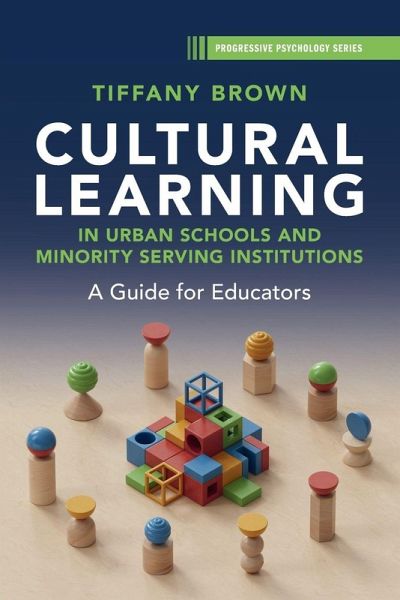
This book examines how K-16 educators in urban schools and minority-serving institutions (MSIs) navigate student-teacher cultural differences. It addresses the psychological impact of these differences on educators as they learn, often independently, to manage diverse classrooms and foster more effective student-teacher relationships in real time.
This book examines how K-16 educators in urban schools and minority-serving institutions (MSIs) navigate student-teacher cultural differences. It addresses the psychological impact of these differences on educators as they learn, often independently, to manage diverse classrooms and foster more effective student-teacher relationships in real time.
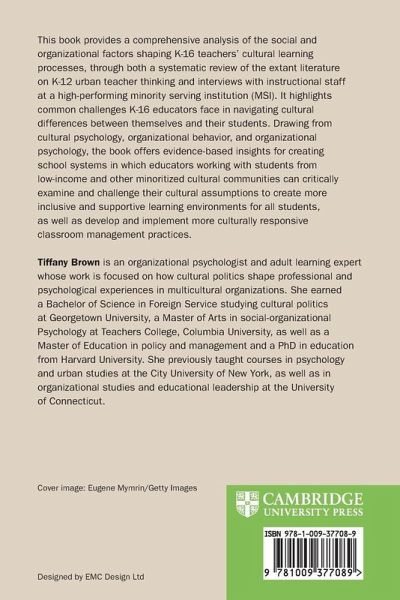
Tiffany Brown is an organizational psychologist and adult learning expert whose work is focused on how cultural politics shape professional and psychological experiences in multicultural organizations. She earned a Bachelor of Science in Foreign Service studying cultural politics at Georgetown University, a Master of Arts in social-organizational psychology at Teachers College, Columbia University, as well as a Master of Education in policy and management and a PhD in Education from Harvard University. She previously taught courses in psychology and urban studies at the City University of New York, as well as in organizational studies and educational leadership at the University of Connecticut.
Inhaltsangabe
Introduction: how cultural learning matters for educators everywhere; 1. An action science approach to cultural learning in urban schools and minority serving institutions (MSIs); 2. Directly observable data on K-12 teachers in urban schools; 3. Culturally accepted meanings and understandings K-12 educators accept about students from MCCs; 4. Individual action strategies urban K-12 teachers use at work; 5. Collective action strategies urban teachers use for cultural learning at work; 6. Single-loop learning and double-loop learning conditions in urban schools; 7. Implications from the systematic review for four types of cultural learning K-12 urban teachers engage in at work; 8. Empirical research on college faculty thinking and action in MSIs; 9. Faculty value orientations for single-loop learning and double-loop learning at work with students from LIMCCS; 10. Consequences of model i and model ii values for learning across student-teacher cultural differences in MSIs; 11. Faculty variance in use of traditional and culturally responsive classroom management strategies; 12. Consequences of variance in use of traditional and culturally responsive classroom management strategies for learning across student-teacher differences in MSIs; 13. Implications from the empirical data for instructor learning across cultures in MSIs; Conclusion: reconciling the knowing-doing gap for K-16 Educators in urban schools and MSIs.
Introduction: how cultural learning matters for educators everywhere; 1. An action science approach to cultural learning in urban schools and minority serving institutions (MSIs); 2. Directly observable data on K-12 teachers in urban schools; 3. Culturally accepted meanings and understandings K-12 educators accept about students from MCCs; 4. Individual action strategies urban K-12 teachers use at work; 5. Collective action strategies urban teachers use for cultural learning at work; 6. Single-loop learning and double-loop learning conditions in urban schools; 7. Implications from the systematic review for four types of cultural learning K-12 urban teachers engage in at work; 8. Empirical research on college faculty thinking and action in MSIs; 9. Faculty value orientations for single-loop learning and double-loop learning at work with students from LIMCCS; 10. Consequences of model i and model ii values for learning across student-teacher cultural differences in MSIs; 11. Faculty variance in use of traditional and culturally responsive classroom management strategies; 12. Consequences of variance in use of traditional and culturally responsive classroom management strategies for learning across student-teacher differences in MSIs; 13. Implications from the empirical data for instructor learning across cultures in MSIs; Conclusion: reconciling the knowing-doing gap for K-16 Educators in urban schools and MSIs.
Es gelten unsere Allgemeinen Geschäftsbedingungen: www.buecher.de/agb
Impressum
www.buecher.de ist ein Internetauftritt der buecher.de internetstores GmbH
Geschäftsführung: Monica Sawhney | Roland Kölbl | Günter Hilger
Sitz der Gesellschaft: Batheyer Straße 115 - 117, 58099 Hagen
Postanschrift: Bürgermeister-Wegele-Str. 12, 86167 Augsburg
Amtsgericht Hagen HRB 13257
Steuernummer: 321/5800/1497
USt-IdNr: DE450055826