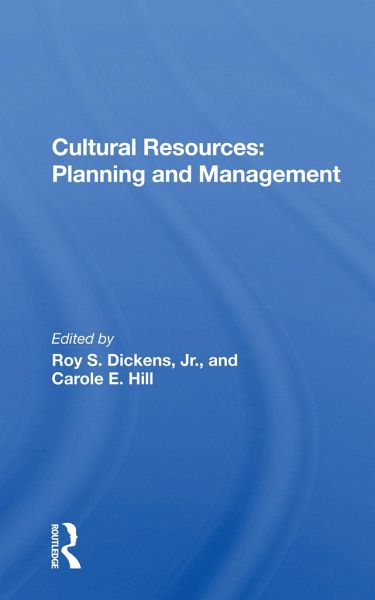
This book offers a wide range of perspectives from academia, private industry, and governmental agencies. It discusses how a resource is defined, legal and government requirements, and improved methods for implementing cultural resource studies and increasing public involvement.
This book offers a wide range of perspectives from academia, private industry, and governmental agencies. It discusses how a resource is defined, legal and government requirements, and improved methods for implementing cultural resource studies and increasing public involvement.
Roy S. Dickens, Jr., is associate professor of anthropology and director of the Laboratory of Archaeology at Georgia State University. Carole E. Hill is chairperson and associate professor in the Department of Anthropology, Georgia State University.
Inhaltsangabe
Part I: Definition of the Cultural Resource 1. Archaeology and Cultural Materials as a Resource 2. Planning for the Future with an Eye on the Past: The Value of Local Historical Resources 3. Folklore: An Endangered Cultural Resource? 4. Living Cultures and Cultural Resource Policy Part II: The Legal Process 5. Allegories of Eligibility: The Determination of Eligibility Process and the Capacity for Thought Among Archaeologists 6. The National Register of Historic Pieces and the Grants-in-Aid Program 7. The Environmental Review Process and Cultural Resources Management: A Case Study 8. Comprehensive Review and Governmental Requirements for Cultural Resource Planning and Management: A State Perspective 9. Cultural Resource Management and Nepa: The Perspective of an Urban Environmental Planner Part III: Expectations of Agency and Contractor 10. Agency/Contractor Interface: A Game of Strategy Played along the Social Structure of Contact 11. Experiences in Social Impact Assessment: The Anthropologist and the Agencies 12. Mitigation of Energy Facility Impacts: Opportunities for Cooperation Among Companies, Communities, and Anthropologists 13. Developing Proposals for Federal Research: Grant Versus Contract Part IV: Methods and Public Participation 14. Environmental Impact Studies in a Social Science Perspective: A Task Ahead 15. Understanding Impact: Visual Media and Reflexive Research 16. Family Impact Assessment: In Search of a Model 17. The Cultural Impact Statement 18. Public Participation Through Information Education Programs
Part I: Definition of the Cultural Resource 1. Archaeology and Cultural Materials as a Resource 2. Planning for the Future with an Eye on the Past: The Value of Local Historical Resources 3. Folklore: An Endangered Cultural Resource? 4. Living Cultures and Cultural Resource Policy Part II: The Legal Process 5. Allegories of Eligibility: The Determination of Eligibility Process and the Capacity for Thought Among Archaeologists 6. The National Register of Historic Pieces and the Grants-in-Aid Program 7. The Environmental Review Process and Cultural Resources Management: A Case Study 8. Comprehensive Review and Governmental Requirements for Cultural Resource Planning and Management: A State Perspective 9. Cultural Resource Management and Nepa: The Perspective of an Urban Environmental Planner Part III: Expectations of Agency and Contractor 10. Agency/Contractor Interface: A Game of Strategy Played along the Social Structure of Contact 11. Experiences in Social Impact Assessment: The Anthropologist and the Agencies 12. Mitigation of Energy Facility Impacts: Opportunities for Cooperation Among Companies, Communities, and Anthropologists 13. Developing Proposals for Federal Research: Grant Versus Contract Part IV: Methods and Public Participation 14. Environmental Impact Studies in a Social Science Perspective: A Task Ahead 15. Understanding Impact: Visual Media and Reflexive Research 16. Family Impact Assessment: In Search of a Model 17. The Cultural Impact Statement 18. Public Participation Through Information Education Programs
Es gelten unsere Allgemeinen Geschäftsbedingungen: www.buecher.de/agb
Impressum
www.buecher.de ist ein Internetauftritt der buecher.de internetstores GmbH
Geschäftsführung: Monica Sawhney | Roland Kölbl | Günter Hilger
Sitz der Gesellschaft: Batheyer Straße 115 - 117, 58099 Hagen
Postanschrift: Bürgermeister-Wegele-Str. 12, 86167 Augsburg
Amtsgericht Hagen HRB 13257
Steuernummer: 321/5800/1497
USt-IdNr: DE450055826