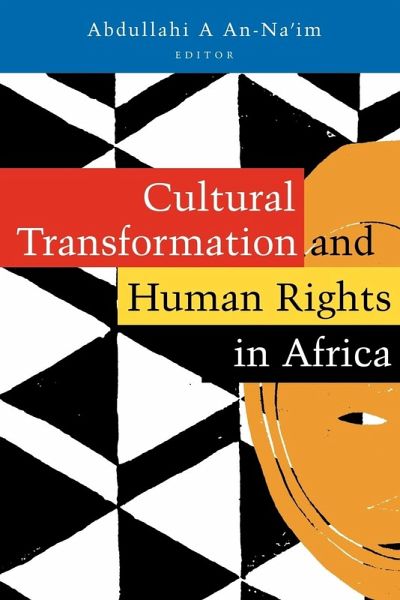
The authors of this volume seek to contribute to the clarification of the very difficult conceptual and practical questions surrounding the legitimization and permanent protection of human rights in non-Western cultural contexts, specifically in this case Africa. The contributors try to clarify thinking about what ought to constitute human rights in an African context as well as strategies for realizing them within communities and countries. These issues are particularly contentious when the specific point at issue is the promotion and protection of economic, social and cultural rights, and…mehr
The authors of this volume seek to contribute to the clarification of the very difficult conceptual and practical questions surrounding the legitimization and permanent protection of human rights in non-Western cultural contexts, specifically in this case Africa. The contributors try to clarify thinking about what ought to constitute human rights in an African context as well as strategies for realizing them within communities and countries. These issues are particularly contentious when the specific point at issue is the promotion and protection of economic, social and cultural rights, and even more so in relation to the rights of women. The underlying premise is that there are possibilities for the local promotion of what ought to be universal human rights through processes of cultural transformation over time. While conceding the difficulties and constraints of the relationship between local cultures and the notion of the universality of human rights, the contributors believe that it is both necessary and possible to address these issues by making use of creative possibilities within specific countries. Several of the contributors explore these questions of cultural transformation and human rights generally. The African Charter of Human and People's Rights is examined to see if there is a case for recognizing a specifically African cultural contribution to conceptualizations of human rights which have been originally formulated in a European social context. The volume then proceeds to translate the general issues at stake into the particular question of women's rights - especially their ability to own, control and have access to land and other property rights. This thoughtful set of explorations by African scholars and human rights activists adds significantly to our understanding of the complex relationships that exist between culture, religion, law and human rights.
Abdullahi Ahmed An-Na'im is Charles Howard Candler Professor of Law at Emory University, Georgia, USA. Prior to that he was executive director of Human Rights Watch/Africa in Washington D.C. for two years. Born in the Sudan and educated at the Universities of Khartoum, Cambridge and Edinburgh, his distinguished scholarly career has spanned 25 years with appointments in various North African, Canadian and US universities. He is the author of Towards an Islamic Reformation: Civil Liberties, Human Rights and International Law (1990) and editor of a numerous volumes on human rights issues from a cross-cultural perspective. Abdullahi Ahmed An-Na'im is Charles Howard Candler Professor of Law at Emory University, Georgia, USA. Prior to that he was executive director of Human Rights Watch/Africa in Washington D.C. for two years. Born in the Sudan and educated at the Universities of Khartoum, Cambridge and Edinburgh, his distinguished scholarly career has spanned 25 years with appointments in various North African, Canadian and US universities. He is the author of Towards an Islamic Reformation: Civil Liberties, Human Rights and International Law (1990) and editor of a numerous volumes on human rights issues from a cross-cultural perspective.
Inhaltsangabe
Introduction - Abdullahi A. An-Na'im 1. Cultural Transformation and Human Rights in African Societies - Abdullahi A. An-Na'im and Jeffrey Hammond 2. Human Rights and Cultural Branding: Who Speaks and How - Martin Chanock 3. The Banjul Charter: The Case for an African Cultural Fingerprint - Makau Mutua 4. Mediating Culture and Human Rights in Favour of Land Rights for Women in Africa: A Framework for Community-Legal Action - Florence Butegwa 5. Are Local Norms and Practices Fences or Pathways? The Example of Women's Property Rights - Celestine Nyamu-Musembi 6. Religious Revivalism, Human Rights Activism and the Struggle for Women's Rights in Nigeria - Hussaina J. Abdullah 7. Contradictory Perspectives on Rights and Justice in the Context of Land Tenure Reform in Tanzania - Issa Shivji 8. Effects of Land Tenure on Women's Access and Control of Land in Kenya - Akinyoi Nzioki
Introduction - Abdullahi A. An-Na'im 1. Cultural Transformation and Human Rights in African Societies - Abdullahi A. An-Na'im and Jeffrey Hammond 2. Human Rights and Cultural Branding: Who Speaks and How - Martin Chanock 3. The Banjul Charter: The Case for an African Cultural Fingerprint - Makau Mutua 4. Mediating Culture and Human Rights in Favour of Land Rights for Women in Africa: A Framework for Community-Legal Action - Florence Butegwa 5. Are Local Norms and Practices Fences or Pathways? The Example of Women's Property Rights - Celestine Nyamu-Musembi 6. Religious Revivalism, Human Rights Activism and the Struggle for Women's Rights in Nigeria - Hussaina J. Abdullah 7. Contradictory Perspectives on Rights and Justice in the Context of Land Tenure Reform in Tanzania - Issa Shivji 8. Effects of Land Tenure on Women's Access and Control of Land in Kenya - Akinyoi Nzioki
Es gelten unsere Allgemeinen Geschäftsbedingungen: www.buecher.de/agb
Impressum
www.buecher.de ist ein Internetauftritt der buecher.de internetstores GmbH
Geschäftsführung: Monica Sawhney | Roland Kölbl | Günter Hilger
Sitz der Gesellschaft: Batheyer Straße 115 - 117, 58099 Hagen
Postanschrift: Bürgermeister-Wegele-Str. 12, 86167 Augsburg
Amtsgericht Hagen HRB 13257
Steuernummer: 321/5800/1497
USt-IdNr: DE450055826