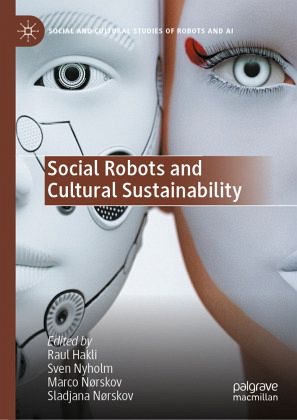
This book is about social robots and their disruptive potential with respect to social environments and cultural institutions. It seeks to develop an in-depth understanding and ethical analysis of how our cultural tenets are affected by the introduction of socially competent robotic technologies and how we can ensure that this will foster human well-being. Researchers around the world and from a variety of disciplines are exploring the many facets of this novel type of technology. This volume is comprised of state-of-the-art research contributions from leading experts within the field,…mehr
This book is about social robots and their disruptive potential with respect to social environments and cultural institutions. It seeks to develop an in-depth understanding and ethical analysis of how our cultural tenets are affected by the introduction of socially competent robotic technologies and how we can ensure that this will foster human well-being.
Researchers around the world and from a variety of disciplines are exploring the many facets of this novel type of technology. This volume is comprised of state-of-the-art research contributions from leading experts within the field, providing a comprehensive exploration and elaboration of topics crucial to social robotics and cultural sustainability. The result is a unique book that brings together a variety of disciplines, including well-established experts within the field, as well as promising newcomers, highlighting the dynamics that are at play when social robots meet our various cultural institutions.
Die Herstellerinformationen sind derzeit nicht verfügbar.
Autorenporträt
Raul Hakli is a University Researcher at the Department of Practical Philosophy, University of Helsinki, Finland. His research interests include philosophy of social robotics and AI, social ontology, and institutional epistemology.
Sven Nyholm is Professor of the Ethics of Artificial Intelligence at LMU Munich (Ludwig-Maximilians-Universität München) and Principal Investigator for AI Ethics at the Munich Center for Machine Learning and section editor for the same subject for the academic journal Science and Engineering Ethics.
Marco Nørskov is a Senior Researcher at the Research Unit for Robophilosophy and Integrative Social Robotics, at the Department of Philosophy and History of Ideas, Aarhus University, Denmark.
Sladjana Nørskov is a Special Advisor and a former Associate Professor at Aarhus University, Denmark. She specializes in innovation management, organizational behavior and social robotics.
Inhaltsangabe
Chapter 1. Introduction: Culturally Sustainable Social Robotics?(Raul Hakli, Sven Nyholm, & Marco Nørskov).- Chapter 2. What is Culture in Cultural Robotics? A Framework for Understanding Culture in Human-Robot Interaction (Henry Taylor & Masoumeh Mansouri).-Chapter 3. Flip the Script: From Ontology to an Ethics of Otherness (David Gunkel).- Chapter 4. Cultural Robotics or Robocolonialism? Meaning, Narrative, and Power with Social Robots (Mark Coeckelbergh).- Chapter 5. Social Robots and Regionality: Cross-Cultural Perspectives on Cultural Sustainability (Yuko Itatsu).- Chapter 6. The Importance of Relationality in Religious Robots: Why Religious Robots Should Focus on Nurturing Relationships (Anna Puzio).- Chapter 7. Value-Based Human-Robot Interaction: A Perceptual Control Theory Approach towards Socially Intelligent Agents (Theresa Schmiedel & Vivienne Zhong).- Chapter 8. Social Robots: Culturally Sustainable or Socially Disruptive? The Case of Humanoid Robots (Sven Nyholm).- Chapter 9. Trust and Social Robots: How Can We Prevent Social Robots from Eroding Trust? (Anna Strasser).
Chapter 1. Introduction: Culturally Sustainable Social Robotics?(Raul Hakli, Sven Nyholm, & Marco Nørskov).- Chapter 2. What is Culture in Cultural Robotics? A Framework for Understanding Culture in Human-Robot Interaction (Henry Taylor & Masoumeh Mansouri).-Chapter 3. Flip the Script: From Ontology to an Ethics of Otherness (David Gunkel).- Chapter 4. Cultural Robotics or Robocolonialism? Meaning, Narrative, and Power with Social Robots (Mark Coeckelbergh).- Chapter 5. Social Robots and Regionality: Cross-Cultural Perspectives on Cultural Sustainability (Yuko Itatsu).- Chapter 6. The Importance of Relationality in Religious Robots: Why Religious Robots Should Focus on Nurturing Relationships (Anna Puzio).- Chapter 7. Value-Based Human-Robot Interaction: A Perceptual Control Theory Approach towards Socially Intelligent Agents (Theresa Schmiedel & Vivienne Zhong).- Chapter 8. Social Robots: Culturally Sustainable or Socially Disruptive? The Case of Humanoid Robots (Sven Nyholm).- Chapter 9. Trust and Social Robots: How Can We Prevent Social Robots from Eroding Trust? (Anna Strasser).
Es gelten unsere Allgemeinen Geschäftsbedingungen: www.buecher.de/agb
Impressum
www.buecher.de ist ein Internetauftritt der buecher.de internetstores GmbH
Geschäftsführung: Monica Sawhney | Roland Kölbl | Günter Hilger
Sitz der Gesellschaft: Batheyer Straße 115 - 117, 58099 Hagen
Postanschrift: Bürgermeister-Wegele-Str. 12, 86167 Augsburg
Amtsgericht Hagen HRB 13257
Steuernummer: 321/5800/1497
USt-IdNr: DE450055826