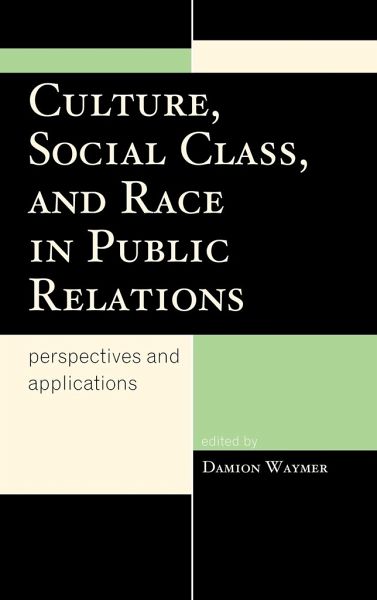
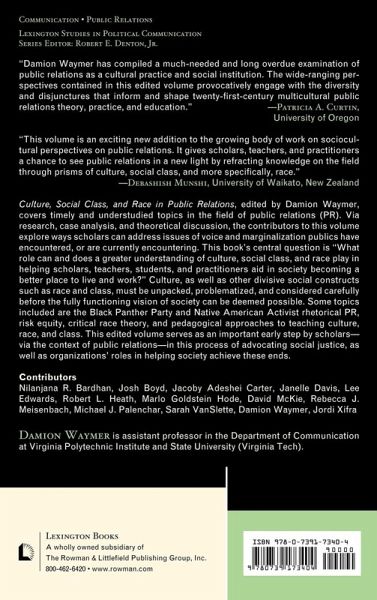
Culture, Race, and Class-Based Perspectives in Public Relations, edited by Damion Waymer, looks at "diversity in public relations" in a novel way. Several public relations books look at gender or transnational/global PR; however, this book foregrounds issues of culture, race, and class in public relations. Some topics included are the Black Panther Party and Native American Activist rhetorical PR, risk equity, critical race theory, and pedagogical approaches to teaching culture, race, and class.
Culture, Race, and Class-Based Perspectives in Public Relations, edited by Damion Waymer, looks at "diversity in public relations" in a novel way. Several public relations books look at gender or transnational/global PR; however, this book foregrounds issues of culture, race, and class in public relations. Some topics included are the Black Panther Party and Native American Activist rhetorical PR, risk equity, critical race theory, and pedagogical approaches to teaching culture, race, and class.
Damion Waymer is assistant professor in the Department of Communication at Virginia Polytechnic Institute and State University (Virginia Tech.)
Inhaltsangabe
Part 1. Theoretical Discussions of Culture, Social Class, and Race in Public Relations Chapter 1. Culture, Social Class, and Race-Based Perspectives in Public Relations: An Introduction by Damion Waymer Chapter 2. Culture as "Traveling" Variable in Transnational Public Relations: A Dialectical Approach by Nilanjana Bardhan Chapter 3. A City Divided: Understanding "Class Issues" in Government Public Relations by Damion Waymer Chapter 4. The Corporation-as-Middle-Class-Person: Corporate Social Responsibility and Class by Josh Boyd Chapter 5. Critical Race Theory and Public Relations by Lee Edwards Chapter 6. Two Unreconciled Strivings: Racial Constructionism and Eliminitivism in the Philosophy of Race and its Relevance to Public Relations by Jacoby A. Carter Part 2. Questions of Pedagogy and Practice: Exploring Topics of Culture, Social Class, and Race in Public Relations Education Chapter 7. Human Trafficking in the PR Classroom: Raising Awareness for a Cause, Creating More Ethical PR Practitioners by Sarah Hagedorn Van Slette Chapter 8. Expanding the Spectrum of PR and Race: Lessons from European Theorists, Media Critiques, and Catalan Programming by Jordi Xifra and David McKie Chapter 9. Higher Learning: Rethinking Crisis Communication in Response to Racial Incidents on Campus by Marlo Goldstein Hode and Rebecca J. Meisenbach Chapter 10. Broaching an Uncomfortable Subject: Teaching Race in an Undergraduate Public Relations Classroom by Damion Waymer Part 3. Culture, Social Class, and Race in Public Relations: Applications and Implications Chapter 11. Decolonizing Occupy Oakland: Listening for Native American Voices in a Struggle against Social Inequality by Jackson B. Miller and Janelle Davis Chapter 12. Speaking with and for Those Beyond the Margins: Outcast Advocacy Relations (OAR) in Public by Damion Waymer Chapter 13. Right to Know and Risk Communication: Implications of Risk Equity by Michael Palenchar Chapter 14. Was Black Rhetoric Ever Anything but Race in Public Relations? The Challenge of the Rhetoric of Identity by Robert L. Heath Afterword by Damion Waymer
Part 1. Theoretical Discussions of Culture, Social Class, and Race in Public Relations Chapter 1. Culture, Social Class, and Race-Based Perspectives in Public Relations: An Introduction by Damion Waymer Chapter 2. Culture as "Traveling" Variable in Transnational Public Relations: A Dialectical Approach by Nilanjana Bardhan Chapter 3. A City Divided: Understanding "Class Issues" in Government Public Relations by Damion Waymer Chapter 4. The Corporation-as-Middle-Class-Person: Corporate Social Responsibility and Class by Josh Boyd Chapter 5. Critical Race Theory and Public Relations by Lee Edwards Chapter 6. Two Unreconciled Strivings: Racial Constructionism and Eliminitivism in the Philosophy of Race and its Relevance to Public Relations by Jacoby A. Carter Part 2. Questions of Pedagogy and Practice: Exploring Topics of Culture, Social Class, and Race in Public Relations Education Chapter 7. Human Trafficking in the PR Classroom: Raising Awareness for a Cause, Creating More Ethical PR Practitioners by Sarah Hagedorn Van Slette Chapter 8. Expanding the Spectrum of PR and Race: Lessons from European Theorists, Media Critiques, and Catalan Programming by Jordi Xifra and David McKie Chapter 9. Higher Learning: Rethinking Crisis Communication in Response to Racial Incidents on Campus by Marlo Goldstein Hode and Rebecca J. Meisenbach Chapter 10. Broaching an Uncomfortable Subject: Teaching Race in an Undergraduate Public Relations Classroom by Damion Waymer Part 3. Culture, Social Class, and Race in Public Relations: Applications and Implications Chapter 11. Decolonizing Occupy Oakland: Listening for Native American Voices in a Struggle against Social Inequality by Jackson B. Miller and Janelle Davis Chapter 12. Speaking with and for Those Beyond the Margins: Outcast Advocacy Relations (OAR) in Public by Damion Waymer Chapter 13. Right to Know and Risk Communication: Implications of Risk Equity by Michael Palenchar Chapter 14. Was Black Rhetoric Ever Anything but Race in Public Relations? The Challenge of the Rhetoric of Identity by Robert L. Heath Afterword by Damion Waymer
Es gelten unsere Allgemeinen Geschäftsbedingungen: www.buecher.de/agb
Impressum
www.buecher.de ist ein Internetauftritt der buecher.de internetstores GmbH
Geschäftsführung: Monica Sawhney | Roland Kölbl | Günter Hilger
Sitz der Gesellschaft: Batheyer Straße 115 - 117, 58099 Hagen
Postanschrift: Bürgermeister-Wegele-Str. 12, 86167 Augsburg
Amtsgericht Hagen HRB 13257
Steuernummer: 321/5800/1497
USt-IdNr: DE450055826