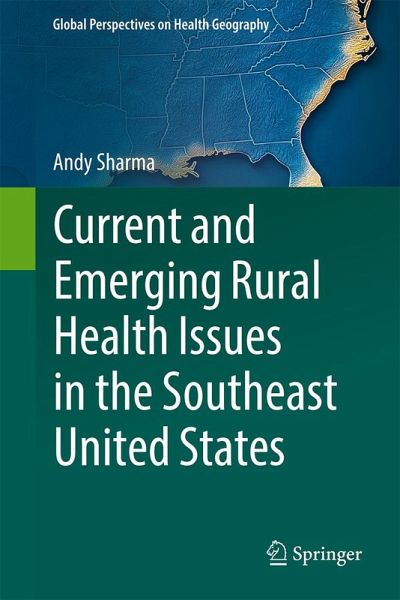
This book provides an insightful examination of various health challenges affecting rural communities in the Southeast United States (e.g., Alabama, Arkansas, Georgia, Mississippi, Louisiana, Tennessee). These areas are contending with a shortage of healthcare providers, inadequate infrastructure, an aging population, and limited economic and political resources, which contribute to significant and often overlooked health needs. Adopting an interdisciplinary approach that encompasses economics, geography, history, policy, and sociology, the book addresses critical topics such as diabetes, a…mehr
This book provides an insightful examination of various health challenges affecting rural communities in the Southeast United States (e.g., Alabama, Arkansas, Georgia, Mississippi, Louisiana, Tennessee). These areas are contending with a shortage of healthcare providers, inadequate infrastructure, an aging population, and limited economic and political resources, which contribute to significant and often overlooked health needs. Adopting an interdisciplinary approach that encompasses economics, geography, history, policy, and sociology, the book addresses critical topics such as diabetes, a leading cause of mortality both in the United States and worldwide. Over the past two decades, the Southeastern U.S. has experienced a public health concern related to diabetes, disproportionately affecting minority populations. The region's diabetes prevalence is particularly high in rural areas. The book also discusses rising obesity rates, cardiovascular diseases, and hypertension. The severity of these health conditions is closely linked to a range of economic, social, and geographical factors. Additionally, the book features an insightful chapter on emerging health issues and the effects of natural disasters. It explores the critical challenges faced by rural communities in the aftermath of events such as floods, hurricanes, severe storms, and tornadoes, supported by relevant case studies. The concluding chapter addresses the increasing prevalence of extreme heat events in the region over recent years and offers resources for additional exploration of the topic.
Artikelnr. des Verlages: 89257757, 978-3-032-07542-0
Seitenzahl: 132
Erscheinungstermin: 6. Januar 2026
Englisch
Abmessung: 235mm x 155mm
ISBN-13: 9783032075420
ISBN-10: 3032075424
Artikelnr.: 75304089
Herstellerkennzeichnung
Springer-Verlag GmbH
Tiergartenstr. 17
69121 Heidelberg
ProductSafety@springernature.com
Autorenporträt
Andy Sharma is an academic researcher focusing on population health, aging, and community well-being. Andy’s work has been published in various peer-reviewed journals, including Ageing and Society, Annals of GIS, Applied Geography, The Gerontologist, Journal of Family and Economic Issues, The Journals of Gerontology: Series B, Planning Theory and Practice, Population Research and Policy Review, and Women’s Health Issues . He is co-author of A Brave New World of Healthcare Revisited (2013) with former Colorado Governor Richard D. Lamm. In recognition of Andy’s contribution to understanding COVID-19-related mortality among older adults, the Gerontological Society of America invited him to present his research in a featured webinar. His applied work on improving diabetes testing in Mississippi also led to a formal visit coordinated by the Mississippi State Department of Health. Andy is at the forefront of innovation in public health research, exploring a project that leverages large language models and artificial intelligence to conduct community assessments and identify local health needs. Andy Sharma was granted a PhD in Public Policy with a minor in Sociology from the University of North Carolina at Chapel Hill, where he was a funded pre-doctoral trainee at the Carolina Population Center. He also earned an MS in Mathematics from Loyola University Chicago and an MA in Economics from DePaul University, credentials that reflect advanced training in both quantitative analysis and policy research. Through his outreach, publications, and public engagement, Andy Sharma provides recommendations to public health practitioners and policymakers on approaches to improve population health outcomes. Amanda Sharma is a contributing author for Chapter 5: Emerging Health Issues and Natural Disasters. With twenty years of experience in public service and emergency management, Amanda has held various roles at the Federal Emergency Management Agency (FEMA), the Environmental Protection Agency (EPA), and local government, contributing to national disaster efforts in Florida, Louisiana, Minnesota, Nebraska, and New Mexico. Amanda provides consulting in risk communication, resilience planning, and transformational leadership. Amanda earned an Executive MBA from the Daniels College of Business and a Master in Resource Law Studies from the Sturm College of Law, both at the University of Denver.
Inhaltsangabe
1 Introduction.- 2 History of Rural Health.- 3 Social and Racial Considerations for Health.- 4 Current Health Issues.- 5 Emerging Health Issues and Natural Disasters.- 6 Conclusion.
1 Introduction.- 2 History of Rural Health.- 3 Social and Racial Considerations for Health.- 4 Current Health Issues.- 5 Emerging Health Issues and Natural Disasters.- 6 Conclusion.
Es gelten unsere Allgemeinen Geschäftsbedingungen: www.buecher.de/agb
Impressum
www.buecher.de ist ein Internetauftritt der buecher.de internetstores GmbH
Geschäftsführung: Monica Sawhney | Roland Kölbl | Günter Hilger
Sitz der Gesellschaft: Batheyer Straße 115 - 117, 58099 Hagen
Postanschrift: Bürgermeister-Wegele-Str. 12, 86167 Augsburg
Amtsgericht Hagen HRB 13257
Steuernummer: 321/5800/1497
USt-IdNr: DE450055826