**Selected for Doody’s Core Titles® 2024 with "Essential Purchase" designation in General Surgery** Drawing on the experience and knowledge of master world-renowned trauma surgeons, Current Therapy of Trauma and Surgical Critical Care, 3rd Edition , offers a comprehensive summary of optimal treatment and post-operative management of traumatic injuries. Ideally suited for everyday use, this practical, concise reference highlights the most important aspects of urgent surgical care, from damage control to noninvasive techniques to chemical and biological injuries. A focus on the surgical…mehr
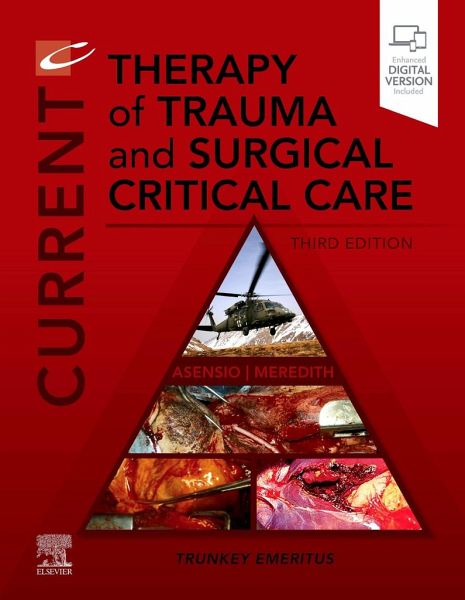
**Selected for Doody’s Core Titles® 2024 with "Essential Purchase" designation in General Surgery** Drawing on the experience and knowledge of master world-renowned trauma surgeons, Current Therapy of Trauma and Surgical Critical Care, 3rd Edition , offers a comprehensive summary of optimal treatment and post-operative management of traumatic injuries. Ideally suited for everyday use, this practical, concise reference highlights the most important aspects of urgent surgical care, from damage control to noninvasive techniques to chemical and biological injuries. A focus on the surgical techniques required to manage even the most complex injuries makes it both an excellent resource for quick review before entering the operating room and a valuable review tool for board certification or recertification. * Covers the entire spectrum of Trauma Surgery and Surgical Critical Care-from initial evaluation, military and civilian field and trauma center evaluation and resuscitation, to diagnosis, operative, and postoperative critical care and outcomes-in nearly 100 print and 39 online-exclusive chapters, all newly streamlined to emphasize frontline procedural treatment * Features extensive new data and updates to Cardiac, Thoracic, Vascular, and Military Surgery chapters, plus numerous new intraoperative photographs and high-quality line drawings that highlight the most important aspects of urgent surgical care * Contains 14 new chapters, including Innovations in Trauma Surgery Simulation; Air Evacuation and Critical Care in Military Casualties; REBOA: Indications and Controversies; Penetrating Extracranial Vertebral Artery; Penetrating Arterio-Venous Fistulas; The Genomics of Profound Shock and Trauma; ECMO; and newer strategies, such as nerve blocks for pain management to combat the opioid epidemic * Incorporates a wealth of military knowledge from both recent and past military conflicts, as well as from asymmetric warfare; many of the authors and co-authors have extensive past and present military experience * Uses a consistent, easy-to-follow chapter format throughout, for quick and easy reference and review * Reviews the essential principles of diagnosis and treatment, as well as the specifics of surgical therapy, making it useful for surgeons across all specialties * Integrates evidence-based practice guidelines into the text whenever possible, as well as comprehensive utilization of the American Association for the Surgery of Trauma - Organ Injury Scales (AAST-OIS) * Contains such a wealth of operative photographs and line drawings, both in the printed version and many more in the electronic version, that it could be considered an Atlas of Trauma Surgery * An eBook version is included with purchase. The eBook allows you to access all of the text, figures and references, with the ability to search, customize your content, make notes and highlights, and have content read aloud
Part 1 Trauma Systems 1 Development of Trauma Systems 2 Trauma Center Organization and Verification for Current Therapy of Trauma and Surgical Critical Care 3 Injury Severity Scoring: Its Definition and Practical Application 4 Role of Alcohol and Other Drugs in Trauma 5 Injury Prevention: An Evidence-Based Public Health Approach 6 Lessons Learned in Military Trauma in Colombia 7 Trauma Scoring 8 Simulation-Based Training for Combat Surgery Part 2 Prehospital Trauma Care 9 Prehospital Trauma Care: Influence of Emergency Medical Services on Trauma Center Patient Outcomes 10 Field Triage in the Military Arena 11 Trauma Systems on the Battlefield 12 Field Triage in the Civilian Arena 13 En Route Care 14 Prehospital Airway Management: Intubation, Devices, and Controversies 15 Prehospital Fluid Resuscitation: What Type, How Much, and Controversies 16 Mass Casualty Events: The Role of Hospitals and Trauma Systems 17 Injuries From Explosives 18 Prehospital Care of Biologic Agent-Induced Injuries 19 Wound Ballistics: What Every Trauma Surgeon Should Know 20 Common Prehospital Complications and Pitfalls in the Trauma Patient Part 3 Initial Assessment and Resuscitation 21 Airway Management: What Every Trauma Surgeon Should Know, From Intubation to Cricothyroidotomy 22 Resuscitation Fluids 23 REBOA: Resuscitative Endovascular Balloon Occlusion of the Aorta 24 Resuscitative Thoracotomy 25 Focused Assessment with Sonography for the Trauma Patient Role of Radiology in Initial Trauma Evaluation 26 Interventional Radiology: Diagnostic and Therapeutic Roles 27 Interventional Radiology Management During Intermediate and Long-Term Phases of Trauma Care 28 Endpoints of Resuscitation 148 Part 4 Head and Central Nervous System Injuries 29 Traumatic Brain Injury: Pathophysiology, Clinical Diagnosis, and Prehospital and Emergency Center Care 30 Nonoperative Care, and Complications 31 Spinal Cord Injury, Blunt and Penetrating, Neurogenic and Spinal Shock Part 5 Maxillofacial and Ocular Injuries 32 Maxillofacial Trauma 33 Trauma to the Eye and Orbit Part 6 Neck Injuries 34 Penetrating Neck Injuries 35 Blunt Cerebrovascular Injuries 36 Tracheal, Laryngeal, and Oropharyngeal Injuries Part 7 Thoracic Injuries 37 Pertinent Surgical Anatomy of the Thorax and Mediastinum 38 Thoracic Wall Injuries: Ribs, Sternal and Scapular Fractures, and Hemothoraces and Pneumothoraces 39 Diagnostic and Therapeutic Roles of Bronchoscopy and Video-Assisted Thoracoscopy in the Management of Thoracic Trauma 40 Pulmonary Contusion and Flail Chest 41 Operative Treatment of Chest Wall Injury 42 Tracheal and Tracheobronchial Tree Injuries 43 Operative Management of Pulmonary Injuries: Lung-Sparing and Formal Resections 44 Complications of Pulmonary and Pleural Injury 45 Cardiac Injuries 46 Thoracic Vascular Injury 47 Thoracic Aortic Injury 48 Esophageal Injuries: Principles of Management Part 8 Abdominal Injuries 49 Diaphragmatic Injury 50 Surgical Anatomy of the Abdomen and Retroperitoneum 51 Diagnostic Peritoneal Lavage and Laparoscopy in the Evaluation of Abdominal Trauma 52 Nonoperative Management of Blunt and Penetrating Abdominal Injuries 53 Gastric Injuries 54 Small Bowel Injury 55 Duodenal Injuries 56 Pancreatic Injuries and Pancreaticoduodenectomy 57 Liver Injury 58 Splenic Injuries 59 Abdominal Vascular Injury 60 Colon and Rectal Injuries 61 Genitourinary Tract Injuries 62 Gynecologic Injuries: Trauma to Uterus, Ovaries, and Female Genitalia Part 9 Special Issues in Major Torso Trauma 63 Multidisciplinary Management of Pelvic Fractures: Operative and Nonoperative Management 64 Current Concepts in the Diagnosis and Management of Hemorrhagic Shock 65 Exsanguination: Reliable Models to Indicate Damage Control 66 Damage Control Resuscitation: An Evidence-Based Report 67 Newer Strategies from the Use of Blood and Blood Products: Lessons Learned from Recent Wars 68 Surgical Techniques for Damage Control Operations for Abdominal, Thoracic, Pelvic, and Extremity Trauma 69 Abdominal Compartment Syndrome, Damage Control, and the Open Abdomen 70 Torso Trauma on the Modern Battlefield Part 10 Peripheral Vascular Injury 71 Vascular Anatomy of the Extremities 72 Diagnosis of Vascular Trauma 73 Penetrating Carotid Artery Injuries 74 Penetrating Extracranial Vertebral Artery Injuries 75 Subclavian Vessel Injuries: Difficult Anatomy and Difficult Territory 76 Operative Exposure and Management of Axillary Vessel Injuries 77 Brachial Vessel Injuries: High Morbidity and Low Mortality Injuries 78 Iliac Vessel Injuries: Difficult Injuries and Difficult Management Problems 79 Femoral Vessel Injuries: High Mortality and Low Morbidity Injuries 80 Popliteal Vessel Injuries: Complex Anatomy and High Amputation Rates 81 Shank Vessel Injuries: The Forgotten Vascular Injuries 82 Penetrating Arteriovenous Fistulas: Uncommon and Challenging Entities 83 Temporary Vascular Shunts Part 11 Musculoskeletal and Peripheral Central Nervous System Injuries 84 Upper Extremity Fractures: Orthopedic Management 85 Lower Extremity and Degloving Injury 86 Cervical, Thoracic, and Lumbar Spine Fractures 87 Pelvic Fractures 88 Wrist and Hand Fractures: Orthopaedic Management Scapulothoracic Dissociation and Degloving Injuries of the Extremities 89 Extremity Replantation: Indications and Timing Part 12 Special Issues and Situations in Trauma Management 90 Flap Reconstruction in the Management of Complex Musculoskeletal Injuries 91 What Every Surgeon Should Know About the Traumatic Airway 92 Pediatric Trauma 93 Trauma in Pregnancy 94 Trauma in Our "Elders" 95 Burns 96 Soft Tissue Infections 97 Common Errors in Trauma Care 98 Combat Trauma Care: Lessons Learned From Recent Combat Operations 99 Danger Associated Molecular Patterns, Complements, and Other Novel Biomarkers in Trauma Patient Management 100 Microbiome and Trauma 101 Genomics of Profound Shock and Trauma Part 13 Critical Care I: Management of Organ Failures and Techniques for Support 102 Cardiac Hemodynamics: Pulmonary Artery Catheter and the Meaning of Its Readings 103 Oxygen Transport 104 Pharmacologic Support of Cardiac Failure 105 Diagnosis and Management of Cardiac Dysrhythmias 106 Fundamentals of Mechanical Ventilation 107 Advanced Techniques in Mechanical Ventilation 108 Acute Kidney Injury and Renal Replacement Therapy in the Surgical Intensive Care Unit 109 Management of Coagulation Disorders in the Surgical Intensive Care Unit 110 Management of Endocrine Disorders in the Surgical Intensive Care Unit 111 Transfusion: Management of Blood and Blood Products in Trauma Part 14 Critical Care II: Special Issues and Treatments 112 Thromboelastography: Techniques and Uses 113 Acute Respiratory Distress Syndrome 114 The Evolving Epidemiology of Multiple Organ Failure 115 Sepsis, Septic Shock, and Its Treatment 116 The Immunology of Trauma 117 Overview of Infectious Diseases in Trauma Patients 118 Nosocomial Pneumonia 119 Antibiotic Use in the Intensive Care Unit: The Old and the New 120 Fungal Colonization and Infection During Critical Illness 121 Preoperative and Postoperative Nutritional Support: Strategies for Enteral and Parenteral Therapies 122 Venous Thromboembolic Events: Diagnosis, Treatment, and Filters as Adjuncts 123 Hypothermia and Trauma 124 Surgical Procedures in the Surgical Intensive Care Unit 125 Anesthesia in the Critical Care Unit and Pain Management 126 Anesthesia Adjuncts in the Management of Pain in Trauma Patients: New Blocks and Other Techniques to Combat the Opioid Epidemic 127 Extracorporeal Membrane Oxygenation for Acute Cardiopulmonary Failure Part 15 Rehabilitation and Quality of Life After Trauma and Other Issues 128 Surgery During Global Pandemics: Focus on Prioritization and Resource Allocation 129 Diagnostic Management of Brain Death in the Intensive Care Unit and Organ Donation 130 Palliative Care in the Trauma Intensive Care Unit 131 Trauma rehabilitation 132 Trauma outcomes
Part 1 Trauma Systems 1 Development of Trauma Systems 2 Trauma Center Organization and Verification for Current Therapy of Trauma and Surgical Critical Care 3 Injury Severity Scoring: Its Definition and Practical Application 4 Role of Alcohol and Other Drugs in Trauma 5 Injury Prevention: An Evidence-Based Public Health Approach 6 Lessons Learned in Military Trauma in Colombia 7 Trauma Scoring 8 Simulation-Based Training for Combat Surgery Part 2 Prehospital Trauma Care 9 Prehospital Trauma Care: Influence of Emergency Medical Services on Trauma Center Patient Outcomes 10 Field Triage in the Military Arena 11 Trauma Systems on the Battlefield 12 Field Triage in the Civilian Arena 13 En Route Care 14 Prehospital Airway Management: Intubation, Devices, and Controversies 15 Prehospital Fluid Resuscitation: What Type, How Much, and Controversies 16 Mass Casualty Events: The Role of Hospitals and Trauma Systems 17 Injuries From Explosives 18 Prehospital Care of Biologic Agent-Induced Injuries 19 Wound Ballistics: What Every Trauma Surgeon Should Know 20 Common Prehospital Complications and Pitfalls in the Trauma Patient Part 3 Initial Assessment and Resuscitation 21 Airway Management: What Every Trauma Surgeon Should Know, From Intubation to Cricothyroidotomy 22 Resuscitation Fluids 23 REBOA: Resuscitative Endovascular Balloon Occlusion of the Aorta 24 Resuscitative Thoracotomy 25 Focused Assessment with Sonography for the Trauma Patient Role of Radiology in Initial Trauma Evaluation 26 Interventional Radiology: Diagnostic and Therapeutic Roles 27 Interventional Radiology Management During Intermediate and Long-Term Phases of Trauma Care 28 Endpoints of Resuscitation 148 Part 4 Head and Central Nervous System Injuries 29 Traumatic Brain Injury: Pathophysiology, Clinical Diagnosis, and Prehospital and Emergency Center Care 30 Nonoperative Care, and Complications 31 Spinal Cord Injury, Blunt and Penetrating, Neurogenic and Spinal Shock Part 5 Maxillofacial and Ocular Injuries 32 Maxillofacial Trauma 33 Trauma to the Eye and Orbit Part 6 Neck Injuries 34 Penetrating Neck Injuries 35 Blunt Cerebrovascular Injuries 36 Tracheal, Laryngeal, and Oropharyngeal Injuries Part 7 Thoracic Injuries 37 Pertinent Surgical Anatomy of the Thorax and Mediastinum 38 Thoracic Wall Injuries: Ribs, Sternal and Scapular Fractures, and Hemothoraces and Pneumothoraces 39 Diagnostic and Therapeutic Roles of Bronchoscopy and Video-Assisted Thoracoscopy in the Management of Thoracic Trauma 40 Pulmonary Contusion and Flail Chest 41 Operative Treatment of Chest Wall Injury 42 Tracheal and Tracheobronchial Tree Injuries 43 Operative Management of Pulmonary Injuries: Lung-Sparing and Formal Resections 44 Complications of Pulmonary and Pleural Injury 45 Cardiac Injuries 46 Thoracic Vascular Injury 47 Thoracic Aortic Injury 48 Esophageal Injuries: Principles of Management Part 8 Abdominal Injuries 49 Diaphragmatic Injury 50 Surgical Anatomy of the Abdomen and Retroperitoneum 51 Diagnostic Peritoneal Lavage and Laparoscopy in the Evaluation of Abdominal Trauma 52 Nonoperative Management of Blunt and Penetrating Abdominal Injuries 53 Gastric Injuries 54 Small Bowel Injury 55 Duodenal Injuries 56 Pancreatic Injuries and Pancreaticoduodenectomy 57 Liver Injury 58 Splenic Injuries 59 Abdominal Vascular Injury 60 Colon and Rectal Injuries 61 Genitourinary Tract Injuries 62 Gynecologic Injuries: Trauma to Uterus, Ovaries, and Female Genitalia Part 9 Special Issues in Major Torso Trauma 63 Multidisciplinary Management of Pelvic Fractures: Operative and Nonoperative Management 64 Current Concepts in the Diagnosis and Management of Hemorrhagic Shock 65 Exsanguination: Reliable Models to Indicate Damage Control 66 Damage Control Resuscitation: An Evidence-Based Report 67 Newer Strategies from the Use of Blood and Blood Products: Lessons Learned from Recent Wars 68 Surgical Techniques for Damage Control Operations for Abdominal, Thoracic, Pelvic, and Extremity Trauma 69 Abdominal Compartment Syndrome, Damage Control, and the Open Abdomen 70 Torso Trauma on the Modern Battlefield Part 10 Peripheral Vascular Injury 71 Vascular Anatomy of the Extremities 72 Diagnosis of Vascular Trauma 73 Penetrating Carotid Artery Injuries 74 Penetrating Extracranial Vertebral Artery Injuries 75 Subclavian Vessel Injuries: Difficult Anatomy and Difficult Territory 76 Operative Exposure and Management of Axillary Vessel Injuries 77 Brachial Vessel Injuries: High Morbidity and Low Mortality Injuries 78 Iliac Vessel Injuries: Difficult Injuries and Difficult Management Problems 79 Femoral Vessel Injuries: High Mortality and Low Morbidity Injuries 80 Popliteal Vessel Injuries: Complex Anatomy and High Amputation Rates 81 Shank Vessel Injuries: The Forgotten Vascular Injuries 82 Penetrating Arteriovenous Fistulas: Uncommon and Challenging Entities 83 Temporary Vascular Shunts Part 11 Musculoskeletal and Peripheral Central Nervous System Injuries 84 Upper Extremity Fractures: Orthopedic Management 85 Lower Extremity and Degloving Injury 86 Cervical, Thoracic, and Lumbar Spine Fractures 87 Pelvic Fractures 88 Wrist and Hand Fractures: Orthopaedic Management Scapulothoracic Dissociation and Degloving Injuries of the Extremities 89 Extremity Replantation: Indications and Timing Part 12 Special Issues and Situations in Trauma Management 90 Flap Reconstruction in the Management of Complex Musculoskeletal Injuries 91 What Every Surgeon Should Know About the Traumatic Airway 92 Pediatric Trauma 93 Trauma in Pregnancy 94 Trauma in Our "Elders" 95 Burns 96 Soft Tissue Infections 97 Common Errors in Trauma Care 98 Combat Trauma Care: Lessons Learned From Recent Combat Operations 99 Danger Associated Molecular Patterns, Complements, and Other Novel Biomarkers in Trauma Patient Management 100 Microbiome and Trauma 101 Genomics of Profound Shock and Trauma Part 13 Critical Care I: Management of Organ Failures and Techniques for Support 102 Cardiac Hemodynamics: Pulmonary Artery Catheter and the Meaning of Its Readings 103 Oxygen Transport 104 Pharmacologic Support of Cardiac Failure 105 Diagnosis and Management of Cardiac Dysrhythmias 106 Fundamentals of Mechanical Ventilation 107 Advanced Techniques in Mechanical Ventilation 108 Acute Kidney Injury and Renal Replacement Therapy in the Surgical Intensive Care Unit 109 Management of Coagulation Disorders in the Surgical Intensive Care Unit 110 Management of Endocrine Disorders in the Surgical Intensive Care Unit 111 Transfusion: Management of Blood and Blood Products in Trauma Part 14 Critical Care II: Special Issues and Treatments 112 Thromboelastography: Techniques and Uses 113 Acute Respiratory Distress Syndrome 114 The Evolving Epidemiology of Multiple Organ Failure 115 Sepsis, Septic Shock, and Its Treatment 116 The Immunology of Trauma 117 Overview of Infectious Diseases in Trauma Patients 118 Nosocomial Pneumonia 119 Antibiotic Use in the Intensive Care Unit: The Old and the New 120 Fungal Colonization and Infection During Critical Illness 121 Preoperative and Postoperative Nutritional Support: Strategies for Enteral and Parenteral Therapies 122 Venous Thromboembolic Events: Diagnosis, Treatment, and Filters as Adjuncts 123 Hypothermia and Trauma 124 Surgical Procedures in the Surgical Intensive Care Unit 125 Anesthesia in the Critical Care Unit and Pain Management 126 Anesthesia Adjuncts in the Management of Pain in Trauma Patients: New Blocks and Other Techniques to Combat the Opioid Epidemic 127 Extracorporeal Membrane Oxygenation for Acute Cardiopulmonary Failure Part 15 Rehabilitation and Quality of Life After Trauma and Other Issues 128 Surgery During Global Pandemics: Focus on Prioritization and Resource Allocation 129 Diagnostic Management of Brain Death in the Intensive Care Unit and Organ Donation 130 Palliative Care in the Trauma Intensive Care Unit 131 Trauma rehabilitation 132 Trauma outcomes
Es gelten unsere Allgemeinen Geschäftsbedingungen: www.buecher.de/agb
Impressum
www.buecher.de ist ein Internetauftritt der buecher.de internetstores GmbH
Geschäftsführung: Monica Sawhney | Roland Kölbl | Günter Hilger
Sitz der Gesellschaft: Batheyer Straße 115 - 117, 58099 Hagen
Postanschrift: Bürgermeister-Wegele-Str. 12, 86167 Augsburg
Amtsgericht Hagen HRB 13257
Steuernummer: 321/5800/1497
USt-IdNr: DE450055826