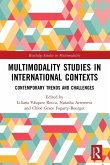
Looking at both English Medium Instruction (EMI) and multimodality in higher education, this edited volume bridges the gap between the two contexts by offering various new insights into fundamentals in multilingual education, EMI discourse and current teaching practices in internationalised contexts.
Looking at both English Medium Instruction (EMI) and multimodality in higher education, this edited volume bridges the gap between the two contexts by offering various new insights into fundamentals in multilingual education, EMI discourse and current teaching practices in internationalised contexts.
Vicent Beltrán-Palanques is Associate Professor in the Department of English Studies at the Universitat Jaume I, Spain. His research interests focus on ESP/EAP pedagogy, English-Medium Instruction in higher education, multimodal discourse analysis and multimodal literacy and pragmatics and interaction. He has published in international journals such as System, Journal of English for Academic Purposes and English for Specific Purposes , as well as in international publishing houses like Routledge, Brill and Springer. Edgar Bernad-Mechó is Associate Professor at Universitat Jaume I, Spain. He specialises in the use of metadiscourse and multimodality in academic contexts and for science dissemination. He has published papers in journals like the Journal of English for Academic Purposes or Discourse Studies, and co-edited a special issue on multimodality for Ibérica. In his recent studies he has explored the modal density and coherence of YouTube videos for science dissemination and looked at the use of humor and other engagement strategies in science communication online.
Inhaltsangabe
Introduction: A multimodal perspective on content and language teaching in higher education.Vicent Beltrán-Palanques & Edgar Bernad-Mechó Chapter 1: The multimodal turn in higher education. Fei Victor Lim Section 1: Content and language-oriented classrooms 2. Chapter 2: English-medium instruction (EMI) multimodal classroom discourse to enhance L2 university students' comprehension. Natalia Norte & Teresa Morell 3. Chapter 3: Multimodal orchestration for socal science-specific meaning - making flow in higher education. Phoebe Siu, Esther Ka-Man Tong & Winfred Wenhui Xuan 4. Chapter 4: Listening to silence in Spanish and English-medium instruction online lectures. Mercedes Querol-Julián & Maite Amondarain Garrido 5. Chapter 5: The role of multimodal competence in 'doing EMI lecturing': Exploring the effectiveness of non-linguistic resources in EMI. Balbina Moncada-Comas & Maria Sabaté-Dalmau 6. Chapter 6: A proposal for CLIL teacher training: Acknowledging multimodal literacies as pedagogical affordances in CLILicised Physical Education Celina Salvador-Garcia & Noelia Ruiz-Madrid Section 2: ESP/EAP and multimodality 7. Chapter 7: Strategic translanguaging and trans-semiotizing in an English for academic purposes class: A multimodal analysis. Jiajia Eve Liu, Yuen Yi Lo & Angel M. Y. Lin 8. Chapter 8: Preparing doctoral students for conference presentations: Teaching multimodal academic literacy and the role of organizational metadiscourse Vicent Beltrán-Palanques & Edgar Bernad-Mechó 9. Chapter 9: Training students in multimodal pragmatics for the Integration of Content and Language in business university studies Nuria Edo-Marzá & Inmaculada Fortanez-Gómez 10. Chapter 10: Digital multimodal composing in the teaching of English for business communication: A genre-based analysis of student-authored videos Yi Deng & Dezheng (William) Feng 11. Concluding chapter - The wood and the trees: Evaluating multimodality in English-medium higher education through the ROAD-MAPPING lens Ute Smit
Introduction: A multimodal perspective on content and language teaching in higher education.Vicent Beltrán-Palanques & Edgar Bernad-Mechó Chapter 1: The multimodal turn in higher education. Fei Victor Lim Section 1: Content and language-oriented classrooms 2. Chapter 2: English-medium instruction (EMI) multimodal classroom discourse to enhance L2 university students' comprehension. Natalia Norte & Teresa Morell 3. Chapter 3: Multimodal orchestration for socal science-specific meaning - making flow in higher education. Phoebe Siu, Esther Ka-Man Tong & Winfred Wenhui Xuan 4. Chapter 4: Listening to silence in Spanish and English-medium instruction online lectures. Mercedes Querol-Julián & Maite Amondarain Garrido 5. Chapter 5: The role of multimodal competence in 'doing EMI lecturing': Exploring the effectiveness of non-linguistic resources in EMI. Balbina Moncada-Comas & Maria Sabaté-Dalmau 6. Chapter 6: A proposal for CLIL teacher training: Acknowledging multimodal literacies as pedagogical affordances in CLILicised Physical Education Celina Salvador-Garcia & Noelia Ruiz-Madrid Section 2: ESP/EAP and multimodality 7. Chapter 7: Strategic translanguaging and trans-semiotizing in an English for academic purposes class: A multimodal analysis. Jiajia Eve Liu, Yuen Yi Lo & Angel M. Y. Lin 8. Chapter 8: Preparing doctoral students for conference presentations: Teaching multimodal academic literacy and the role of organizational metadiscourse Vicent Beltrán-Palanques & Edgar Bernad-Mechó 9. Chapter 9: Training students in multimodal pragmatics for the Integration of Content and Language in business university studies Nuria Edo-Marzá & Inmaculada Fortanez-Gómez 10. Chapter 10: Digital multimodal composing in the teaching of English for business communication: A genre-based analysis of student-authored videos Yi Deng & Dezheng (William) Feng 11. Concluding chapter - The wood and the trees: Evaluating multimodality in English-medium higher education through the ROAD-MAPPING lens Ute Smit
Es gelten unsere Allgemeinen Geschäftsbedingungen: www.buecher.de/agb
Impressum
www.buecher.de ist ein Internetauftritt der buecher.de internetstores GmbH
Geschäftsführung: Monica Sawhney | Roland Kölbl | Günter Hilger
Sitz der Gesellschaft: Batheyer Straße 115 - 117, 58099 Hagen
Postanschrift: Bürgermeister-Wegele-Str. 12, 86167 Augsburg
Amtsgericht Hagen HRB 13257
Steuernummer: 321/5800/1497
USt-IdNr: DE450055826