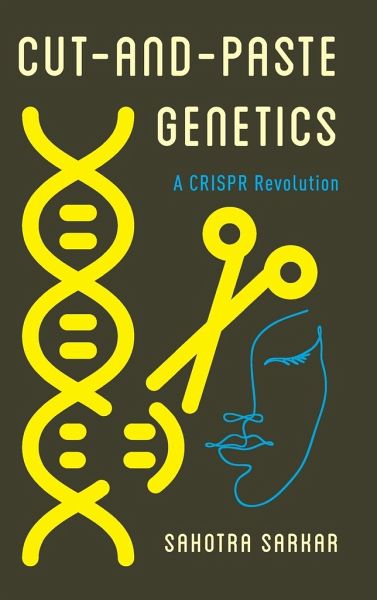
Bringing together historical and ethical insights on the revolutionary, Nobel prize winning CRISPR/Cas9 gene editing technology, this accessible book examines the history of human attempts to understand and control our evolution, how the CRISPR/Cas9 technology works and what it could mean for the elimination of genetic diseases.
Bringing together historical and ethical insights on the revolutionary, Nobel prize winning CRISPR/Cas9 gene editing technology, this accessible book examines the history of human attempts to understand and control our evolution, how the CRISPR/Cas9 technology works and what it could mean for the elimination of genetic diseases.
Sahotra Sarkar is a Professor in the Departments of Philosophy and Integrative Biology at the University of Texas, Austin. He came to Texas after teaching at Boston and McGill Universities and holding fellowships at MIT and the Max Planck Institute. A specialist in the history and philosophy of science, he has particular interests in both philosophy of biology and physics.
Inhaltsangabe
Preface 1.Breeding a Perfect Society Beginnings: Davenport and eugenics in the United States IQ and involuntary sterilization Genetics against eugenics Exporting sterilization The Watson scandal Davenport's dreams today 2.Molecular Diseases, Elusive Treatments The molecularization of biology Molecular diseases But no molecular medicine Dreams of editing genes Followed by stunning failure Recombinant DNA made no difference Gene editing BC 3.What Good Was the Human Genome Project? The sequence revealed Common diseases and common variants Medical irrelevance of the sequence Critiques of the HGP, past and present Evolution and architecture of the genome Evolutionary contingency 4.The CRISPR Revolution The CRISPR structure emerges Its function is decoded The mechanism of immunity Onward to gene editing The delivery problem Ubiquitous CRISPR 5.Inevitable Eugenics? Eugenics in the news What is eugenics? Defining eugenics A working definition Inescapable eugenics? Matters of ethics 6.Eliminating Genetic Diseases The long reach of Huntington's disease The He Jiankui affair The ethics of human germ-line intervention The limits of current science Gene specificity and Lenin's brain A policy proposal Proceed with caution Liberal and moderate eugenics 7.Designer Baby Delusions Why not genetic enhancement? The normal and the enhanced Liberal eugen- ics and genetic enhancement Rationality of genetic enhancement Planned human obsolescence Where is the science? The case of intelligence Genomics and IQ What about physical traits Genetic reductionism Contextual developmental construction What is perfection? 8.A CRISPR Future Editing the human germ-line Gene drives The ethics of promoting extinction Biosecurity CRISPR without the hype
Preface 1.Breeding a Perfect Society Beginnings: Davenport and eugenics in the United States IQ and involuntary sterilization Genetics against eugenics Exporting sterilization The Watson scandal Davenport's dreams today 2.Molecular Diseases, Elusive Treatments The molecularization of biology Molecular diseases But no molecular medicine Dreams of editing genes Followed by stunning failure Recombinant DNA made no difference Gene editing BC 3.What Good Was the Human Genome Project? The sequence revealed Common diseases and common variants Medical irrelevance of the sequence Critiques of the HGP, past and present Evolution and architecture of the genome Evolutionary contingency 4.The CRISPR Revolution The CRISPR structure emerges Its function is decoded The mechanism of immunity Onward to gene editing The delivery problem Ubiquitous CRISPR 5.Inevitable Eugenics? Eugenics in the news What is eugenics? Defining eugenics A working definition Inescapable eugenics? Matters of ethics 6.Eliminating Genetic Diseases The long reach of Huntington's disease The He Jiankui affair The ethics of human germ-line intervention The limits of current science Gene specificity and Lenin's brain A policy proposal Proceed with caution Liberal and moderate eugenics 7.Designer Baby Delusions Why not genetic enhancement? The normal and the enhanced Liberal eugen- ics and genetic enhancement Rationality of genetic enhancement Planned human obsolescence Where is the science? The case of intelligence Genomics and IQ What about physical traits Genetic reductionism Contextual developmental construction What is perfection? 8.A CRISPR Future Editing the human germ-line Gene drives The ethics of promoting extinction Biosecurity CRISPR without the hype
Es gelten unsere Allgemeinen Geschäftsbedingungen: www.buecher.de/agb
Impressum
www.buecher.de ist ein Internetauftritt der buecher.de internetstores GmbH
Geschäftsführung: Monica Sawhney | Roland Kölbl | Günter Hilger
Sitz der Gesellschaft: Batheyer Straße 115 - 117, 58099 Hagen
Postanschrift: Bürgermeister-Wegele-Str. 12, 86167 Augsburg
Amtsgericht Hagen HRB 13257
Steuernummer: 321/5800/1497
USt-IdNr: DE450055826