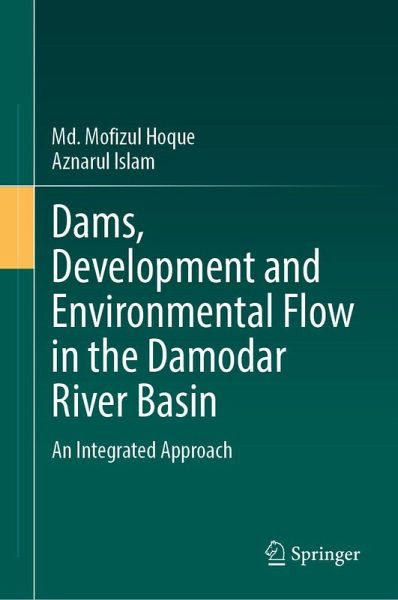
The Damodar River Basin (DRB), one of the most populated regions of the world, exerts huge pressure on land through different kinds of human interventions like the construction of the Damodar Valley Corporation (DVC) and environmental flow alterations. However, there is no single book produced to date on the environmental flow in the context of dams and development from a holistic perspective. This book intends to fill out the long-felt gap in this region, and will not only cater to the needs of students at the undergraduate and graduate levels in earth sciences, geography, and environmental…mehr
The Damodar River Basin (DRB), one of the most populated regions of the world, exerts huge pressure on land through different kinds of human interventions like the construction of the Damodar Valley Corporation (DVC) and environmental flow alterations. However, there is no single book produced to date on the environmental flow in the context of dams and development from a holistic perspective. This book intends to fill out the long-felt gap in this region, and will not only cater to the needs of students at the undergraduate and graduate levels in earth sciences, geography, and environmental sciences, but will also fill up the gap for regional planners and decision-makers in comprehending the complexity of the DRB for better environmental flow restorations.
This book provides the first systematic analysis of the environmental flow of the Damodar River in the context of the dams and development, offering lucid treatment of the subject using quantitative, statistical andGIS methods in an integrated manner. It delivers a community-level analysis of the dams and development with a focus on economic and ecologic dimensions, while fostering an integration between the field-based Indigenous and community knowledge and modern technology for environmental flow restoration of the river.
Md. Mofizul Hoque completed Master of Science in Geography in 2016 and PhD in Geography in 2024 from the Aliah University, Kolkata, India. He has published 12 research articles in various renowned international journals of geography and geoscience. He has contributed 4 book chapters in edited volumes. His principal areas of research include environmental flow, river pollution, soil contamination, and water resource management for sustainable development. Aznarul Islam completed Master of Science in Geography from Kalyani University, West Bengal and MPhil and PhD in Geography from the University of Burdwan, West Bengal, India. He is an Assistant Professor in the Department of Geography, Aliah University (AU), Kolkata, India since 2016 and served as the Head (Officiating), Department of Geography, AU from November 2019 to February 2022. Previously he was an Assistant Professor (West Bengal Education Service) at the Department of Geography, Barasat Government College, West Bengal (2014-2016). Dr. Islam served as the Guest Faculty/visiting faculty in a few institutes like Jadavpur University, Kolkata, and Kazi Nazrul University, Asansol. He was awarded the UGC Junior Research Fellowship in Geography in 2012. Besides, he secured All India Rank 018/188 in Earth Sciences in CSIR-UGC NET in 2011. He has already published more than 80 research papers including 70 SCI journal articles. He is the principal author of the book ‘Riverbank Erosion in the Bengal Delta: An Integrated Perspective’ published in 2024 by Springer. He edited another 10 books and contributed more than 26 book chapters in edited volumes and conference proceedings. He has presented papers in more than 35 national and international seminars and conferences. He has successfully guided 4 PhD theses; 3 theses under preparation. He was awarded one UGC minor research project. He completed one major research project funded by the ICSSR, Govt. of India in 2019 as the sole Project Director. He received a Department of Science and Technology (Govt. of India)- Science and Engineering Research Board (DST-SERB) State University Research Excellence (SURE) Award in 2023 as the Principal Investigator. He has been performing the role of editor and reviewer in various journals published by Springer, Elsevier, Taylor and Francis, Wiley, Nature, MDPI, Frontiers etc. He is a life member of the Foundation of Practising Geographers (FPG), Kolkata, and the National Association of Geographers, India (NAGI), New Delhi. His principal area of research includes exploring river, water and society through the lens of applied spatial sciences using quantitative techniques and geo-informatics for reducing fluvial and hydrological hazards to enhance community relicense.
Inhaltsangabe
Chapter 1: Introduction. Chapter 2: Geographical Personality and Hydrological Hazards In The Damodar River Basin. Chapter 3: Damodar Valley Corporation and Quantitative Environmental Flow Alteration. Chapter 4: Damodar Valley Corporation and Qualitative Environmental Flow Alteration. Chapter 5: Dams and Development. Chapter 6: Dams and Environmental Sustainability. Chapter 7: Environmental Flow Management. Chapter 8: Conclusions.