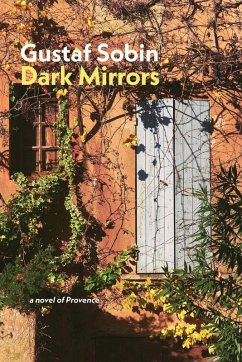
It was the last chance Guy Fallows would give himself. A stunning 16th-century Provençal dovecote he'd found while hiking had given him both the inspiration and the material necessary to write a new novel. It had also led him to Solange Daubigny who'd inherited that seemingly weightless structure, years earlier. Together they found themselves enveloped in a clandestine affair: each Thursday, the elegant, highly sedate Solange flourished under the pseudonym of Frédérique. As their passion grew, so did the tower in Fallows' novel. The dovecote also led Fallows to reconstitute its recent history.…mehr
It was the last chance Guy Fallows would give himself. A stunning 16th-century Provençal dovecote he'd found while hiking had given him both the inspiration and the material necessary to write a new novel. It had also led him to Solange Daubigny who'd inherited that seemingly weightless structure, years earlier. Together they found themselves enveloped in a clandestine affair: each Thursday, the elegant, highly sedate Solange flourished under the pseudonym of Frédérique. As their passion grew, so did the tower in Fallows' novel. The dovecote also led Fallows to reconstitute its recent history. For, during the war years, it had been restored to its present glory by an obscure Italian stonemason, Guido Stampelli. How, though, had Solange's mother - who'd commissioned the work - paid for such labour, given that she'd been left penniless by her husband, despised collaborator who'd fled to West Africa? In Gustaf Sobin's consummate narrative one hypnotically absorbing love story reflects another. Like the limestone monument itself his novel soars to a power quite its own.
Gustaf Sobin (1935-2005) was an American expatriate poet, resident for many years in Provence. He was born in Boston, and graduated from Brown University in 1957. In 1962, he moved to France, meeting René Char during his early days in Paris, a poet whose work he greatly admired and whose poetry was to have a great influence on his own. It was Char who suggested that Sobin go to Provence, and he promptly did so, settling in a small hamlet in the Luberon, not far from Char's home town. He was able to purchase an old silk cocoonery, and then to live frugally, while trying to find his way as a writer. In 1968 he married an English painter, Susannah Bott. For the rest of his life he and his family were to live in this old building, occasionally extended when the need arose. Sobin was eventually to build himself a small cabanon some 50 yards from the house, along a tree-lined path, where he could write, always standing. It took some years before he was to find his poetic voice, and it was only in 1973 that he wrote what he considered to be his first poem, notwithstanding two chapbooks which had appeared in the 1960s. In the 1970s, his work was taken up by Eliot Weinberger's pioneering magazine 'Montemora' which went on to publish his first two collections, 'Wind Chrysalid's Rattle' and 'Celebration of the Sound Through' as supplements to the journal. Subsequent collections were published by New Directions and Talisman House. In the 1990s and early 2000s, Sobin also published four novels and a fine collection of essays on Provence, 'Luminous Debris'. His Collected Poems were published posthumously in 2010.
Es gelten unsere Allgemeinen Geschäftsbedingungen: www.buecher.de/agb
Impressum
www.buecher.de ist ein Internetauftritt der buecher.de internetstores GmbH
Geschäftsführung: Monica Sawhney | Roland Kölbl | Günter Hilger
Sitz der Gesellschaft: Batheyer Straße 115 - 117, 58099 Hagen
Postanschrift: Bürgermeister-Wegele-Str. 12, 86167 Augsburg
Amtsgericht Hagen HRB 13257
Steuernummer: 321/5800/1497
USt-IdNr: DE450055826