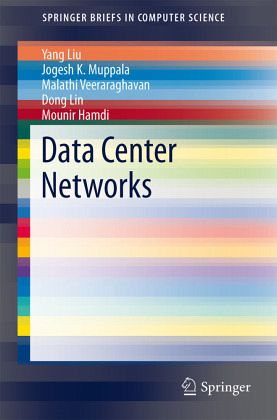
This SpringerBrief presents a survey of data center network designs and topologies and compares several properties in order to highlight their advantages and disadvantages. The brief also explores several routing protocols designed for these topologies and compares the basic algorithms to establish connections, the techniques used to gain better performance, and the mechanisms for fault-tolerance. Readers will be equipped to understand how current research on data center networks enables the design of future architectures that can improve performance and dependability of data centers. This…mehr
This SpringerBrief presents a survey of data center network designs and topologies and compares several properties in order to highlight their advantages and disadvantages. The brief also explores several routing protocols designed for these topologies and compares the basic algorithms to establish connections, the techniques used to gain better performance, and the mechanisms for fault-tolerance. Readers will be equipped to understand how current research on data center networks enables the design of future architectures that can improve performance and dependability of data centers. This concise brief is designed for researchers and practitioners working on data center networks, comparative topologies, fault tolerance routing, and data center management systems. The context provided and information on future directions will also prove valuable for students interested in these topics.
Artikelnr. des Verlages: 86260517, 978-3-319-01948-2
2013
Seitenzahl: 80
Erscheinungstermin: 15. Oktober 2013
Englisch
Abmessung: 235mm x 155mm x 5mm
Gewicht: 137g
ISBN-13: 9783319019482
ISBN-10: 3319019481
Artikelnr.: 39157615
Herstellerkennzeichnung
Springer-Verlag GmbH
Tiergartenstr. 17
69121 Heidelberg
ProductSafety@springernature.com
Autorenporträt
Yang Liu (Senior Member, IEEE) is currently a Professor at the College of Mathematics and Computer Science, Zhejiang Normal University, China. He received his B.S. degree in mathematics from Zhejiang Normal University, Zhejiang, China, in 2003, and his Ph.D. degree from Tongji University, Shanghai, in 2008. He has authored over 100 publications and two books. He is an Associate Editor of Neural Processing Letters (Springer). He was recognized by Elsevier as a Most Cited Chinese Researcher in 2020-2021, and by Clarivate Analytics as a Highly Cited Researcher in 2019-2021. He was the supervisor of the ICCM Best Paper Award in 2016 and 2022. His research interests include distributed optimization, hybrid systems and logical systems. Jianquan Lu (Senior Member, IEEE) is currently a Professor at the Department of Systems Science, School of Mathematics, Southeast University, Nanjing, China. He received his B.S. degree in mathematics from Zhejiang Normal University, Zhejiang, China, in 2003, his M.S. degree in mathematics from Southeast University, Nanjing, China, in 2006, and his Ph.D. degree in applied mathematics from City University of Hong Kong in 2009. From 2010 to 2012, he was an Alexander von Humboldt Research Fellow at the PIK, Germany. His current research interests include collective behavior in complex dynamical networks and multi-agent systems, logical networks, and hybrid systems. He has published over 90 papers in refereed international journals. Dr. Lu was named a Highly Cited Researcher by Clarivate Analytics from 2018 for three consecutive years, and he was elected one of the Most Cited Chinese Researchers by Elsevier in 2014-2019. He was part of the Program for New Century Excellent Talents in University by The Ministry of Education, China in 2010, and won the Second Award of Jiangsu Provincial Progress in Science and Technology in 2016 as the First Project Member, and the First Award of Jiangsu Provincial Progress in Science and Technology in 2010 asthe Second Project Member. Dr. Lu is an associate editor of Neural Processing Letters (Springer), Journal of Franklin Institute (Elsevier), and Neural Computing and Applications (Springer), and a guest editor of Science China: Information Sciences, Mathematics and Computers in Simulation (Elsevier) and IET Control Theory & Applications. Liangjie Sun is currently pursuing her Ph.D. degree at the Department of Mathematics, The University of Hong Kong. She received her B.S. degree in mathematics from Zhejiang Normal University, Zhejiang, China, in 2016, and her M.S. degree in mathematics from Southeast University, Nanjing, China, in 2019. Her undergraduate thesis: "On the Control Theory of Logical Systems: An Approach of Semi-Tensor Product of Matrices" won the New World Mathematics Awards, Bachelor Thesis Awards - Silver Prize in 2016. Her master's thesis: "Sampled-data control of Boolean networks and some related qualitative problems" won the outstanding master's degree award of Jiangsu Province in 2020. Her current research interests include logical dynamics systems and computational biology.
Inhaltsangabe
Introduction.- Data Center Network Topologies: Current State-of-the-Art.- Data Center Network Topologies: Research Proposals.- Routing Techniques.- Performance Enhancement.- Fault-Tolerant Routing.- Conclusions.
Introduction.- Data Center Network Topologies: Current State-of-the-Art.- Data Center Network Topologies: Research Proposals.- Routing Techniques.- Performance Enhancement.- Fault-Tolerant Routing.- Conclusions.
Es gelten unsere Allgemeinen Geschäftsbedingungen: www.buecher.de/agb
Impressum
www.buecher.de ist ein Internetauftritt der buecher.de internetstores GmbH
Geschäftsführung: Monica Sawhney | Roland Kölbl | Günter Hilger
Sitz der Gesellschaft: Batheyer Straße 115 - 117, 58099 Hagen
Postanschrift: Bürgermeister-Wegele-Str. 12, 86167 Augsburg
Amtsgericht Hagen HRB 13257
Steuernummer: 321/5800/1497
USt-IdNr: DE450055826