Data integration is a critical problem in our increasingly interconnected but inevitably heterogeneous world. There are numerous data sources available in organizational databases and on public information systems like the World Wide Web. Not surprisingly, the sources often use different vocabularies and different data structures, being created, as they are, by different people, at different times, for different purposes. The goal of data integration is to provide programmatic and human users with integrated access to multiple, heterogeneous data sources, giving each user the illusion of a…mehr
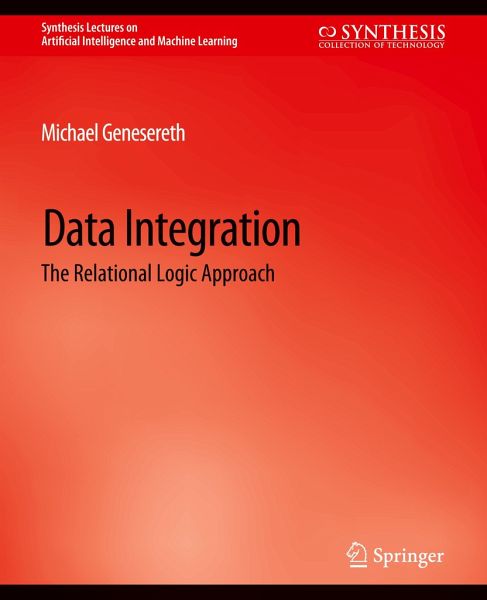
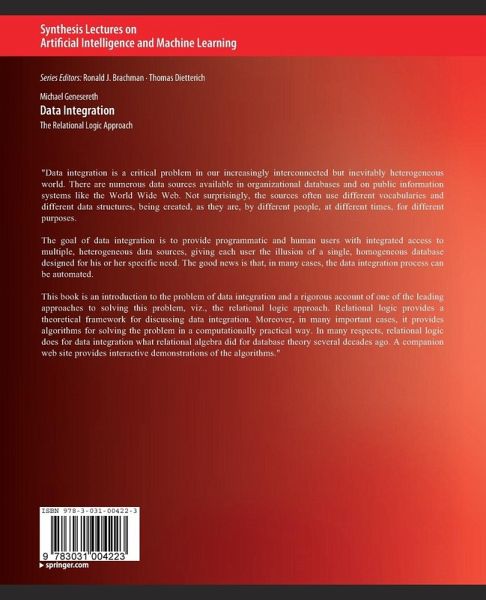
Data integration is a critical problem in our increasingly interconnected but inevitably heterogeneous world. There are numerous data sources available in organizational databases and on public information systems like the World Wide Web. Not surprisingly, the sources often use different vocabularies and different data structures, being created, as they are, by different people, at different times, for different purposes. The goal of data integration is to provide programmatic and human users with integrated access to multiple, heterogeneous data sources, giving each user the illusion of a single, homogeneous database designed for his or her specific need. The good news is that, in many cases, the data integration process can be automated. This book is an introduction to the problem of data integration and a rigorous account of one of the leading approaches to solving this problem, viz., the relational logic approach. Relational logic provides a theoretical framework for discussing data integration. Moreover, in many important cases, it provides algorithms for solving the problem in a computationally practical way. In many respects, relational logic does for data integration what relational algebra did for database theory several decades ago. A companion web site provides interactive demonstrations of the algorithms. Table of Contents: Preface / Interactive Edition / Introduction / Basic Concepts / Query Folding / Query Planning / Master Schema Management / Appendix / References / Index / Author Biography Don't have access? Recommend our Synthesis Digital Library to your library or purchase a personal subscription. Email info@morganclaypool.com for details.
Produktdetails
Produktdetails
Synthesis Lectures on Artificial Intelligence and Machine Learning
Michael Genesereth is a professor in the Computer Science Department at Stanford University and a professor by courtesy in the Stanford Law School. He received his Sc.B. in Physics from M.I.T. and his Ph.D. in Applied Mathematics from Harvard University. Genesereth is most known for his work on Computational Logic and applications of that work in Enterprise Management, Computational Law, and General Game Playing. He is one of the founders of Teknowledge, CommerceNet, Mergent Systems, and Symbium. Genesereth is the current director of the Logic Group at Stanford and co-founder and research director of CodeX (the Stanford Center for Legal Informatics).Vinay K. Chaudhri is formerly a program director in the Artificial Intelligence Center at SRI International, and currently affiliated with the Stanford Computer Science Department. He received his Ph.D. in Computer Science from University of Toronto, Canada. Dr. Chaudhri is arecognized expert on artificial intelligence, including knowledgerepresentation and reasoning, question answering, ontologies, and knowledge acquisition. At Stanford his activities include promoting logic education for secondary schools, investigating techniques for rapidly acquiring formal knowledge and productizing intelligent textbooks. He consults with the financial industry on computable contracts and knowledge graphs. He has also taught courses on knowledge representation and reasoning and logic programming.