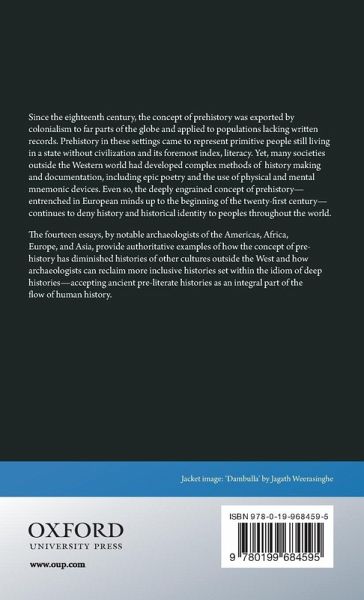
Since the eighteenth century, the concept of prehistory was exported by colonialism to far parts of the globe and applied to populations lacking written records. Prehistory in these settings came to represent primitive people still living in a state without civilization and its foremost index, literacy. Yet, many societies outside the Western world had developed complex methods of history making and documentation, including epic poetry and the use of physical and mental mnemonic devices. Even so, the deeply engrained concept of prehistory--deeply entrenched in European minds up to the…mehr
Since the eighteenth century, the concept of prehistory was exported by colonialism to far parts of the globe and applied to populations lacking written records. Prehistory in these settings came to represent primitive people still living in a state without civilization and its foremost index, literacy. Yet, many societies outside the Western world had developed complex methods of history making and documentation, including epic poetry and the use of physical and mental mnemonic devices. Even so, the deeply engrained concept of prehistory--deeply entrenched in European minds up to the beginning of the twenty-first century--continues to deny history and historical identify to peoples throughout the world. The fourteen essays, by notable archaeologists of the Americas, Africa, Europe, and Asia, provide authoritative examples of how the concept of prehistory has diminished histories of other cultures outside the West and how archaeologists can reclaim more inclusive histories set within the idiom of deep histories--accepting ancient pre-literate histories as an integral part of the flow of human history.
Peter Schmidt is Professor of Anthropology and African Studies at the University of Florida. He has engaged historical archaeology and the archaeology of ancient times in Africa for the last 45 years and his interests range across many theoretical issues and fields of practice, including ethnoarchaeology, symbolic studies, the social construction of technology, and historical representation. Stephen Mrozowski is Professor of Anthropology at the University of Massachusetts Boston where he also serves as Director of the Andrew Fiske Memorial Center for Archaeological Research. He has carried out archaeological and ethnographic fieldwork in Eastern North America, Alaska, Northern Britain, Iceland and Barbados
Inhaltsangabe
* Preface * List of Figures * Notes on Contributors * 1: Peter R. Schmidt and Stephen A. Mrozowski: Introduction: The Death of Prehistory * Part I: Histories of Prehistory * 2: Alice Kehoe: Prehistory's History * 3: Paul Lane: Presencing the Past: Implications for Bridging the History-Prehistory Divide * Part II: Perspectives Arising Out of Africa and India * 4: Jonathan Walz: Routes to History: Archaeology and Being Articulate in Eastern Africa * 5: Peter Schmidt: Historical Archaeology, Colonial Entanglements, and Recuperating 'Timeless' Histories through Structuralism * 6: Matthew Pawlowicz and Adria LaViolette: Swahili Historical Chronicles from an Archaeological Perspective: Bridging History, Archaeology, Coast, and Hinterland in Southern Tanzania * 7: Uzma Rizvi: Creating Prehistory and Protohistory: Constructing otherness and politics of contemporary indigenous populations in India * Part III: Perspective Arising Out of the Americas * 8: Rosemary G. Joyce and Russell Sheptak: History Interrupted: Doing 'Historical Archaeology' in Central America * 9: Kent Lightfoot: Rethinking the Archaeology of Human/Environmental: Interactions in Deep-Time History * 10: Jeffrey Hantman: Sites in History, History in Sites: Archaeology, historical anthropology and indigenous knowledge in the Chesapeake * 11: Stephen Mrozowski: The Tyranny of Prehistory and the Search for a Deeper History * 12: Rae Gould: Cultural Practice and Authenticity: The search for real Indians in New England in the 'historical' period * 13: Joseph Aguilar and Robert Preucel: Pueblo Time, Space, and History in the Aftermath of the Pueblo Revolt of 1680 * 14: Stephen Mrozowski and Peter Schmidt: Conclusion: Reflections on Reforming the Past, Looking to the Future * Appendix: Swahili Chronicles * Bibliography * Index
* Preface * List of Figures * Notes on Contributors * 1: Peter R. Schmidt and Stephen A. Mrozowski: Introduction: The Death of Prehistory * Part I: Histories of Prehistory * 2: Alice Kehoe: Prehistory's History * 3: Paul Lane: Presencing the Past: Implications for Bridging the History-Prehistory Divide * Part II: Perspectives Arising Out of Africa and India * 4: Jonathan Walz: Routes to History: Archaeology and Being Articulate in Eastern Africa * 5: Peter Schmidt: Historical Archaeology, Colonial Entanglements, and Recuperating 'Timeless' Histories through Structuralism * 6: Matthew Pawlowicz and Adria LaViolette: Swahili Historical Chronicles from an Archaeological Perspective: Bridging History, Archaeology, Coast, and Hinterland in Southern Tanzania * 7: Uzma Rizvi: Creating Prehistory and Protohistory: Constructing otherness and politics of contemporary indigenous populations in India * Part III: Perspective Arising Out of the Americas * 8: Rosemary G. Joyce and Russell Sheptak: History Interrupted: Doing 'Historical Archaeology' in Central America * 9: Kent Lightfoot: Rethinking the Archaeology of Human/Environmental: Interactions in Deep-Time History * 10: Jeffrey Hantman: Sites in History, History in Sites: Archaeology, historical anthropology and indigenous knowledge in the Chesapeake * 11: Stephen Mrozowski: The Tyranny of Prehistory and the Search for a Deeper History * 12: Rae Gould: Cultural Practice and Authenticity: The search for real Indians in New England in the 'historical' period * 13: Joseph Aguilar and Robert Preucel: Pueblo Time, Space, and History in the Aftermath of the Pueblo Revolt of 1680 * 14: Stephen Mrozowski and Peter Schmidt: Conclusion: Reflections on Reforming the Past, Looking to the Future * Appendix: Swahili Chronicles * Bibliography * Index
Es gelten unsere Allgemeinen Geschäftsbedingungen: www.buecher.de/agb
Impressum
www.buecher.de ist ein Internetauftritt der buecher.de internetstores GmbH
Geschäftsführung: Monica Sawhney | Roland Kölbl | Günter Hilger
Sitz der Gesellschaft: Batheyer Straße 115 - 117, 58099 Hagen
Postanschrift: Bürgermeister-Wegele-Str. 12, 86167 Augsburg
Amtsgericht Hagen HRB 13257
Steuernummer: 321/5800/1497
USt-IdNr: DE450055826