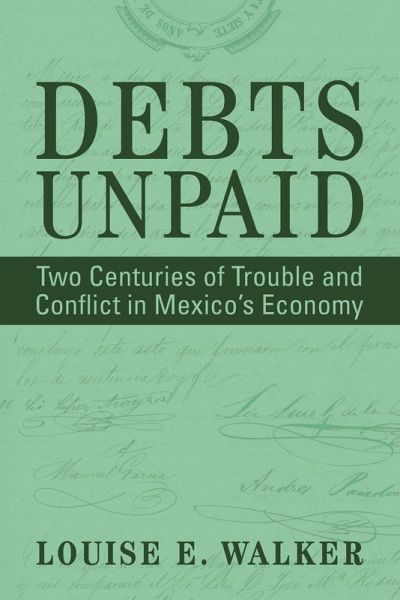
Blending rich storytelling and deep analysis, this study explores how everyday people fought for economic justice in Mexico from the eve of independence to the early 2000s. Small-scale conflicts between Mexico's debtors and creditors were the stress test for economic order over two centuries of transformation.
Blending rich storytelling and deep analysis, this study explores how everyday people fought for economic justice in Mexico from the eve of independence to the early 2000s. Small-scale conflicts between Mexico's debtors and creditors were the stress test for economic order over two centuries of transformation.
Louise E. Walker is Professor of History at Northeastern University. Her previous publications include the prize-winning Waking from the Dream: Mexico's Middle Classes after 1968 (2013).
Inhaltsangabe
Introduction 1. Little debts: Justice and citizenship in small claims, 1810s-1860s 1.1 A contractual society 1.2 The judicial city 1.3 Mediating debt disputes in the juicios verbales 1.4 The parameters of economic justice 1.5 Continuity and change after 1812 1.6 The humdrum as historic 2. Broken contracts: Precaution and risk in litigation and law, 1860s-1870s 2.1 Debt litigation on the rise 2.2 Trading information with friends and strangers 2.3 Risk, uncertainty, and the providencias precautorias 2.4 Property seizure and the politics of property rights 2.5 Avoiding obligations and litigating trust 2.6 Law and economy: Making rules for unpaid debts 2.7 Between two worlds 3. Unworthy: Economic information in credit reports, 1880s-1920s 3.1 Credit reports and the new horizon of bureaucratic trust 3.2 Banamex and financial exclusion 3.3 Evaluating creditworthiness 3.4 Institutional lending in a time of revolution 3.5 Defining the boundaries of economic honour 3.6 Economic information from gossip to bureaucracy 4. Bad cheques: Property crime and the moral economy of financialisation, 1930s-1980s 4.1 The criminalisation of uncovered cheques 4.2 Economic citizenship and financial inclusion 4.3 Misuse, malfeasance, and the growing pains of financial modernity 4.4 Social inertia, friction, and the latent coercion of financialisation 4.5 From delinquency to vulnerability 5. Asking for help: Letters about fairness and dispossession, 1990s-2000s 5.1 From citizens to financial service users 5.2 Institutional borrowing in an era of crisis 5.3 Indebtedness and dehumanisation 5.4 Economic storytelling and the power of the president 5.5 Usury and the new purgatory 5.6 The Credit Bureau and the Black List 5.7 Villains and victims Conclusion Notes References Index.
Introduction 1. Little debts: Justice and citizenship in small claims, 1810s-1860s 1.1 A contractual society 1.2 The judicial city 1.3 Mediating debt disputes in the juicios verbales 1.4 The parameters of economic justice 1.5 Continuity and change after 1812 1.6 The humdrum as historic 2. Broken contracts: Precaution and risk in litigation and law, 1860s-1870s 2.1 Debt litigation on the rise 2.2 Trading information with friends and strangers 2.3 Risk, uncertainty, and the providencias precautorias 2.4 Property seizure and the politics of property rights 2.5 Avoiding obligations and litigating trust 2.6 Law and economy: Making rules for unpaid debts 2.7 Between two worlds 3. Unworthy: Economic information in credit reports, 1880s-1920s 3.1 Credit reports and the new horizon of bureaucratic trust 3.2 Banamex and financial exclusion 3.3 Evaluating creditworthiness 3.4 Institutional lending in a time of revolution 3.5 Defining the boundaries of economic honour 3.6 Economic information from gossip to bureaucracy 4. Bad cheques: Property crime and the moral economy of financialisation, 1930s-1980s 4.1 The criminalisation of uncovered cheques 4.2 Economic citizenship and financial inclusion 4.3 Misuse, malfeasance, and the growing pains of financial modernity 4.4 Social inertia, friction, and the latent coercion of financialisation 4.5 From delinquency to vulnerability 5. Asking for help: Letters about fairness and dispossession, 1990s-2000s 5.1 From citizens to financial service users 5.2 Institutional borrowing in an era of crisis 5.3 Indebtedness and dehumanisation 5.4 Economic storytelling and the power of the president 5.5 Usury and the new purgatory 5.6 The Credit Bureau and the Black List 5.7 Villains and victims Conclusion Notes References Index.
Es gelten unsere Allgemeinen Geschäftsbedingungen: www.buecher.de/agb
Impressum
www.buecher.de ist ein Internetauftritt der buecher.de internetstores GmbH
Geschäftsführung: Monica Sawhney | Roland Kölbl | Günter Hilger
Sitz der Gesellschaft: Batheyer Straße 115 - 117, 58099 Hagen
Postanschrift: Bürgermeister-Wegele-Str. 12, 86167 Augsburg
Amtsgericht Hagen HRB 13257
Steuernummer: 321/5800/1497
USt-IdNr: DE450055826