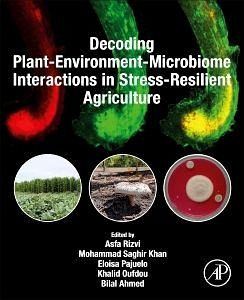
Decoding Plant-Environment-Microbiome Interactions in Stress-Resilient Agriculture delivers both foundational understanding and forward-looking perspectives on the rapidly advancing field of phytomicrobiome research. Showcasing the unique advantages of microbial partnerships in stressed soils, the book explores how optimizing plant-microbiome interactions can transform crop productivity and sustainability. Focusing on the phytomicrobiome’s diverse components-including root-associated microbiota, plant growth-promoting rhizobacteria, endophytes, phosphate-solubilizing microorganisms, arbuscular…mehr
Decoding Plant-Environment-Microbiome Interactions in Stress-Resilient Agriculture delivers both foundational understanding and forward-looking perspectives on the rapidly advancing field of phytomicrobiome research. Showcasing the unique advantages of microbial partnerships in stressed soils, the book explores how optimizing plant-microbiome interactions can transform crop productivity and sustainability. Focusing on the phytomicrobiome’s diverse components-including root-associated microbiota, plant growth-promoting rhizobacteria, endophytes, phosphate-solubilizing microorganisms, arbuscular mycorrhizal fungi, and actinomycetes-the volume reveals how these microbial networks enhance plant stress tolerance, rehabilitate degraded or contaminated soils, and sustain yields under adverse conditions. Harnessing these natural bioresources effectively requires an integrated understanding of the complex crosstalk between plants and their associated microbes, from molecular signaling to ecological mechanisms. Drawing on insights from internationally recognized scientists and leading academicians, this book consolidates cutting-edge research and emerging innovations, providing readers with the knowledge needed to advance stress-resilient and environmentally sustainable agriculture.
Section A: Phytomicrobiome and abiotic stresses 1. Heavy metal-rhizobiome interactions: abundance, composition, and physiological functions 2. Salt stress-soil microbiome interactions: structure, diversity, and physiological functions 3. Drought stress effects on soil microbial diversity and function: an integrative review 4. Effect of extreme temperatures on microbial growth and associated activities 5. Abiotic stress-plant interactions: morphoanatomical features and physiological functions 6. Genotoxic effects of different types of stresses on microbiome and plants 7. Phytochemicals under abiotic stress: production and their role in plant defense 8. Importance of proline in alleviation of abiotic stress in plants: recent advances 9. Development of stress resilience in the rhizobiome: an overview 10. Rhizosphere engineering for optimizing bioremediation potential: recent advances Section B: Phytomicrobiomes as biotools in agriculture resilience under stress conditions 11. Phytomicrobiome: ecology, physiology, and emerging trends in microbial applications 12. The plant holobiont: root exudates, rhizosphere interactions, and biotechnological applications 13. Plant endophytic microbiome: importance in crop production 14. Importance of bacterial exopolysaccharides (EPS) in mitigation of abiotic stress 15. Siderophilic microbes and their role in abatement of abiotic stress in plants 16. Remediation of stressed soils using plant growth-promoting rhizobacteria: recent developments 17. Phytoremediation: basic concepts and real success stories 18. Stress-tolerant rhizosphere microbiome and their interactions with plants: significance for crop production 19 Role of "omics" in designing biofertilizers to enhance plant resilience under stressful conditions 20. Bacterial biosorbents: an effective microbial strategy for metal detoxification 21. Stress-tolerant endophytes: importance in crop yield optimization 22. Performance of food crops in problem soils influenced by arbuscular mycorrhizal fungi 23. Actinomycetota: suitable microbiological agents for bioremediation and crop production 24. A broad host spectrum fungus, Piriformospora indica: a promising candidate for crop improvement in stressed environments 25. Bio-based nanoremediation of inorganic pollutants: concepts and applications Section C: Human health implications and food safety 26. Phytomicrobiome for promoting sustainable agriculture and food security: opportunities, challenges, and solutions 27. Human health risks and regulatory guidelines associated with consumption of contaminated/poor-quality foods 28. "A SWOT" analysis of the transfer of knowledge from the lab to the field: regulatory issues, developmental constraints, and opportunities
Es gelten unsere Allgemeinen Geschäftsbedingungen: www.buecher.de/agb
Impressum
www.buecher.de ist ein Internetauftritt der buecher.de internetstores GmbH
Geschäftsführung: Monica Sawhney | Roland Kölbl | Günter Hilger
Sitz der Gesellschaft: Batheyer Straße 115 - 117, 58099 Hagen
Postanschrift: Bürgermeister-Wegele-Str. 12, 86167 Augsburg
Amtsgericht Hagen HRB 13257
Steuernummer: 321/5800/1497
USt-IdNr: DE450055826