
Andere Kunden interessierten sich auch für
 Decolonising Lifelong Learning in the Age of Transnational Migration40,99 €
 Possibilities and Complexities of Decolonising Higher Education36,99 €
 Contemporary Issues in Primary Physical Education38,99 €
 Islamic value formation29,99 €
 Surveillance Education36,99 €
 Transformative Leadership in Education34,99 €
 Reforming Education Systems for Inclusion and Equity26,99 €

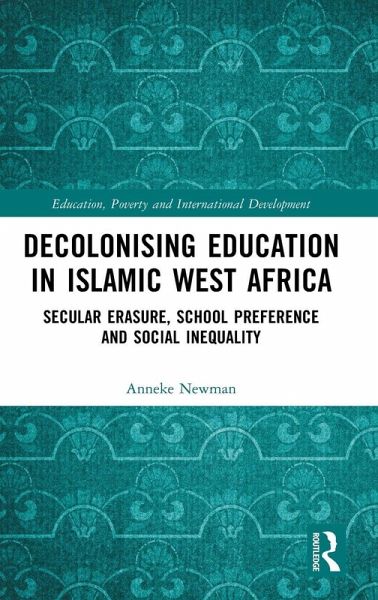
This book uses perceptions and experiences of Qur'anic schools in West Africa to outline a much-needed postsecular approach, reconsidering the place of Islamic education within African decolonial debates about educational pluralism, and the contributions of religious perspectives in academic and international development spaces.
Decolonial theory is used to overcome the challenges of problematic Eurocentric and colonialist stereotypes about religious actors and faith-based schools which persist within international education scholarship and global policy agendas. Through fine-grained ethnography, chapters discuss how parents and young people today engage with classical Qur'anic schools, Islamic schools and French-medium secular education in Senegal, thereby exposing inequalities around gender, descent-based or caste identities and socioeconomic status, as well as their influence on young people's pursuit of knowledge. These findings are valuable for scholars exploringthe development-education-religion nexus and promoting Education for All in communities characterised by other-than-secular worldviews.
The book will be of interest to academics, researchers and postgraduate students working in the sociology of education, international education, anthropology and religious education. Practitioners involved in postcolonial and decolonial debates will also benefit from recommendations regarding educational reform in plural educational contexts.
Decolonial theory is used to overcome the challenges of problematic Eurocentric and colonialist stereotypes about religious actors and faith-based schools which persist within international education scholarship and global policy agendas. Through fine-grained ethnography, chapters discuss how parents and young people today engage with classical Qur'anic schools, Islamic schools and French-medium secular education in Senegal, thereby exposing inequalities around gender, descent-based or caste identities and socioeconomic status, as well as their influence on young people's pursuit of knowledge. These findings are valuable for scholars exploringthe development-education-religion nexus and promoting Education for All in communities characterised by other-than-secular worldviews.
The book will be of interest to academics, researchers and postgraduate students working in the sociology of education, international education, anthropology and religious education. Practitioners involved in postcolonial and decolonial debates will also benefit from recommendations regarding educational reform in plural educational contexts.