
Decolonising Media and Communication Studies Education in Sub-Saharan Africa
Herausgeber: Mudavanhu, Selina Linda; Batisai, Kezia; Mpofu, Shepherd
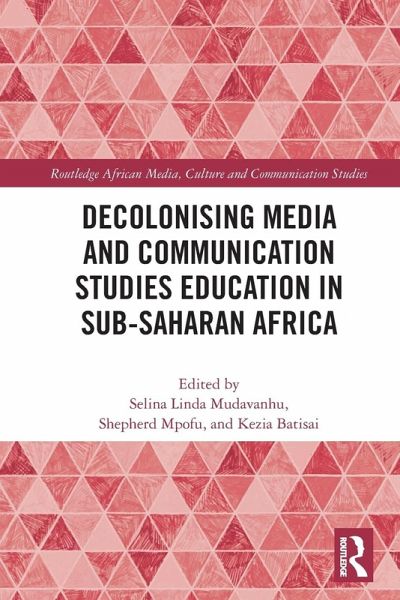

Decolonising Media and Communication Studies Education in Sub-Saharan Africa
Herausgeber: Mudavanhu, Selina Linda; Batisai, Kezia; Mpofu, Shepherd
- Broschiertes Buch
- Merkliste
- Auf die Merkliste
- Bewerten Bewerten
- Teilen
- Produkt teilen
- Produkterinnerung
- Produkterinnerung
The book provides insights on decolonising media and communication studies education from diverse African scholars at different stages of their careers. The concepts and ideas on decolonising teaching and learning in the book are relevant to instructors in any discipline, interested in doing the decolonial work of contesting coloniality.
The book provides insights on decolonising media and communication studies education from diverse African scholars at different stages of their careers. The concepts and ideas on decolonising teaching and learning in the book are relevant to instructors in any discipline, interested in doing the decolonial work of contesting coloniality.
Produktdetails
- Produktdetails
- Verlag: Routledge
- Seitenzahl: 300
- Erscheinungstermin: 30. Januar 2025
- Englisch
- Abmessung: 234mm x 156mm x 16mm
- Gewicht: 459g
- ISBN-13: 9781032483078
- ISBN-10: 1032483075
- Artikelnr.: 72542946
- Herstellerkennzeichnung
- Libri GmbH
- Europaallee 1
- 36244 Bad Hersfeld
- gpsr@libri.de
- Verlag: Routledge
- Seitenzahl: 300
- Erscheinungstermin: 30. Januar 2025
- Englisch
- Abmessung: 234mm x 156mm x 16mm
- Gewicht: 459g
- ISBN-13: 9781032483078
- ISBN-10: 1032483075
- Artikelnr.: 72542946
- Herstellerkennzeichnung
- Libri GmbH
- Europaallee 1
- 36244 Bad Hersfeld
- gpsr@libri.de
Selina Linda Mudavanhu is Assistant Professor in the Communication Studies and Media Arts Department in the Humanities faculty at McMaster University in Canada. She is also Senior Research Associate with the Department of Communication and Media (University of Johannesburg, South Africa). Selina holds a PhD in Media Studies from South Africa. She also has degrees from the University of Zimbabwe. Her research interests include critical media studies, critical race studies, coloniality, and decoloniality as well as digital storytelling. Selina has received grants and awards to convene qualitative projects using digital storytelling with partners in Canada and South Africa. She has received funding from the Ontario Council on Articulation and Transfer, the Carnegie African Diaspora Fellowship Program, the Petro-Canada-McMaster University Young Innovator Award, the McMaster Arts Research Board, McMaster University's International Office, and the MacPherson Institute's Student Partners Program (SPP). Selina has published in edited volumes and peer-reviewed journals and is on the editorial boards of African Journalism Studies and Communicare: Journal for Communication Studies in Africa. Shepherd Mpofu is Associate Professor of Media and Communication at the University of South Africa. He has published several articles on communication, media, and journalism in Africa. His body of work covers social media and politics, social media and identity, and social media and protests. He is the editor of The Politics of Laughter in the Social Media Age: Perspectives From the Global South (Palgrave Macmillan 2021) and Digital Humour in the COVID-19 Pandemic: Perspectives From the Global South (Palgrave Macmillan 2021) and co-editor of Mediating Xenophobia in Africa (Palgrave 2020). Kezia Batisai is Professor of Sociology at the University of Johannesburg who holds a PhD in Gender Studies from the University of Cape Town. Kezia has written several journal articles, book chapters, technical reports, and opinion pieces that expand her theory of marginality. The published work questions notions of marginality and the meaning of being different that expose the politics of nation-building in Africa. Kezia's work articulates these notions of marginality through an interdisciplinary approach to gender, sexuality, health, and migration studies, and interrogates how people marked by society as "the minority" (based on intersecting positionalities) negotiate being different within various hierarchised zones of the everyday. Kezia is an active member of the International Sociological Association; South African Association for Gender Studies; South African Sociological Association; and the Research Network Law, Gender, and Sexuality (LEX) International Steering Committee.
PART I: BIG PICTURE CONSIDERATIONS: DECOLONISING MEDIA AND COMMUNICATION
STUDIES EDUCATION IN SUB-SAHARAN AFRICA 1: Connecting the dots:
decolonising communication and media studies teaching and learning in
sub-Saharan Africa 2: Towards centring African languages in media and
communication courses in postsecondary institutions in Africa PART II:
RETHINKING CLASSROOMS: IMPLICATIONS FOR STUDENTS, INSTRUCTORS, AND
INSTRUCTION 3: Decolonising and reimagining instructor-student
relationships in a communication and media studies fourth-level seminar 4:
De-Westernisation and de-sacralisation as imperatives for the
decolonisation of cinema teaching in sub-Saharan Africa 5: Decolonising
from the margins to the centre: Ghanaian communication classrooms in
perspective PART III: REFLECTIONS ON CURRICULA AND SYLLABI: POSSIBILITIES
AND IMPOSSIBILITIES 6: Reflections on a decolonised communication and media
studies curriculum 7: Towards a decolonised human, university, and
curriculum: Some critical notes 8: "An-Other" centred film curricula:
decolonising film studies in Africa 9: Decolonising the curricula and the
space in Africa: an interdisciplinary approach 10: Should curricula be the
same? Toward media studies curriculum reforms in Kenya 11: Decolonisation
deferred? An analysis of the Education 5.0 Doctrine, the Zimbabwe Council
for Higher Education approved media and communication curriculum and
selected writings by Zimbabwean media academics 12: Proposals for a
decolonised course outline for a theories and methods course in
communication and media studies 13: Reformatting and decolonising
postsecondary educational priorities in South Africa in view of COVID-19
PART IV: BEYOND CLASSROOMS 14: African journalists at crossroads: examining
the impact of China, US, and the UK's short-journalism training programme
o¿ered to African journalists 15: Ekoäo: an African approach to
decolonising communication research and practice
STUDIES EDUCATION IN SUB-SAHARAN AFRICA 1: Connecting the dots:
decolonising communication and media studies teaching and learning in
sub-Saharan Africa 2: Towards centring African languages in media and
communication courses in postsecondary institutions in Africa PART II:
RETHINKING CLASSROOMS: IMPLICATIONS FOR STUDENTS, INSTRUCTORS, AND
INSTRUCTION 3: Decolonising and reimagining instructor-student
relationships in a communication and media studies fourth-level seminar 4:
De-Westernisation and de-sacralisation as imperatives for the
decolonisation of cinema teaching in sub-Saharan Africa 5: Decolonising
from the margins to the centre: Ghanaian communication classrooms in
perspective PART III: REFLECTIONS ON CURRICULA AND SYLLABI: POSSIBILITIES
AND IMPOSSIBILITIES 6: Reflections on a decolonised communication and media
studies curriculum 7: Towards a decolonised human, university, and
curriculum: Some critical notes 8: "An-Other" centred film curricula:
decolonising film studies in Africa 9: Decolonising the curricula and the
space in Africa: an interdisciplinary approach 10: Should curricula be the
same? Toward media studies curriculum reforms in Kenya 11: Decolonisation
deferred? An analysis of the Education 5.0 Doctrine, the Zimbabwe Council
for Higher Education approved media and communication curriculum and
selected writings by Zimbabwean media academics 12: Proposals for a
decolonised course outline for a theories and methods course in
communication and media studies 13: Reformatting and decolonising
postsecondary educational priorities in South Africa in view of COVID-19
PART IV: BEYOND CLASSROOMS 14: African journalists at crossroads: examining
the impact of China, US, and the UK's short-journalism training programme
o¿ered to African journalists 15: Ekoäo: an African approach to
decolonising communication research and practice
PART I: BIG PICTURE CONSIDERATIONS: DECOLONISING MEDIA AND COMMUNICATION
STUDIES EDUCATION IN SUB-SAHARAN AFRICA 1: Connecting the dots:
decolonising communication and media studies teaching and learning in
sub-Saharan Africa 2: Towards centring African languages in media and
communication courses in postsecondary institutions in Africa PART II:
RETHINKING CLASSROOMS: IMPLICATIONS FOR STUDENTS, INSTRUCTORS, AND
INSTRUCTION 3: Decolonising and reimagining instructor-student
relationships in a communication and media studies fourth-level seminar 4:
De-Westernisation and de-sacralisation as imperatives for the
decolonisation of cinema teaching in sub-Saharan Africa 5: Decolonising
from the margins to the centre: Ghanaian communication classrooms in
perspective PART III: REFLECTIONS ON CURRICULA AND SYLLABI: POSSIBILITIES
AND IMPOSSIBILITIES 6: Reflections on a decolonised communication and media
studies curriculum 7: Towards a decolonised human, university, and
curriculum: Some critical notes 8: "An-Other" centred film curricula:
decolonising film studies in Africa 9: Decolonising the curricula and the
space in Africa: an interdisciplinary approach 10: Should curricula be the
same? Toward media studies curriculum reforms in Kenya 11: Decolonisation
deferred? An analysis of the Education 5.0 Doctrine, the Zimbabwe Council
for Higher Education approved media and communication curriculum and
selected writings by Zimbabwean media academics 12: Proposals for a
decolonised course outline for a theories and methods course in
communication and media studies 13: Reformatting and decolonising
postsecondary educational priorities in South Africa in view of COVID-19
PART IV: BEYOND CLASSROOMS 14: African journalists at crossroads: examining
the impact of China, US, and the UK's short-journalism training programme
o¿ered to African journalists 15: Ekoäo: an African approach to
decolonising communication research and practice
STUDIES EDUCATION IN SUB-SAHARAN AFRICA 1: Connecting the dots:
decolonising communication and media studies teaching and learning in
sub-Saharan Africa 2: Towards centring African languages in media and
communication courses in postsecondary institutions in Africa PART II:
RETHINKING CLASSROOMS: IMPLICATIONS FOR STUDENTS, INSTRUCTORS, AND
INSTRUCTION 3: Decolonising and reimagining instructor-student
relationships in a communication and media studies fourth-level seminar 4:
De-Westernisation and de-sacralisation as imperatives for the
decolonisation of cinema teaching in sub-Saharan Africa 5: Decolonising
from the margins to the centre: Ghanaian communication classrooms in
perspective PART III: REFLECTIONS ON CURRICULA AND SYLLABI: POSSIBILITIES
AND IMPOSSIBILITIES 6: Reflections on a decolonised communication and media
studies curriculum 7: Towards a decolonised human, university, and
curriculum: Some critical notes 8: "An-Other" centred film curricula:
decolonising film studies in Africa 9: Decolonising the curricula and the
space in Africa: an interdisciplinary approach 10: Should curricula be the
same? Toward media studies curriculum reforms in Kenya 11: Decolonisation
deferred? An analysis of the Education 5.0 Doctrine, the Zimbabwe Council
for Higher Education approved media and communication curriculum and
selected writings by Zimbabwean media academics 12: Proposals for a
decolonised course outline for a theories and methods course in
communication and media studies 13: Reformatting and decolonising
postsecondary educational priorities in South Africa in view of COVID-19
PART IV: BEYOND CLASSROOMS 14: African journalists at crossroads: examining
the impact of China, US, and the UK's short-journalism training programme
o¿ered to African journalists 15: Ekoäo: an African approach to
decolonising communication research and practice