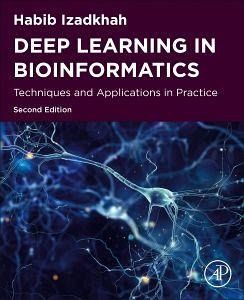
Deep Learning in Bioinformatics: Techniques and Applications in Practice, Second Edition introduces the topic in an easy-to-understand way, exploring how it can be utilized for addressing important problems in bioinformatics, including drug discovery, de novo molecular design, sequence analysis, protein structure prediction, gene expression regulation, protein classification, biomedical image processing and diagnosis, biomolecule interaction prediction, and in systems biology. The book also presents theoretical and practical successes of deep learning in bioinformatics, pointing out problems…mehr
Deep Learning in Bioinformatics: Techniques and Applications in Practice, Second Edition introduces the topic in an easy-to-understand way, exploring how it can be utilized for addressing important problems in bioinformatics, including drug discovery, de novo molecular design, sequence analysis, protein structure prediction, gene expression regulation, protein classification, biomedical image processing and diagnosis, biomolecule interaction prediction, and in systems biology. The book also presents theoretical and practical successes of deep learning in bioinformatics, pointing out problems and suggesting future research directions. The Second Edition includes several new chapters, and the applications and examples have been updated for new Deep Learning advances and techniques throughout. Dr. Izadkhah provides valuable insights and will help researchers use deep learning techniques in their biological and bioinformatics studies.
Dr. Habib Izadkhah is an Associate Professor at the Department of Computer Science, University of Tabriz, Iran. He worked in the industry for a decade as a software engineer before becoming an academic. His research interests include algorithms and graphs, software engineering, and bioinformatics. More recently he has been working on the developing and applying Deep Learning to a variety of problems, dealing with biomedical images, speech recognition, text understanding, and generative models. He has contributed to various research projects, authored a number of research papers in international conferences, workshops, and journals, and also has written five books, including Source Code Modularization: Theory and Techniques from Springer.
Inhaltsangabe
1. Why Life Science? 2. A Review of Machine Learning 3. An Introduction to the Python Ecosystem for Deep Learning 4. Preprocessing Techniques for Bioinformatics Data 5. Foundations of Neural Networks and Deep Learning 6. Convolutional Neural Networks in Biology and Bioinformatics 7. Recurrent Neural Networks: Generating New Molecules and Proteins Sequence Classification 8. Sequence-Based Analysis and Neural Networks 9. Graph Neural Networks for Bioinformatics 10. Transfer Learning in Bioinformatics: Adapting Pre-Trained Models 11. Pathway-Based Neural Networks for Biological Insights 12. Multi-Omics Integration Using Multi-Input Neural Networks 13. Deep Learning for Genomic and Metabolomics Data Analysis 14. Autoencoders and Deep Generative Models in Bioinformatics 15. Interpretable Neural Networks for Understanding Decisions in Biological Processes 16. Applications of Deep Learning in Personalized Medicine 17. Ethical Considerations and Challenges in Deep Learning for Bioinformatics
1. Why Life Science? 2. A Review of Machine Learning 3. An Introduction to the Python Ecosystem for Deep Learning 4. Preprocessing Techniques for Bioinformatics Data 5. Foundations of Neural Networks and Deep Learning 6. Convolutional Neural Networks in Biology and Bioinformatics 7. Recurrent Neural Networks: Generating New Molecules and Proteins Sequence Classification 8. Sequence-Based Analysis and Neural Networks 9. Graph Neural Networks for Bioinformatics 10. Transfer Learning in Bioinformatics: Adapting Pre-Trained Models 11. Pathway-Based Neural Networks for Biological Insights 12. Multi-Omics Integration Using Multi-Input Neural Networks 13. Deep Learning for Genomic and Metabolomics Data Analysis 14. Autoencoders and Deep Generative Models in Bioinformatics 15. Interpretable Neural Networks for Understanding Decisions in Biological Processes 16. Applications of Deep Learning in Personalized Medicine 17. Ethical Considerations and Challenges in Deep Learning for Bioinformatics
Es gelten unsere Allgemeinen Geschäftsbedingungen: www.buecher.de/agb
Impressum
www.buecher.de ist ein Internetauftritt der buecher.de internetstores GmbH
Geschäftsführung: Monica Sawhney | Roland Kölbl | Günter Hilger
Sitz der Gesellschaft: Batheyer Straße 115 - 117, 58099 Hagen
Postanschrift: Bürgermeister-Wegele-Str. 12, 86167 Augsburg
Amtsgericht Hagen HRB 13257
Steuernummer: 321/5800/1497
USt-IdNr: DE450055826