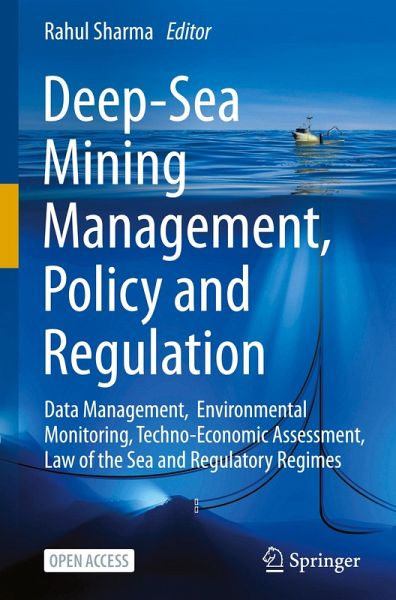
Deep-sea mining is currently in a critical phase wherein, detailed resource estimation has led to identification of potentially rich areas on the seafloor that can be mined, as well as testing of pre-prototype seabed mining machines and establishment of pilot plants for processing of deep-sea minerals is underway. This coupled with rigorous environmental data collection along with impact assessment of simulated as well as test mining is not only providing requisite information for likely impacts for development of predictive models but also for developing mitigation measures to minimise such…mehr
Deep-sea mining is currently in a critical phase wherein, detailed resource estimation has led to identification of potentially rich areas on the seafloor that can be mined, as well as testing of pre-prototype seabed mining machines and establishment of pilot plants for processing of deep-sea minerals is underway. This coupled with rigorous environmental data collection along with impact assessment of simulated as well as test mining is not only providing requisite information for likely impacts for development of predictive models but also for developing mitigation measures to minimise such impacts.
Interest in mining the seafloor deposits as potential source of critical metals has been enhanced in the current century owing to the rising population and consumer demands, as well as the fact that these minerals contain battery metals such as Co, Ni, Mn besides copper that can help transition to green energy alternatives. However, concerns over ecological impacts on marine ecosystems and those related to economic, social and cultural implications need to be addressed for ensuring sustainable mining of seabed mineral resources.
With this in view, this fifth book in the series of Deep-sea Mining , focusses on issues related to management, policy and regulation. The book is divided into the following five sections:
I General issues on resource potential and future prospects
Rahul Sharma (Ph.D.), is a Consultant on Deep-sea Mining and Former Chief Scientist, National Institute of Oceanography, India, having an experience of 4 decades in the field of deep-sea minerals exploration, environmental impact assessment and economic assessment of deep-sea mining. He has been a guest editor of 3 special issues of international journals, besides writing more than 65 papers and articles in international scientific journals as well as presenting papers at about 60 conferences around the world. He has also contributed a chapter on ‘Environmental consequences of deep-sea mining’ in the Oxford Encyclopaedia. His assignments include Visiting Scientist to Japan, Visiting Professor to Saudi Arabia, and Member of the UNIDO mission ‘to assess the status of Deep-sea mining technologies' in Europe, USA and Japan. Previously, he has edited 4 books in Deep-sea Mining series, viz. Deep-sea Mining (2017), Environmental issues of Deep-sea Mining (2019), Perspectives on Deep-sea Mining (2022) and Deep-sea Mining and the Water Column (2024), all published by Springer Nature.
Inhaltsangabe
Chapter 1: Deep-sea mining Resource potential and future prospects.- Chapter 2: Data management for Marine Scientific Research.- Chapter 3: Data Management Strategies for Deep-Sea Exploration of Polymetallic Nodules and Seafloor Massive Sulfides in the Area.- Chapter 4: Data Needs for Holistic Environmental Impact Assessments of Deep-Sea Mining.- Chapter 5: Geospatial data management and integration for resource and environmental modelling of marine systems.- Chapter 6: Facilitating scientific contributions to support development and implementation of global environmental protection regulations: examples for seabed mining.- Chapter 7: Assessment of cumulative effects for environmental management of deep-sea areas targeted for resource extraction.- Chapter 8: Evolution of Area Based Management Tools for Environmental Impact Assessment of Deep-Sea Mining.- Chapter 9: The Role of Rapid Environmental Assessment in Monitoring the Environmental Impacts of Deep-Sea Mining.- Chapter 10: Monitoring and modelling of deep-water sediment plumes from Deep-Sea Mining.- Chapter 11: A Policy Perspective on Integrating Sea Resource Utilization with Spent Lithium-Ion Battery Processing for Energy Metals Recovery.- Chapter 12: Land based mining versus seabed mining : how to achieve sustainable supply of critical raw materials..- Chapter 13: Deep seabed mining and the United Nations 2030 Agenda for Sustainable Development.- Chapter 14: Deep sea mining and protest activities: a difficult relationship.- Chapter 15: Navigating challenges in Inspection, Compliance and Enforcement ( ICE ) for deep seabed mining beyond national jurisdiction.- Chapter 16: Legal and Institutional Aspects of the Transition to the Exploitation Phase of Mineral Resources in the Area .
Chapter 1: Deep-sea mining Resource potential and future prospects.- Chapter 2: Data management for Marine Scientific Research.- Chapter 3: Data Management Strategies for Deep-Sea Exploration of Polymetallic Nodules and Seafloor Massive Sulfides in the Area.- Chapter 4: Data Needs for Holistic Environmental Impact Assessments of Deep-Sea Mining.- Chapter 5: Geospatial data management and integration for resource and environmental modelling of marine systems.- Chapter 6: Facilitating scientific contributions to support development and implementation of global environmental protection regulations: examples for seabed mining.- Chapter 7: Assessment of cumulative effects for environmental management of deep-sea areas targeted for resource extraction.- Chapter 8: Evolution of Area Based Management Tools for Environmental Impact Assessment of Deep-Sea Mining.- Chapter 9: The Role of Rapid Environmental Assessment in Monitoring the Environmental Impacts of Deep-Sea Mining.- Chapter 10: Monitoring and modelling of deep-water sediment plumes from Deep-Sea Mining.- Chapter 11: A Policy Perspective on Integrating Sea Resource Utilization with Spent Lithium-Ion Battery Processing for Energy Metals Recovery.- Chapter 12: Land based mining versus seabed mining : how to achieve sustainable supply of critical raw materials..- Chapter 13: Deep seabed mining and the United Nations 2030 Agenda for Sustainable Development.- Chapter 14: Deep sea mining and protest activities: a difficult relationship.- Chapter 15: Navigating challenges in Inspection, Compliance and Enforcement ( ICE ) for deep seabed mining beyond national jurisdiction.- Chapter 16: Legal and Institutional Aspects of the Transition to the Exploitation Phase of Mineral Resources in the Area .
Es gelten unsere Allgemeinen Geschäftsbedingungen: www.buecher.de/agb
Impressum
www.buecher.de ist ein Internetauftritt der buecher.de internetstores GmbH
Geschäftsführung: Monica Sawhney | Roland Kölbl | Günter Hilger
Sitz der Gesellschaft: Batheyer Straße 115 - 117, 58099 Hagen
Postanschrift: Bürgermeister-Wegele-Str. 12, 86167 Augsburg
Amtsgericht Hagen HRB 13257
Steuernummer: 321/5800/1497
USt-IdNr: DE450055826