Steven Blockmans, Sophia Russack
Deliberative Democracy in the EU
Countering Populism with Participation and Debate
Steven Blockmans, Sophia Russack
Deliberative Democracy in the EU
Countering Populism with Participation and Debate
- Gebundenes Buch
- Merkliste
- Auf die Merkliste
- Bewerten Bewerten
- Teilen
- Produkt teilen
- Produkterinnerung
- Produkterinnerung
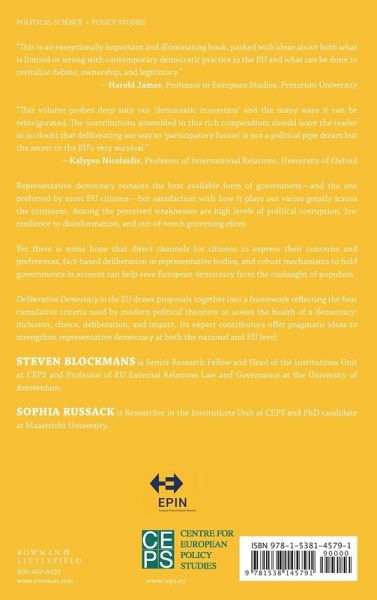
Deliberative Democracy in the EU: Promoting Participation to Impede Populism examines practices for increasing effective participation in democracy today.
Andere Kunden interessierten sich auch für
Representative Democracy in the EU144,99 €
Direct Democracy in the EU55,99 €
Representative Democracy in the EU54,99 €
Constitutional Deliberative Democracy in Europe52,99 €
Graham SmithDeliberative Democracy and the Environment233,99 €
Gabriele CiprianiFinancing the EU Budget31,99 €-
-
-
Deliberative Democracy in the EU: Promoting Participation to Impede Populism examines practices for increasing effective participation in democracy today.
Produktdetails
- Produktdetails
- Verlag: Center for European Policy Studies
- Seitenzahl: 396
- Erscheinungstermin: 30. November 2020
- Englisch
- Abmessung: 235mm x 157mm x 28mm
- Gewicht: 792g
- ISBN-13: 9781538145791
- ISBN-10: 1538145790
- Artikelnr.: 59641276
- Herstellerkennzeichnung
- Libri GmbH
- Europaallee 1
- 36244 Bad Hersfeld
- gpsr@libri.de
- Verlag: Center for European Policy Studies
- Seitenzahl: 396
- Erscheinungstermin: 30. November 2020
- Englisch
- Abmessung: 235mm x 157mm x 28mm
- Gewicht: 792g
- ISBN-13: 9781538145791
- ISBN-10: 1538145790
- Artikelnr.: 59641276
- Herstellerkennzeichnung
- Libri GmbH
- Europaallee 1
- 36244 Bad Hersfeld
- gpsr@libri.de
Senior Research Fellow at the CEPS and Professor of EU External Relations Law and Governance at the University of Amsterdam
1.Democracy as ecosystem Steven Blockmans
2. Efficiency, authority and representation Daniel Smilov
3. Democracy and its discontents: European attitudes to representative
democracy and its alternatives Jacek Kucharczyk and Filip Pazderski
4. The emotional landscape of European voters Catharina Sørensen and
William Rohde Madsen
Part I. Representative Democracy
5. Improving representativeness in Europe: A story of missed and future
opportunities Dídac Gutiérrez-Peris and Héctor Sánchez Margalef
6. Transparency in EU decision-making: Under growing pressure, more
important than ever Tuomas Iso-Markku
7. Alignment of national parties and European party federations Jan Kovár,
Zdenek Sychra and Petr Kratochvíl
8. How to Appoint a Commission President: The revised lead candidate
procedure Sophia Russack
9. How can European Affairs Committees be strengthened? Iveta Kazoka and
Sintija Tarasova
10. Revising the Early Warning System to reinforce the 'third chamber' of
EU multi-level law-making Filippa Chatzistavrou and Konstantinos
Papanikolaou
11. COSAC's (untapped) potential Paula Lamoso González
12. EU democracy in an era of a changing media environment and
disinformation Stefan Schaller, Paul Schmidt and Susan Milford-Faber
13. Democratic backsliding: The role of political corruption Aneta Világi
and Pavol Babos
14. The rule of law: Bastion of democracy, or barrier to it? Agata
Gostynska-Jakubowska and Ian Bond
Part II. Direct Democracy
15. National referendums: Between legitimate popular decision-making and
populist takeover Atanas Slavov
16. An EU-wide referendum: Potential threat or tool of empowerment?
Eleonora Poli
17. The European Citizens' Initiative and its reform: Truly unique or the
same old story? Minna Ålander and Nicolai von Ondarza
18. Modern petitions for modern European democracies Elizabete Vizgunova
19. Europe's deliberative instruments: Has the EU delivered? Wojciech
Bialozyt and Romain Le Quiniou
20. How can technology facilitate citizen participation in the EU? Mihai
Sebe, Bogdan Mure?an and Eliza Va?
Part III. Conclusions
21. Patterns and particularities in European democracy Richard Youngs
22. Participatory fusion: How to galvanise representative democracy with
deliberative tools Steven Blockmans
About the Contributors
2. Efficiency, authority and representation Daniel Smilov
3. Democracy and its discontents: European attitudes to representative
democracy and its alternatives Jacek Kucharczyk and Filip Pazderski
4. The emotional landscape of European voters Catharina Sørensen and
William Rohde Madsen
Part I. Representative Democracy
5. Improving representativeness in Europe: A story of missed and future
opportunities Dídac Gutiérrez-Peris and Héctor Sánchez Margalef
6. Transparency in EU decision-making: Under growing pressure, more
important than ever Tuomas Iso-Markku
7. Alignment of national parties and European party federations Jan Kovár,
Zdenek Sychra and Petr Kratochvíl
8. How to Appoint a Commission President: The revised lead candidate
procedure Sophia Russack
9. How can European Affairs Committees be strengthened? Iveta Kazoka and
Sintija Tarasova
10. Revising the Early Warning System to reinforce the 'third chamber' of
EU multi-level law-making Filippa Chatzistavrou and Konstantinos
Papanikolaou
11. COSAC's (untapped) potential Paula Lamoso González
12. EU democracy in an era of a changing media environment and
disinformation Stefan Schaller, Paul Schmidt and Susan Milford-Faber
13. Democratic backsliding: The role of political corruption Aneta Világi
and Pavol Babos
14. The rule of law: Bastion of democracy, or barrier to it? Agata
Gostynska-Jakubowska and Ian Bond
Part II. Direct Democracy
15. National referendums: Between legitimate popular decision-making and
populist takeover Atanas Slavov
16. An EU-wide referendum: Potential threat or tool of empowerment?
Eleonora Poli
17. The European Citizens' Initiative and its reform: Truly unique or the
same old story? Minna Ålander and Nicolai von Ondarza
18. Modern petitions for modern European democracies Elizabete Vizgunova
19. Europe's deliberative instruments: Has the EU delivered? Wojciech
Bialozyt and Romain Le Quiniou
20. How can technology facilitate citizen participation in the EU? Mihai
Sebe, Bogdan Mure?an and Eliza Va?
Part III. Conclusions
21. Patterns and particularities in European democracy Richard Youngs
22. Participatory fusion: How to galvanise representative democracy with
deliberative tools Steven Blockmans
About the Contributors
1.Democracy as ecosystem Steven Blockmans
2. Efficiency, authority and representation Daniel Smilov
3. Democracy and its discontents: European attitudes to representative
democracy and its alternatives Jacek Kucharczyk and Filip Pazderski
4. The emotional landscape of European voters Catharina Sørensen and
William Rohde Madsen
Part I. Representative Democracy
5. Improving representativeness in Europe: A story of missed and future
opportunities Dídac Gutiérrez-Peris and Héctor Sánchez Margalef
6. Transparency in EU decision-making: Under growing pressure, more
important than ever Tuomas Iso-Markku
7. Alignment of national parties and European party federations Jan Kovár,
Zdenek Sychra and Petr Kratochvíl
8. How to Appoint a Commission President: The revised lead candidate
procedure Sophia Russack
9. How can European Affairs Committees be strengthened? Iveta Kazoka and
Sintija Tarasova
10. Revising the Early Warning System to reinforce the 'third chamber' of
EU multi-level law-making Filippa Chatzistavrou and Konstantinos
Papanikolaou
11. COSAC's (untapped) potential Paula Lamoso González
12. EU democracy in an era of a changing media environment and
disinformation Stefan Schaller, Paul Schmidt and Susan Milford-Faber
13. Democratic backsliding: The role of political corruption Aneta Világi
and Pavol Babos
14. The rule of law: Bastion of democracy, or barrier to it? Agata
Gostynska-Jakubowska and Ian Bond
Part II. Direct Democracy
15. National referendums: Between legitimate popular decision-making and
populist takeover Atanas Slavov
16. An EU-wide referendum: Potential threat or tool of empowerment?
Eleonora Poli
17. The European Citizens' Initiative and its reform: Truly unique or the
same old story? Minna Ålander and Nicolai von Ondarza
18. Modern petitions for modern European democracies Elizabete Vizgunova
19. Europe's deliberative instruments: Has the EU delivered? Wojciech
Bialozyt and Romain Le Quiniou
20. How can technology facilitate citizen participation in the EU? Mihai
Sebe, Bogdan Mure?an and Eliza Va?
Part III. Conclusions
21. Patterns and particularities in European democracy Richard Youngs
22. Participatory fusion: How to galvanise representative democracy with
deliberative tools Steven Blockmans
About the Contributors
2. Efficiency, authority and representation Daniel Smilov
3. Democracy and its discontents: European attitudes to representative
democracy and its alternatives Jacek Kucharczyk and Filip Pazderski
4. The emotional landscape of European voters Catharina Sørensen and
William Rohde Madsen
Part I. Representative Democracy
5. Improving representativeness in Europe: A story of missed and future
opportunities Dídac Gutiérrez-Peris and Héctor Sánchez Margalef
6. Transparency in EU decision-making: Under growing pressure, more
important than ever Tuomas Iso-Markku
7. Alignment of national parties and European party federations Jan Kovár,
Zdenek Sychra and Petr Kratochvíl
8. How to Appoint a Commission President: The revised lead candidate
procedure Sophia Russack
9. How can European Affairs Committees be strengthened? Iveta Kazoka and
Sintija Tarasova
10. Revising the Early Warning System to reinforce the 'third chamber' of
EU multi-level law-making Filippa Chatzistavrou and Konstantinos
Papanikolaou
11. COSAC's (untapped) potential Paula Lamoso González
12. EU democracy in an era of a changing media environment and
disinformation Stefan Schaller, Paul Schmidt and Susan Milford-Faber
13. Democratic backsliding: The role of political corruption Aneta Világi
and Pavol Babos
14. The rule of law: Bastion of democracy, or barrier to it? Agata
Gostynska-Jakubowska and Ian Bond
Part II. Direct Democracy
15. National referendums: Between legitimate popular decision-making and
populist takeover Atanas Slavov
16. An EU-wide referendum: Potential threat or tool of empowerment?
Eleonora Poli
17. The European Citizens' Initiative and its reform: Truly unique or the
same old story? Minna Ålander and Nicolai von Ondarza
18. Modern petitions for modern European democracies Elizabete Vizgunova
19. Europe's deliberative instruments: Has the EU delivered? Wojciech
Bialozyt and Romain Le Quiniou
20. How can technology facilitate citizen participation in the EU? Mihai
Sebe, Bogdan Mure?an and Eliza Va?
Part III. Conclusions
21. Patterns and particularities in European democracy Richard Youngs
22. Participatory fusion: How to galvanise representative democracy with
deliberative tools Steven Blockmans
About the Contributors