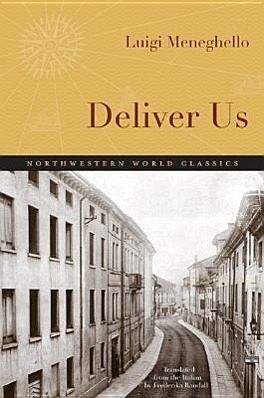
Originally published in 1963, and today considered a landmark in twentieth century Italian literature, Luigi Meneghello’s Deliver Us is the memoir, not of an extraordinary childhood, but of the very ordinary one the author shared with most of his generation, when Italy was a rural country under the twin authorities of Church and Fascism. His boyhood begins in 1922, the year of Mussolini’s March on Rome, and ends when Meneghello, 21, goes up into the hills to join the partisans. Called a romanzo—a story, although not a novel, as that term usually suggests—the book is a genre all of its own that…mehr
Originally published in 1963, and today considered a landmark in twentieth century Italian literature, Luigi Meneghello’s Deliver Us is the memoir, not of an extraordinary childhood, but of the very ordinary one the author shared with most of his generation, when Italy was a rural country under the twin authorities of Church and Fascism. His boyhood begins in 1922, the year of Mussolini’s March on Rome, and ends when Meneghello, 21, goes up into the hills to join the partisans. Called a romanzo—a story, although not a novel, as that term usually suggests—the book is a genre all of its own that mixes personal and collective memory, amateur ethnography, and reflections on language. Meneghello’s sharp insights and narrative skill come together in an original meditation on how words, people, places, and things shape thought itself. Only loosely chronological, Deliver Us proceeds by themes—childhood games, Fascist symbols, religious precepts, and the rites of poverty, of death, of eros, and of love. Meneghello’s ironic musings and profoundly honest recollections make an utterly unsentimental human comedy of that was the whole world to his dawning consciousness.
Luigi Meneghello (1922–2007) was among Italy’s most acclaimed twentieth century writers. After taking part in the resistance during the war, he accepted a one-year scholarship to the University of Reading in 1947. This led to a teaching appointment in the English department, and in 1961 Meneghello founded a highly influential Italian Studies department, which he led until his retirement from teaching in 1980. Deliver Us (Libera nos a malo 1963) was his first book. Among his other significant books are I piccoli maestri (1964), about the Italian resistance; Pomo pero (1974), Fiori italiani (1976) and Jura (1987), on the nature of speech, writing, and literary form. Frederika Randall’s translations include Padre Pio: Miracles and Politics in a Secular Age (2010) and The Body of Il Duce (Metropolitan Books, 2005) by Sergio Luzzatto; and Sicilian Tragedee by Ottavio Cappellani (2008). A journalist in Rome, she has written for The New York Times, The Nation, and many other publications.
Es gelten unsere Allgemeinen Geschäftsbedingungen: www.buecher.de/agb
Impressum
www.buecher.de ist ein Internetauftritt der buecher.de internetstores GmbH
Geschäftsführung: Monica Sawhney | Roland Kölbl | Günter Hilger
Sitz der Gesellschaft: Batheyer Straße 115 - 117, 58099 Hagen
Postanschrift: Bürgermeister-Wegele-Str. 12, 86167 Augsburg
Amtsgericht Hagen HRB 13257
Steuernummer: 321/5800/1497
USt-IdNr: DE450055826