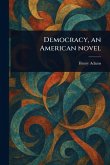
Democracy: An American Novel by Henry Adams is a thought-provoking exploration of politics, power, and morality in late 19th-century America. Set against the backdrop of Gilded Age Washington D.C., the novel follows the ambitious and idealistic Madeleine Lee as she navigates the complexities of the nation's capital. Through Madeleine's eyes, readers are introduced to a cast of characters representing various political factions, social classes, and ethical dilemmas. As Madeleine becomes embroiled in the intrigues of Washington society, she grapples with questions of integrity, compromise, and…mehr
Democracy: An American Novel by Henry Adams is a thought-provoking exploration of politics, power, and morality in late 19th-century America. Set against the backdrop of Gilded Age Washington D.C., the novel follows the ambitious and idealistic Madeleine Lee as she navigates the complexities of the nation's capital. Through Madeleine's eyes, readers are introduced to a cast of characters representing various political factions, social classes, and ethical dilemmas. As Madeleine becomes embroiled in the intrigues of Washington society, she grapples with questions of integrity, compromise, and the true nature of democracy in a rapidly changing and often corrupt political landscape. With its incisive commentary and complex characters, "Democracy" remains a timeless and relevant exploration of American politics and society.
Henry Adams (February 16, 1838 - March 27, 1918) was an American historian, member of the Adams political family, being descended from two U.S. Presidents. His sophisticated writing emerged from a confluence of personal reflection and historical insight. As a historian, Adams is celebrated for his 'History of the United States During the Administrations of Thomas Jefferson and James Madison.' Adams reveled in complexity, interweaving social, political, and psychological themes. One of his best-known works, 'Democracy, an American Novel' (1880), reflects his deep engagement with the political climate of his time under the veil of fiction, told with an astute and critical eye. The novel was published anonymously, and it offered a scathing critique of the venality and dysfunction he perceived in Washington politics. Adams's literary legacy is also etched by his later autobiographical book 'The Education of Henry Adams' (1918), which he originally printed privately. 'The Education' is acclaimed not merely for its introspection but as a model of early modernist prose, where Adams positions himself as a keen observer of a rapidly transforming world. His works frequently addressed themes of political corruption, historical progression, and the conflict between traditions and modernity, often forecasting the societal transitions of the 20th century.
Es gelten unsere Allgemeinen Geschäftsbedingungen: www.buecher.de/agb
Impressum
www.buecher.de ist ein Internetauftritt der buecher.de internetstores GmbH
Geschäftsführung: Monica Sawhney | Roland Kölbl | Günter Hilger
Sitz der Gesellschaft: Batheyer Straße 115 - 117, 58099 Hagen
Postanschrift: Bürgermeister-Wegele-Str. 12, 86167 Augsburg
Amtsgericht Hagen HRB 13257
Steuernummer: 321/5800/1497
USt-IdNr: DE450055826